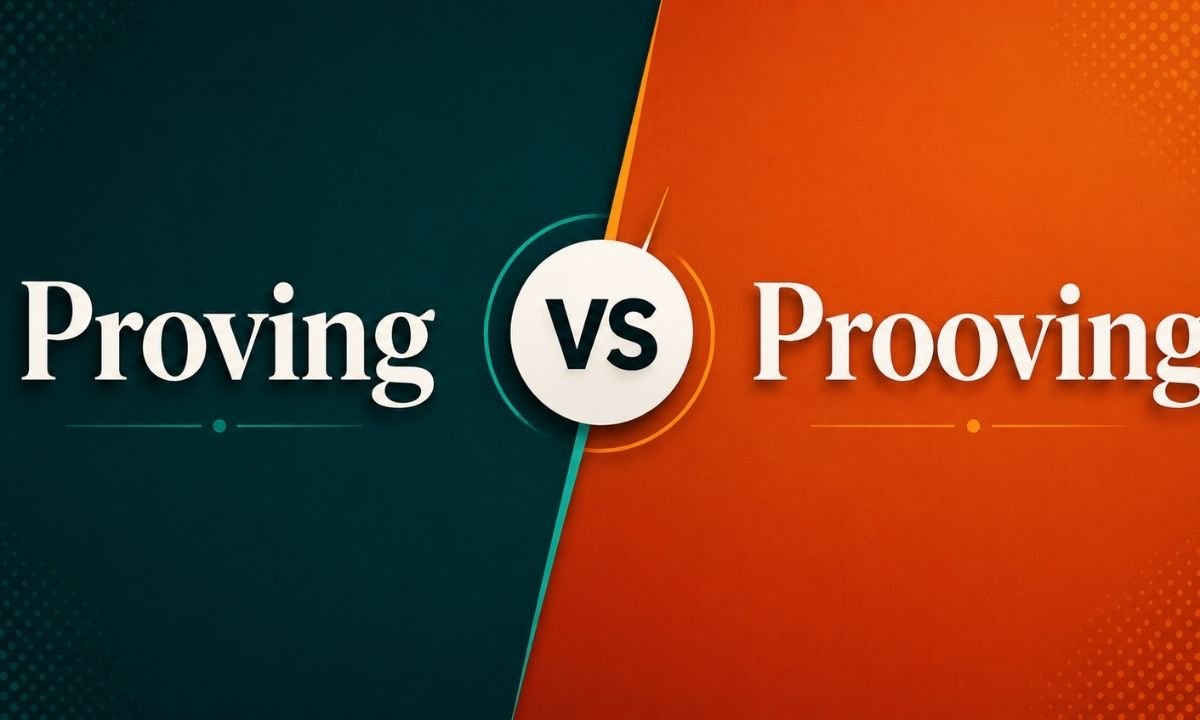
You are typing a sentence, you pause at the word, and suddenly it looks wrong. Is it “proving” or “prooving”? This mix up happens because the base word “prove” seems to invite an extra “o” when the “-ing” ending gets added. It does not.
The correct spelling is “proving,” never “prooving.” Here is exactly why, and how to use it correctly every time.
The Quick Answer (Proving vs Prooving)
“Proving” is the only correct spelling. It is the present participle and gerund form of the verb “prove,” meaning to show that something is true through evidence, argument, or demonstration. “Prooving” is not a word in any dictionary, in American English or British English. It is simply a common misspelling caused by the way English speakers instinctively (but incorrectly) apply spelling patterns from other “-oo” words.
If you remember one rule, remember this: drop the silent “e” from “prove” and add “ing.” That gives you “proving,” with a single “o.”
What Does “Proving” Mean?
“Proving” describes the act of demonstrating that something is true, real, or valid. It can refer to:
- Presenting facts or evidence that confirm a claim
- Testing something to show it works
- Establishing a mathematical or logical conclusion
- Showing your ability or worth through action
For example, a lawyer spends a trial proving a client’s innocence. A scientist runs experiments aimed at proving a hypothesis. In everyday speech, someone might talk about proving themselves at a new job.
Learn more about the correct usage of “Proving vs. Prooving” and avoid this common spelling mistake.
Why Do People Write “Prooving” by Mistake?
The confusion is understandable. English has plenty of words where doubling the “o” is correct, like “shooting,” “booking,” or “rooting.” Because “prove” contains an “o” sound that stretches out when spoken, some writers assume the spelling should stretch too, producing “prooving.”
Another factor is autocorrect and casual texting habits, where extra letters slip through unnoticed. Once a misspelling gets typed often enough, it can start to feel familiar, even though it never becomes correct.
The truth is simpler than the confusion suggests: “prove” only ever has one “o,” in every form, including “proving,” “proved,” and “proves.”
Proving vs Prooving at a Glance
| Term | Correct? | Meaning | Use |
| Proving | Yes | Demonstrating that something is true or valid | Standard spelling in all contexts, formal and informal |
| Prooving | No | Not a recognized English word | Never correct; treat as a spelling error |
Grammar Breakdown: Part of Speech and Verb Forms
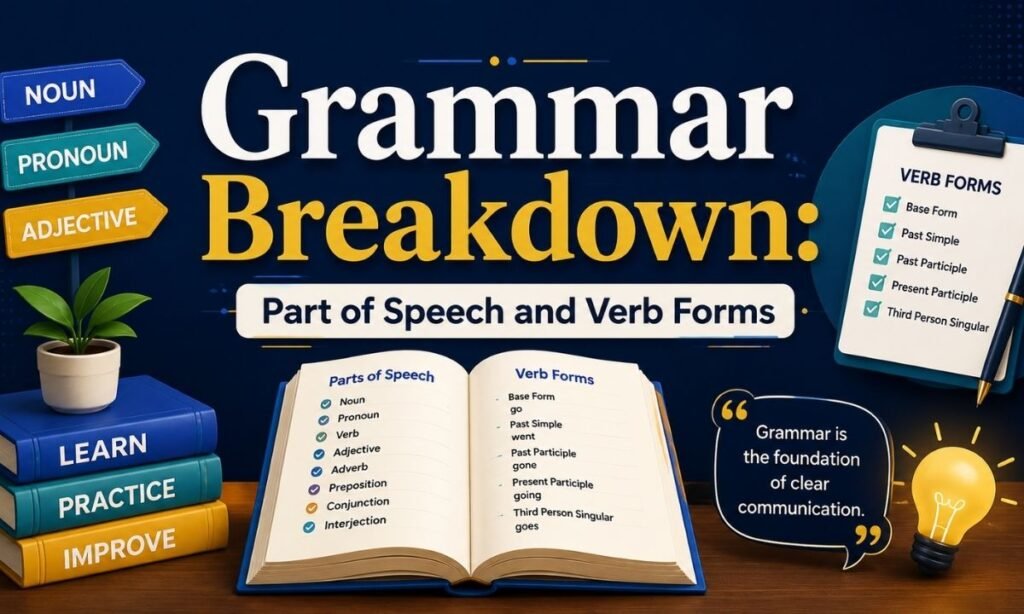
“Proving” is a verb form, specifically the present participle of “prove.” Depending on the sentence, it can function two ways:
- As part of a verb phrase: “She is proving her point.” Here it pairs with a form of “to be” to show ongoing action.
- As a gerund (acting like a noun): “Proving your theory will take time.” Here “proving” is the subject of the sentence.
The full verb pattern looks like this:
- Base form: prove
- Present participle / gerund: proving
- Past tense: proved
- Past participle: proved or proven
American English commonly accepts both “proved” and “proven” as past participles, as in “The results have proved consistent” or “The results have proven consistent.” British English also uses both, though “proven” appears slightly more often as an adjective, such as in “a proven method.”
Where Does “Proving” Come From?
The word “prove” traces back to the Latin verb probare, meaning to test, examine, or approve. This root traveled through Old French as prover before entering Middle English. The “-ing” suffix is a native English addition, used across the language to form present participles and gerunds from verbs.
There is no separate history behind “prooving.” It never developed as an alternate spelling in any documented stage of the English language. It is a modern spelling slip, not an older or regional variant.
How to Pronounce “Proving”
“Proving” is pronounced PROO-ving, with two syllables. The stress falls on the first syllable, and the “o” makes a long “oo” sound, similar to the vowel sound in “move” or “groove.” Even though the spoken word has that long “oo” sound, the written word still uses only a single letter “o.” Pronunciation and spelling do not always match in English, and this is a clear example.
How to Use “Proving” in a Sentence
Here are natural examples across different contexts:
Everyday conversation: “I keep proving to myself that I can wake up early if I actually try.”
Workplace communication: “Our team is proving the new process saves time, based on last month’s numbers.”
Academic writing: “The researcher spent three chapters proving her central hypothesis before addressing its implications.”
Email: “Attached is the data proving the system meets the required safety standards.”
Business writing: “The pilot program is proving successful across all three regional offices.”
Casual writing: “He’s always proving people wrong, and honestly, it’s kind of impressive.”
Each of these sentences uses “proving” as either an ongoing action or a gerund acting as a subject or object, and in every case, the spelling stays the same.
Common Mistakes to Avoid
Incorrect: She is prooving her theory with new evidence. Correct: She is proving her theory with new evidence. The extra “o” is never added, regardless of how the word sounds when spoken.
Incorrect: This report is prooving our point. Correct: This report is proving our point. Even in fast, informal typing, only one “o” belongs in this word.
Incorrect: I’ve been prooving myself at work all year. Correct: I’ve been proving myself at work all year. This mistake is common in casual messages, but it is still a spelling error worth catching before hitting send.
If you ever hesitate, remember that “prove” itself only has one “o,” and adding “-ing” never changes that.
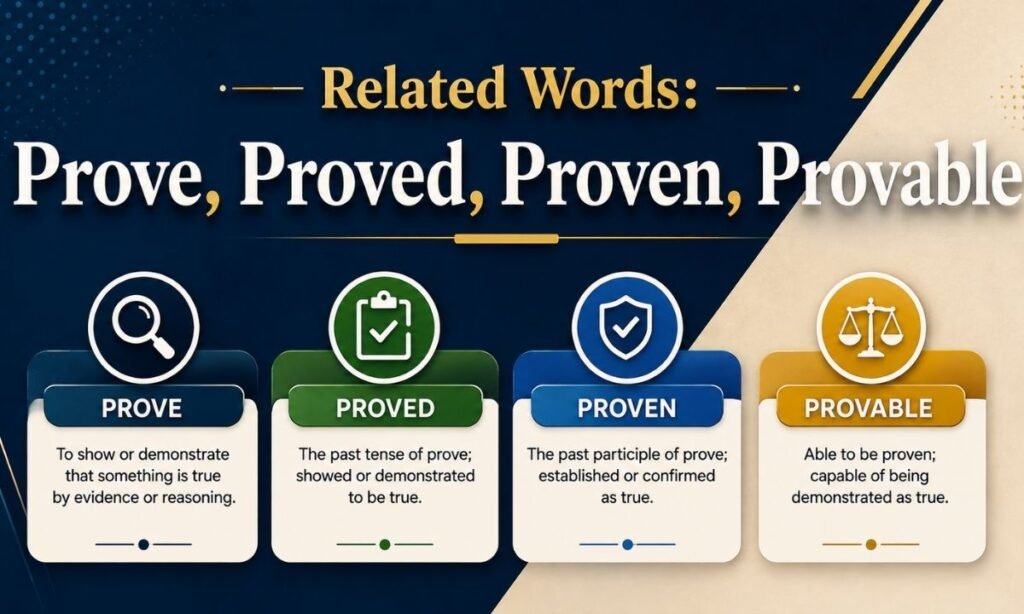
Related Words: Prove, Proved, Proven, Provable
Understanding “proving” gets easier when you see it alongside its word family:
- Prove (base verb): “I will prove my point.”
- Proved (past tense or past participle): “I proved my point yesterday.”
- Proven (past participle or adjective): “This is a proven method.”
- Provable (adjective): “The claim is provable with the right data.”
- Unproven (adjective): “The theory remains unproven.”
None of these related forms ever double the “o” either. The single “o” pattern stays consistent throughout the entire family of words.
Quick Tips to Remember the Correct Spelling
- Think of the base word “prove.” It has one “o,” and every form built from it keeps that same single “o.”
- Compare it to similar verbs like “move” to “moving” or “improve” to “improving.” None of these double the vowel.
- If autocorrect or muscle memory keeps producing “prooving,” slow down and check the base word first.
- When writing quickly, it can help to mentally spell out p-r-o-v-i-n-g before typing it in full.
Frequently Asked Questions
Is “prooving” ever correct?
No. “Prooving” is not a recognized word in any standard or academic English dictionary. It should always be corrected to “proving.”
What does “proving” mean?
“Proving” means demonstrating or establishing that something is true, accurate, or valid, usually through evidence, testing, or argument.
How do I use “proving” in a sentence?
Use it after a form of “to be” for ongoing action, such as “They are proving their case,” or as a gerund subject, such as “Proving this will take effort.”
Is it “proved” or “proven” after “have”?
Both are accepted in American and British English. “I have proved my point” and “I have proven my point” are equally correct, though “proven” is more common as a standalone adjective, as in “a proven fact.”
Why do people misspell “proving” as “prooving”?
The long “oo” sound when the word is spoken leads some writers to assume the spelling doubles the “o,” but the written form always keeps a single “o,” matching the base word “prove.”
The Bottom Line on Proving or Prooving
“Proving” is the correct spelling, in every context, tense, and register of English. “Prooving” is a spelling mistake with no dictionary backing and no historical basis.
The next time you are typing this word and pause to second guess it, remember the simple anchor: prove has one “o,” and so does proving.

Smith Jason is an SEO expert with 2–3 years of experience, sharing grammar tips, confusing words, vocabulary and writing advice.