You typed “vinal record” or “vinal flooring” into a search bar, and now you’re second-guessing yourself. Is it vinal or vinyl? The confusion happens because the two words sound almost identical when spoken aloud.
Here’s the short answer: vinyl is the word you want in nearly every situation. Vinal is a real but rare technical term, and it almost never means what you think it means.
What Is the Correct Spelling: Vinal or Vinyl?
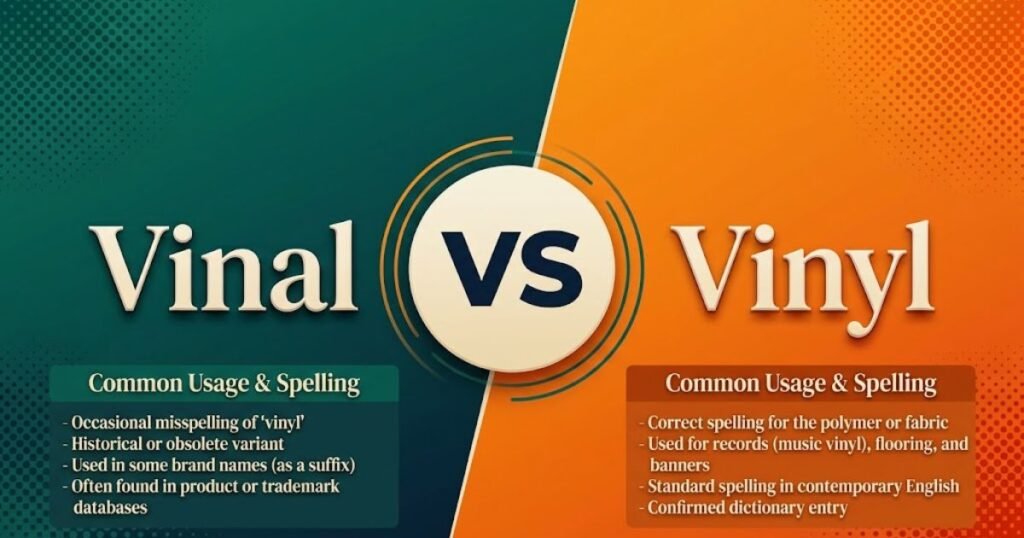
Vinyl is correct for records, flooring, siding, stickers, car wraps, and clothing. If you’re describing a plastic material, a phonograph record, or anything made from PVC (polyvinyl chloride), the word is always vinyl, spelled with a y.
Vinal is a separate, legitimate English word, but it refers to something completely different: a type of synthetic fiber made from polyvinyl alcohol, used mostly in industrial rope and specialty fabric. It has nothing to do with records, flooring, or decals. So while vinal isn’t technically a misspelling, it’s almost certainly not the word you meant to use.
What Does Vinyl Mean?
Vinyl is a noun and an adjective that refers to a group of tough, flexible plastic materials made from polyvinyl chloride. Chemically, the term comes from the vinyl group, a chemical structure built around a carbon-carbon double bond.
In everyday English, vinyl shows up in a few common contexts:
- Records: Phonograph records pressed from PVC, often just called “vinyl” as a collective noun (as in, “I bought some vinyl this weekend”).
- Flooring: Vinyl tiles and vinyl sheet flooring, prized for being water resistant and easy to clean.
- Signage and decals: Adhesive vinyl used for stickers, banners, and car wraps.
- Clothing and upholstery: Vinyl fabric that mimics the look of leather.
- Siding: Vinyl siding used on the exterior of homes.
Because vinyl covers so many products, it’s one of those words people use constantly without thinking twice, until autocorrect or a fast typing session turns it into “vinal.”
What Does Vinal Actually Mean?
Vinal is a genuine dictionary word, but it lives in a narrow, technical lane. It describes a synthetic fiber made by treating polyvinyl alcohol so it becomes insoluble in water. Manufacturers use vinal fibers in some ropes, fishing nets, and industrial textiles because the material holds up well under stress and moisture.
You won’t see vinal used to describe a record collection, a kitchen floor, or a bumper sticker. If someone uses “vinal” in that context, they almost certainly meant “vinyl.” Vinal also occasionally shows up as a surname, which adds to the confusion when people search the word online.
Vinal vs Vinyl: Quick Comparison Table
| Term | Correct For | Meaning | Common Use |
| Vinyl | Records, flooring, signage, siding, clothing | PVC based plastic material | Everyday English, product names, casual speech |
| Vinal | Industrial rope and specialty fabric | Synthetic fiber from polyvinyl alcohol | Rare, technical or scientific writing only |
Why Do People Confuse Vinal and Vinyl?
The mix-up isn’t really a grammar problem. It’s a listening and typing problem. Both words are pronounced almost the same way, and the unstressed second syllable makes the “y” and “a” sound nearly indistinguishable in casual speech.
Add in autocorrect, fast typing, and the brain’s habit of simplifying spelling patterns, and “vinyl” quietly turns into “vinal” without anyone noticing. Since vinal happens to be a real word, most spell checkers won’t flag it, which lets the error slip through.
Pronunciation Guide
Vinyl is pronounced VYE-nul (/ˈvaɪnəl/), with the stress on the first syllable. Vinal is pronounced the same way in casual speech, which is exactly why so many people write one when they mean the other. The spelling is really the only reliable way to tell them apart on the page.
Read Related Post: Proving or Prooving: Which Spelling Is Correct?
Grammar Breakdown: Part of Speech and Usage
Vinyl functions as both a noun and an adjective.
- As a noun: “She collects vinyl from the 1970s.”
- As an adjective: “They installed vinyl flooring in the kitchen.”
Vinyl is typically treated as an uncountable noun when referring to the material or to records as a format (“I prefer vinyl to streaming”). It can be countable when referring to individual sheets or rolls of the material in a manufacturing context.
Vinal follows the same basic pattern as a countable or uncountable noun depending on context, but you’ll rarely need to use it in everyday writing.
There’s no meaningful difference between American and British English here. Both dialects use vinyl the same way for records, flooring, and plastic products.
Where Does the Word Vinyl Come From?
Vinyl traces back to the chemical term for the vinyl group, a structure derived from ethylene. Chemists began using the term in the 19th century to describe compounds built around this carbon structure. Polyvinyl chloride, developed and commercialized in the 20th century, borrowed the name, and the shortened form “vinyl” eventually became the everyday word for records and plastic products once PVC records became popular in the mid-1900s.
Real Life Examples
Everyday conversation: “My dad still has boxes of vinyl in the garage.”
Workplace communication: “Can you confirm whether the flooring samples are vinyl or laminate before we finalize the order?”
Academic writing: “Polyvinyl chloride, commonly shortened to vinyl, remains one of the most widely produced plastics in the world.”
Email: “Attached is the quote for vinyl banners for the trade show booth.”
Business writing: “Our vinyl siding line comes with a 25 year warranty against fading and cracking.”
Casual writing: “I finally found that album on vinyl at the record shop downtown.”
Each example uses vinyl because each one describes a plastic material or record format, not the industrial fiber that vinal refers to.
Common Mistakes with Vinal and Vinyl
Incorrect: The vinal record had a scratch that skipped every time I played it. Correct: The vinyl record had a scratch that skipped every time I played it. The word describes the plastic disc, so vinyl is the right spelling.
Incorrect: We ordered vinal stickers for the storefront window. Correct: We ordered vinyl stickers for the storefront window. Adhesive decals and signage always use vinyl, never vinal.
Incorrect: The contractor recommended vinal siding for better insulation. Correct: The contractor recommended vinyl siding for better insulation. Siding is a PVC based product, so vinyl applies here.
A simple way to avoid the mistake: if you’re not writing about industrial rope or specialty synthetic fiber, you almost certainly want vinyl.
Related Terms Worth Knowing
- PVC: Short for polyvinyl chloride, the plastic that vinyl products are made from.
- Polyvinyl alcohol: The chemical base for vinal fiber.
- Acetate: A different synthetic material sometimes confused with vinyl in flooring and fabric contexts.
- Analog: Often paired with vinyl records when discussing sound quality compared to digital formats.
How to Remember the Correct Spelling
A quick trick: think of the “y” in vinyl as standing for “yes, this is the plastic one.” If you’re talking about records, flooring, decals, or siding, the “y” belongs in the word. Save “vinal” for the rare occasions you’re actually discussing synthetic rope fiber, which for most people is never.
Frequently Asked Questions
Is vinal a real word?
Yes, but it’s rare. Vinal refers to a synthetic fiber made from polyvinyl alcohol, used mainly in industrial rope and specialty fabric. It’s not interchangeable with vinyl in everyday use.
Is vinal just a misspelling of vinyl?
In most everyday contexts, yes. When people write “vinal record” or “vinal flooring,” they mean vinyl. True vinal, the fiber, has nothing to do with those products.
What does vinyl mean?
Vinyl is a plastic material made from polyvinyl chloride (PVC). It’s used for records, flooring, siding, signage, and various other products valued for durability and flexibility.
How do I use vinyl in a sentence?
Example: “I bought a vinyl copy of my favorite album last weekend.” Use vinyl any time you’re referring to records, plastic flooring, siding, or similar PVC based materials.
Why do vinal and vinyl sound the same?
Both words share a similar pronunciation pattern, with the stress on the first syllable and a soft, quick second syllable. That similarity, combined with fast typing and autocorrect, is the main reason people swap the spelling.
The Bottom Line
Vinyl is the word for records, flooring, siding, and plastic products, while vinal is a rare technical term for a type of synthetic fiber.
Unless you’re specifically discussing industrial rope material, vinyl is almost always the spelling you need. Keep that one distinction in mind, and you’ll never second guess yourself again.

Smith Jason is an SEO expert with 2–3 years of experience, sharing grammar tips, confusing words, vocabulary and writing advice.