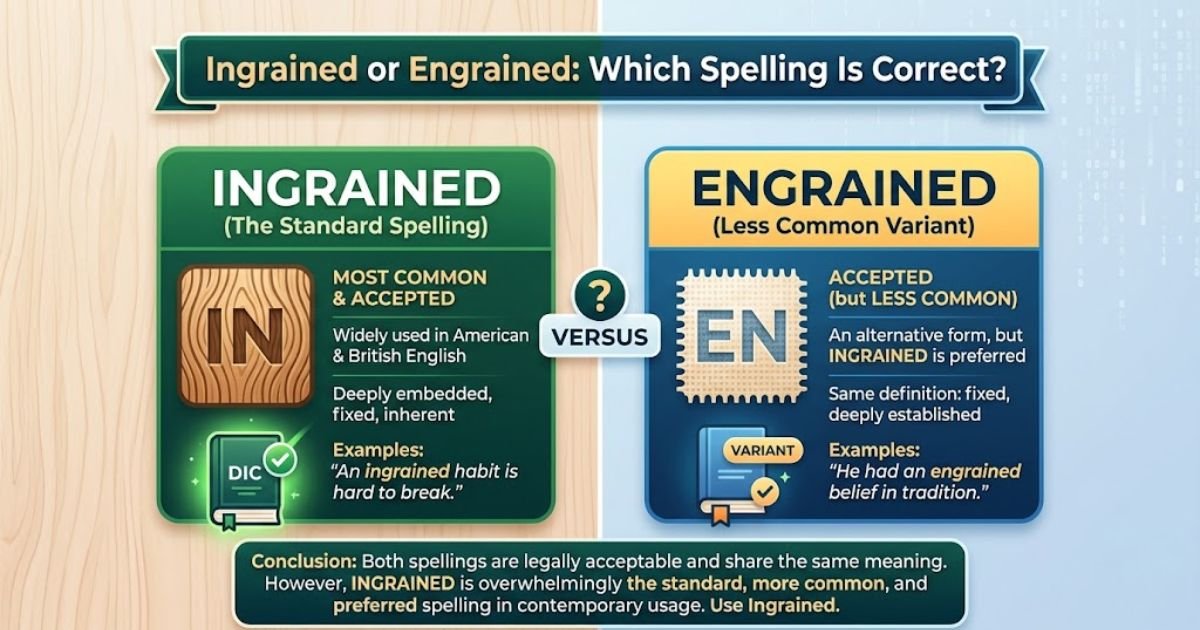
You’re writing about a habit that runs deep, and suddenly you’re not sure how to spell it. Ingrained or engrained? Both look plausible, since English has plenty of words that start with in- and en-. The answer is simple: ingrained is the standard spelling. Engrained is a rare variant that most editors will change. Here’s what each form means and how to use it.
Which Spelling Is Correct: Ingrained or Engrained?
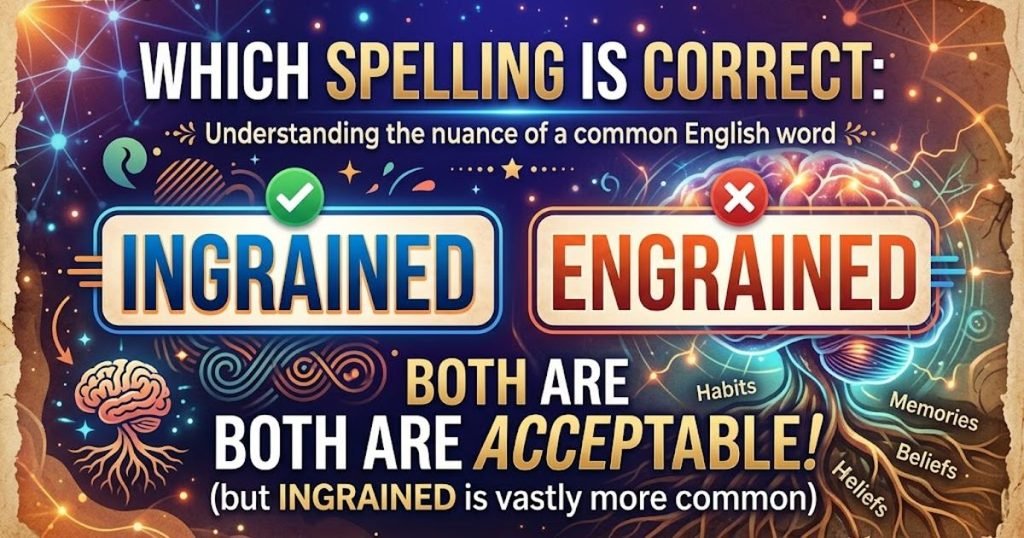
Ingrained is the correct and preferred spelling in American English. Major dictionaries list ingrain as the main entry and treat engrain as a secondary variant.
If you want one rule for school papers, work emails, and published writing, use ingrained. You will never be marked wrong for it.
What Does Ingrained Mean?
Ingrained means deeply fixed, firmly established, or built into something so thoroughly that it is hard to remove or change.
It has two main uses:
- Figurative: describing habits, beliefs, attitudes, or behaviors that have become part of a person or group.
- Literal: describing dirt, stains, or marks that have worked deep into a surface.
The idea in both cases is depth. Something ingrained is not sitting on the surface.
Is Engrained Ever Correct?
Engrained is not a different word, and it is not a new meaning. It is an older variant spelling of the same word, and it means exactly what ingrained means.
That puts it in a gray area. It is not a made-up word, but it is uncommon, and many readers will assume it is a typo. Some style-conscious editors will change it on sight.
The same pattern holds in British English. Ingrained is the standard spelling on both sides of the Atlantic, so there is no regional exception where engrained becomes the better choice.
The practical advice: write ingrained unless you are quoting a source that uses the other spelling.
Ingrained vs. Engrained at a Glance
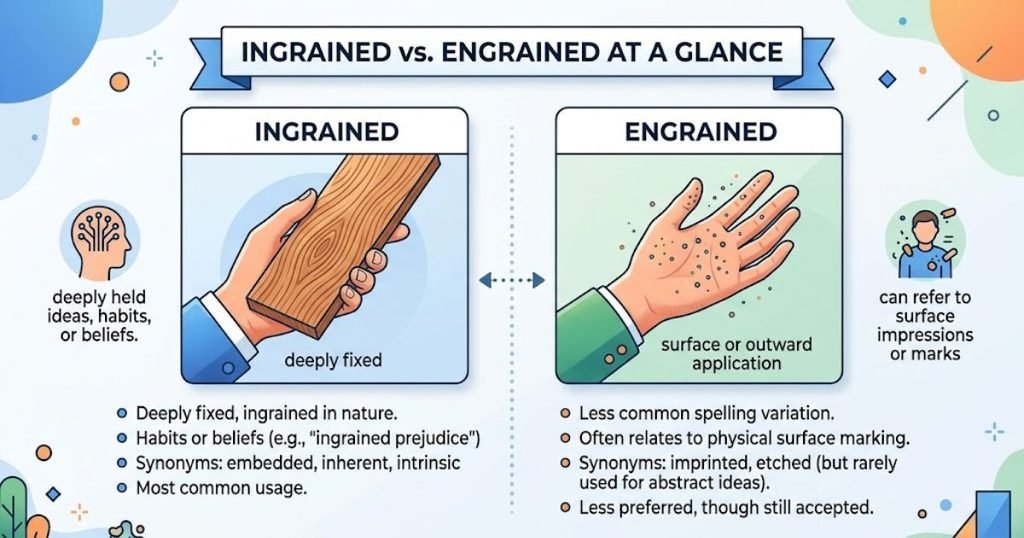
| Term | Standard? | Meaning | When to use it |
| Ingrained | Yes | Deeply fixed or firmly established | All writing, formal and casual |
| Engrained | Rare variant | Same meaning as ingrained | Avoid, except when quoting |
Note that the second row is not a different definition. The two spellings never split into separate meanings.
Read Related Post: Gluing or Glueing: Which One Is Actually Right?
What Part of Speech Is Ingrained?
Ingrained works as two parts of speech, depending on the sentence.
As an adjective, it describes a noun:
- an ingrained habit
- ingrained prejudice
- ingrained dirt
As a past participle, it is a verb form of ingrain, meaning to fix something deeply. You can spot the verb use when someone or something is doing the fixing:
- Years of practice ingrained the routine in her.
- The routine was ingrained in her by years of practice.
Here is the full verb pattern:
| Form | Word |
| Base form | ingrain |
| Third person singular | ingrains |
| Present participle | ingraining |
| Past tense and past participle | ingrained |
The adjective usually comes with the preposition in: ingrained in the culture, ingrained in his thinking. You may also see ingrained into, though in is more common.
Where Does the Word Ingrained Come From?
The word comes from the world of cloth dyeing, which explains why it means what it does.
Ingrain traces back to Middle English engreynen, from Old French engrainer, which combines a prefix meaning “in” with grain. In the dye trade, “grain” referred to a costly dye made from tiny insects called kermes. Their dried bodies looked like seeds, so the dye took the name “grain.”
Cloth dyed “in grain” kept its color deeply and would not wash out. Over time, English speakers stretched the idea from fabric to people: a habit fixed as firmly as a fast dye became an ingrained habit.
That old spelling with en- is the source of engrained. As the word developed, in- won out as the standard form, and en- survived only as a minor variant.
How Do You Pronounce Ingrained?
Ingrained is pronounced in-GRAYND, with the stress on the second syllable. The gra rhymes with “day.”
Engrained is pronounced en-GRAYND. In fast, casual speech, the unstressed first syllable of both words blurs into almost the same sound. That is one reason people struggle with the spelling: you cannot reliably tell them apart by ear.
Do not confuse either word with engrave (to carve into a surface). The sound is similar, but the meaning is not.
How Do You Use Ingrained in a Sentence?
Here are natural examples across different settings.
Everyday conversation
- “Saying thank you is so ingrained in me that I do it to the self-checkout machine.”
- “I’ve been up at 5 a.m. for years, so it’s pretty ingrained now.”
Workplace communication
- “Safety checks need to become ingrained in our daily process, not an afterthought.”
- “The old approval workflow is deeply ingrained, so expect some resistance to the change.”
Academic writing
- “The study found that ingrained stereotypes shaped how participants evaluated the candidates.”
- “Ingrained cultural norms often outlast the conditions that created them.”
- “Once the new template becomes ingrained, we should see fewer formatting errors.”
Literal use
- “The grease was so ingrained in the fabric that washing barely helped.”
Look at the workplace example about the approval workflow. It works because ingrained describes something that has been in place long enough to resist change. The word carries both depth and stubbornness, so it fits best when something is hard to dislodge.
What Are the Most Common Mistakes With Ingrained and Engrained?
These mistakes are normal, and most come from the sound-alike spelling.
Mistake 1: Using the rare spelling
Incorrect: These beliefs are deeply engrained in our culture.
Correct: These beliefs are deeply ingrained in our culture.
Engrained is not a serious error, but ingrained is the form readers expect.
Mistake 2: Confusing it with “engraved”
Incorrect: Good manners were engraved in him from childhood.
Correct: Good manners were ingrained in him from childhood.
Engraved means physically carved or cut into a surface. Use it for names on a trophy or a ring. For habits and beliefs, choose ingrained.
Mistake 3: Writing it as two words or with a hyphen
Incorrect: The habit is in grained in his routine.
Correct: The habit is ingrained in his routine.
It is always one word.
Mistake 4: Using ingrained for a new habit
Incorrect: I started running yesterday, and it’s already ingrained.
Correct: I started running yesterday, and I hope it becomes ingrained.
Ingrained implies something built up over time. A brand-new habit is not ingrained yet.
How Does Ingrained Compare With Instilled, Innate, and Similar Words?
Several words sit close to ingrained. They are not interchangeable.
- Instilled: put into someone gradually. Her parents instilled a strong work ethic. Instilled describes the process, while ingrained describes the result.
- Innate: present from birth. An innate sense of rhythm. Ingrained things are acquired over time, while innate things are natural.
- Deep-seated: very similar in meaning, and a good synonym. A deep-seated fear of failure.
- Entrenched: firmly established and difficult to change, often used for systems and attitudes. Entrenched bureaucracy.
- Deeply rooted: another close alternative, especially for traditions and beliefs.
- Inbred: passed down through breeding or family, often used more literally.
Words that mean the opposite include superficial, shallow, fleeting, and temporary.
One more lookalike: ingrown, as in ingrown toenail. That one has a separate meaning and is not a spelling variant.
How Can You Remember the Right Spelling?
Try one of these quick memory tricks.
Use the “in” connection. Ingrained means fixed in deeply. The in- at the start matches the idea of something going inside.
Remember the grain. The word contains grain, like the grain in wood. A pattern that runs through the grain is built into the material, which is the same idea as a habit built into a person.
Default to the standard. When in doubt, pick ingrained. It is correct in every situation where the other spelling would be acceptable.
FAQ’s
Is engrained a real word?
Yes, but it is an uncommon variant spelling of ingrained. It has the same meaning, though most writers and editors prefer ingrained.
What does ingrained mean?
It means deeply fixed or firmly established. It applies to habits, beliefs, and attitudes, and also to dirt or stains that have soaked into a material.
How do I use ingrained in a sentence?
Place it before a noun or after a linking verb, usually with in. Example: “Recycling is ingrained in our household routine.”
Is ingrained spelled differently in British English?
No. Ingrained is the standard spelling in both American and British English.
Is ingrained a positive or negative word?
It is neutral. An ingrained sense of fairness sounds positive, while ingrained prejudice sounds negative. The surrounding words set the tone.
Conclusion
Use ingrained. It is the standard spelling, it carries the meaning of something fixed deeply, and it is the form readers and editors expect. Engrained is only a rare variant of the same word.
Something ingrained is built into a person, a group, or a surface, and if you can spell it with confidence, you’ll be able to describe it with confidence too.

Smith Jason is an SEO expert with 2–3 years of experience, sharing grammar tips, confusing words, vocabulary and writing advice.