
Many writers type “puting” because the base word is short and the ending looks simple. Then autocorrect underlines it in red and doubt sets in. The confusion is understandable, since English spelling rules are not always obvious. The answer is quick: “putting” is the correct spelling, and “puting” is a misspelling. This guide explains why, so you can spell it correctly every time.
Is It Puting or Putting? The Short Answer
“Putting” is the only correct spelling. “Puting” is not a standard English word. It is the present participle and gerund of the verb “put,” and it always has two t’s.
Here is the difference in one glance:
- Correct: She is putting the books on the shelf.
- Incorrect: She is puting the books on the shelf.
If you are ever unsure, spell the base word “put” and double the final t before adding “-ing.”
What Does Putting Mean?
“Putting” means placing something somewhere, or bringing something into a certain state or condition. It is a form of the verb “put,” which is one of the most flexible verbs in English.
Common meanings include:
- Placing: “I’m putting my keys in the bowl.”
- Causing a condition: “The news is putting everyone in a good mood.”
- Expressing something: “I’m putting my thoughts into words.”
- Assigning or adding: “They are putting a tax on imported goods.”
There is also a second, unrelated use in golf. “Putting” can describe the act of tapping the ball toward the hole on the green, as in “putting practice” or “a putting contest.” That word comes from the golf verb “putt,” not the general verb “put.”
Puting vs Putting: Quick Comparison Table
| Term | Correct? | Meaning | Use |
| Putting | Yes | Placing, setting, or expressing something; also hitting a golf ball on the green | Use in all writing, formal and casual |
| Puting | No | No standard meaning | Avoid; fix it to “putting” |
The incorrect form has no legitimate use in standard English. You might occasionally see “Puting” as part of a name or a transliteration from another language, but it is never an English verb form.
Why Does Putting Have Two T’s?
“Putting” doubles the final t because of a common spelling pattern for short verbs. When a one-syllable verb ends in a single vowel followed by a single consonant, you double that consonant before adding a suffix that starts with a vowel, such as “-ing” or “-ed.”
Look at “put” step by step:
- It has one syllable.
- It ends with a single vowel (u) followed by a single consonant (t).
- The suffix “-ing” begins with a vowel.
So the t doubles, and “put” becomes “putting.”
The doubling protects the short vowel sound. Without it, the u could be read as a long vowel, like the “u” in “cute.” Compare “cuter” and “cutter.” The double consonant tells you the vowel stays short. That is why “puting” looks like it should rhyme with “cuting,” which is not how anyone says the word.
What Part of Speech Is Putting?
“Putting” can play several grammatical roles, depending on how it appears in a sentence.
Present participle (verb form). It works with a helping verb to show ongoing action: “We are putting the finishing touches on the presentation.”
Gerund (noun form). It acts as a noun: “Putting off the decision only made things worse.”
Participle used as a modifier. It can describe another noun: “The person putting the sign up is my brother.”
The verb “put” is irregular in a helpful way. Its past tense and past participle are both “put,” with no “-ed” ending. Here are all the forms together:
| Form | Example |
| Base form | put |
| Third person singular | puts |
| Past tense | put |
| Past participle | put |
| Present participle | putting |
Because “put” looks the same in the present and past, context tells you the tense. “I put the file on your desk yesterday” is past. “I put the file on your desk every morning” is present.
Read Related Post: “Unphased” vs “Unfazed”: Which Spelling Is Correct?
Where Does the Word Put Come From?
“Put” has a long history in English. It traces back to Old English, where a related verb carried the sense of pushing or thrusting. Over time it developed into Middle English “putten” and broadened into the everyday word we use today.
Because the root is old and the word is so short, English speakers have used it in countless expressions. The spelling “putting” follows the same doubling pattern that applies to many other short Germanic verbs. No special historical exception explains “puting,” since that form has never been standard.
How Do You Pronounce Putting?
In American English, “putting” (the general verb) is pronounced PUT-ing. The first syllable uses the same vowel sound as “foot” or “book.” It rhymes with “footing.”
Golf is the exception. In “putting green” or “putting practice,” the vowel matches “putt,” which sounds like “but” or “cut.” So the golf term is pronounced more like PUHT-ing.
This is a real quirk of English. Two related words share a spelling pattern but not a vowel sound:
- put (place something) sounds like “foot”
- putt (golf stroke) sounds like “cut”
Both take a double t when you add “-ing.”
How Do You Use Putting in a Sentence?
The best way to learn it is to see it in different settings. Here are natural examples from everyday life and work.
Everyday conversation
- “I’m putting the kids to bed, so I’ll call you back.”
- “Stop putting it off and just make the appointment.”
Workplace communication
- “I’m putting together a summary of last quarter’s results.”
- “Thanks for putting this on the calendar.”
Emails
- “I’m putting the attached document in the shared folder for review.”
- “We’re putting the launch on hold until Thursday.”
Academic writing
- “The author is putting forward a new theory about memory.”
- “By putting the two studies side by side, the researchers found a clear pattern.”
Formal or business writing
- “The board is putting the proposal to a vote next week.”
- “The company is putting new safety procedures in place.”
Golf
- “She spent an hour putting on the practice green.”
The phrase “putting forward” in the academic example means proposing an idea for discussion. “Putting to a vote” in the formal example means formally asking for a vote. Both are fixed phrases that use “putting” naturally.
What Are Common Puting and Putting Mistakes?
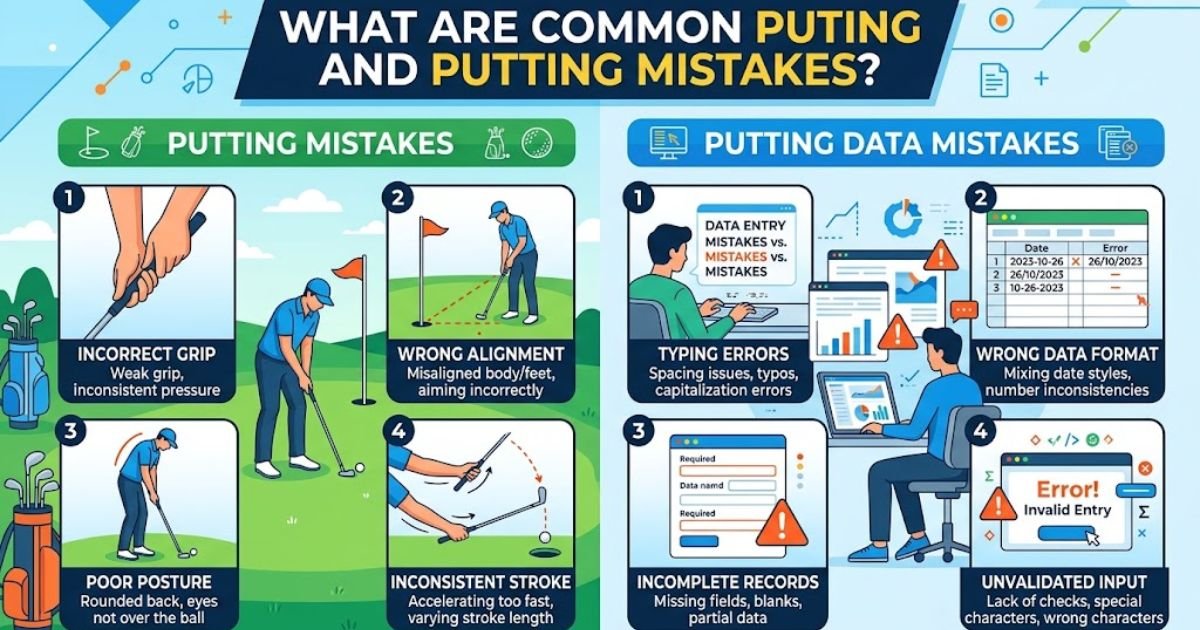
Everyone misspells a word now and then, and this one is easy to slip on. Here are the most common errors, with quick fixes.
Mistake 1: Leaving out one t
Incorrect: I am puting the report on your desk.
Correct: I am putting the report on your desk.
The final t must double before “-ing” because “put” is a short verb with a single vowel and consonant at the end.
Mistake 2: Confusing the general verb with the golf verb
Incorrect: He is puting for birdie on the last hole.
Correct: He is putting for birdie on the last hole.
The golf verb is “putt,” so it also doubles to “putting.” The base word already has two t’s, and “-ing” simply attaches.
Mistake 3: Adding an extra letter to the wrong place
Incorrect: She’s puttting the plan into action.
Correct: She’s putting the plan into action.
Two t’s are enough. A third is a typing slip, not a spelling rule.
Mistake 4: Applying the wrong tense
Incorrect: I putted the papers away.
Correct: I put the papers away.
“Put” does not take “-ed” in the past tense. The one exception is the golf verb, where “putted” is standard: “He putted from ten feet.”
Which Related Forms Follow the Same Spelling Rule?
“Putting” is not alone. Many short verbs double their final consonant before “-ing.” Learning the pattern once helps with dozens of words.
| Base verb | Correct “-ing” form |
| sit | sitting |
| get | getting |
| cut | cutting |
| set | setting |
| hit | hitting |
| shut | shutting |
| run | running |
| stop | stopping |
Some longer verbs follow the rule too, but only when the stress falls on the last syllable, as in “begin” and “beginning” or “forget” and “forgetting.”
Some words do not double the final consonant, which explains part of the confusion:
- Two vowels before the consonant: “wait” becomes “waiting.”
- Two consonants at the end: “help” becomes “helping.”
- Unstressed final syllable: “visit” becomes “visiting.”
“Put” falls squarely in the doubling group, so “putting” is correct.
Several common phrases use this form, including “putting off,” “putting up with,” “putting together,” “putting on,” “putting away,” and “putting aside.” Each one keeps the double t.
How Can You Remember the Correct Spelling?
A few simple habits make the spelling automatic.
Use the rhyme test. Say “sitting,” “getting,” and “putting” together. They are the same pattern, and none of them has a single-t version.
Think of the sound. A short u sound in “putting” needs two t’s to stay short, just as in “butter” and “button.”
Check the base word first. Write “put,” then add the second t and “-ing.” That takes about two seconds.
Let spell check help, but do not rely on it alone. Most tools catch “puting,” yet a rushed edit can still let it through in headlines and captions, where errors are most visible.
FAQ’s
Is “puting” ever correct?
No. “Puting” is not a standard English word, so it should always be corrected to “putting.”
What does “putting” mean?
“Putting” is the present participle and gerund of “put.” It means placing something, causing a condition, or expressing an idea. In golf, it also describes hitting the ball on the green.
How do I use “putting” in a sentence?
Use it with a form of “be” for ongoing action: “I’m putting the groceries away.” You can also use it as a noun: “Putting your ideas in writing helps you think clearly.”
Do British and American English spell it differently?
No. Both use “putting.” The spelling is the same in every major variety of English.
Why does “put” not change in the past tense?
“Put” is an irregular verb. Its past tense and past participle are the same as its base form, so you say “I put it there yesterday” without adding “-ed.”
What Should You Remember About Puting vs Putting?
“Putting” is correct, and “puting” is a common misspelling with no legitimate use. The double t comes from the standard rule for short verbs that end in a single vowel and consonant.
Here is the one takeaway: when you add “-ing” to “put,” double the t. The same habit works for “sitting,” “getting,” and “cutting,” so you are learning a whole family of spellings at once.
If you would like, I can also put this into a downloadable file such as a Markdown or Word document.

Smith Jason is an SEO expert with 2–3 years of experience, sharing grammar tips, confusing words, vocabulary and writing advice.










1 thought on “Puting vs Putting: Which Spelling Is Correct?”