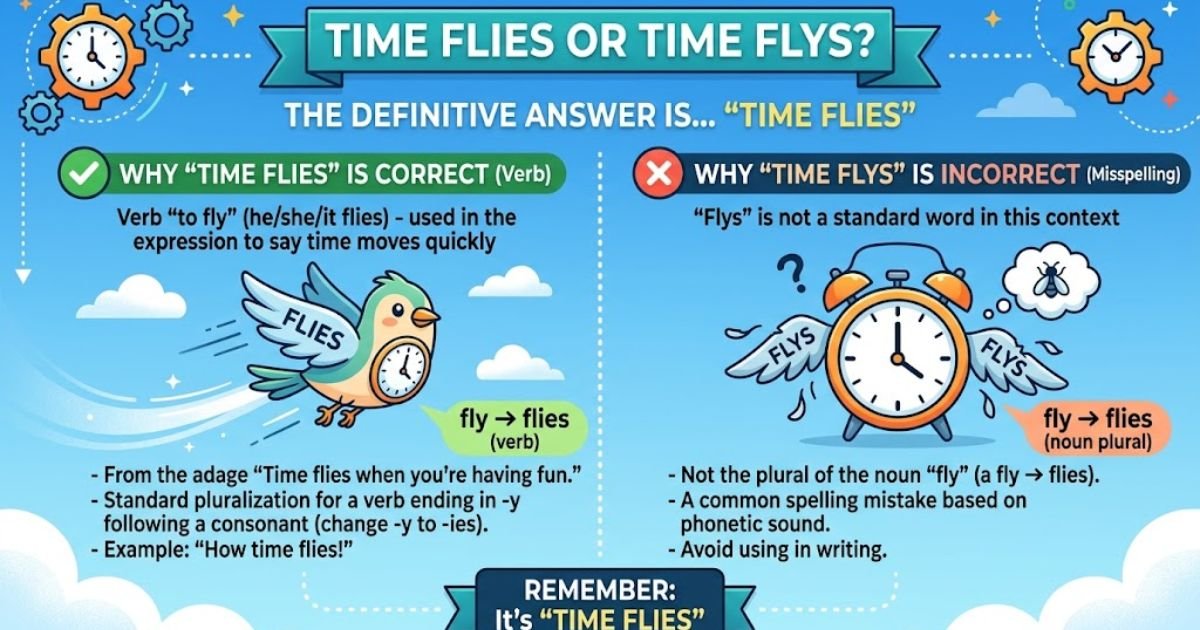
Many writers pause at this phrase because “flys” looks like it should work. After all, you add an s to most verbs. But the rule changes when a word ends in a consonant plus y. The correct spelling is “time flies.” “Time flys” is a misspelling. Here is why, plus meaning, origin, and examples.
What Is the Correct Spelling of Time Flies?
“Time flies” is the correct spelling. “Time flys” is incorrect in standard American and British English.
The phrase means that time seems to pass very quickly. Here, “flies” is the present tense verb form of “fly,” and it matches the singular subject “time.”
Standard dictionaries list “flies” as the third-person singular form of “fly.” They do not list “flys” as a verb form.
Time Flies vs. Time Flys at a Glance
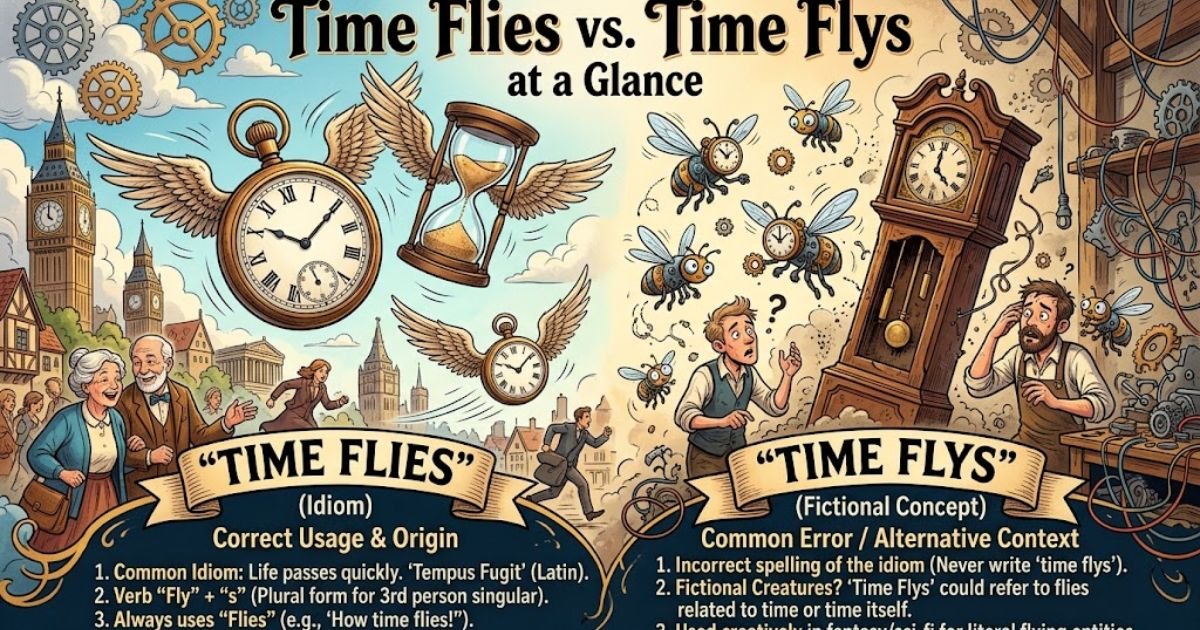
The table below shows the difference in one place.
| Term | Correct? | Meaning | Use |
| Time flies | Yes | Time passes quickly | Everyday speech, writing, formal and casual |
| Time flys | No | None (misspelling) | Avoid in all contexts |
| Time flew | Yes | Time passed quickly (past tense) | Talking about a finished period |
| Time has flown | Yes | Time has passed quickly (present perfect) | Reflecting on the time that has passed |
If you remember one row, remember the first. Everything else follows from the verb “fly.”
What Does “Time Flies” Mean?
“Time flies” is an idiom. It says that hours, days, or years feel like they pass faster than expected. It is a comment on how we experience time, not a literal claim about flying.
People use it in two main ways. The first is surprise at how much time has passed: “I can’t believe it’s already December. Time flies.” The second is enjoyment: “We were laughing so much that the evening was over before I knew it. Time flies when you’re having fun.”
The second version is a well-known extension of the phrase. It ties the feeling of fast time to being busy or happy.
Why Is It “Flies” and Not “Flys”?
The answer is a basic spelling rule. When a verb ends in a consonant plus y, you change the y to i and add es to make the third-person singular form.
- fly becomes flies
- try becomes tries
- carry becomes carries
- study becomes studies
The letter before the y in “fly” is l, which is a consonant. So the y turns into ies. If the letter before the y were a vowel, you would simply add s. That is why “play” becomes “plays” and “enjoy” becomes “enjoys.”
The same rule works for nouns. One insect is a fly, and two are flies. Plurals like “cities” and “babies” follow the same pattern.
Read Related Post: Tomorrow vs Tommorrow: The Correct Spelling Explained Fast
How Does the Grammar of “Time Flies” Work?
“Time flies” is a complete sentence with two parts. “Time” is a singular noun acting as the subject. “Flies” is an intransitive verb in the simple present tense. Intransitive means it does not need a direct object.
Because “time” is singular, the verb takes the third-person singular ending. Compare these:
- I fly, you fly, we fly, they fly
- He flies, she flies, it flies, time flies
The phrase is neutral in register. You can say it to a friend or put it in a business email. It is spelled and used the same way in American and British English.
There is also a well-known grammar joke built on this phrase: “Time flies like an arrow; fruit flies like a banana.” The sentence plays on the fact that “flies” can be a verb or a plural noun. The joke is often attributed to Groucho Marx, but that attribution is disputed, so treat it as folklore.
Where Does “Time Flies” Come From?
The idea is ancient. The Latin phrase “tempus fugit” means “time flees” or “time flies.” It comes from a line in the Roman poet Virgil’s Georgics, written in the first century BCE, which says that time is escaping and cannot be recovered.
The short form “tempus fugit” became a familiar motto in Latin and later in English. You will often see it engraved on clocks and sundials as a reminder to use time well.
The English idiom carries the same image. Time is pictured as something with wings that moves away quickly. English speakers have used “time flies” for centuries, and it remains one of the most common time-related expressions.
How Do You Pronounce Time Flies?
Say it as “tyme flyz.” Both words have the long “i” sound, like the words “bite” and “size.”
- time: rhymes with “climb” and “rhyme”
- flies: rhymes with “skies” and “tries”
The final s in “flies” sounds like a z. Both words are stressed about equally in natural speech, though “flies” often gets a slight emphasis: “Wow, time FLIES.”
How Do You Use Time Flies in a Sentence?
Here are natural examples for different situations.
Everyday conversation:
“Is Emma really starting middle school? Time flies.”
Workplace communication:
“Time flies. We’re already at the end of the quarter, so let’s review our goals this week.”
Email:
“It was great catching up today. I can’t believe it’s been six months since the launch. Time flies!”
Academic or reflective writing:
“Looking back on my four years of college, I realize how quickly time flies when you are absorbed in meaningful work.”
Casual writing or texting:
“Ugh, time flies when you’re binge-watching. It’s 2 a.m.”
In the academic example, “time flies” works as a short clause inside a longer sentence. It is still correct because the subject and verb agree in the third person singular.
What Are the Other Forms of “Fly,” and What Are Related Phrases?
Once you know the verb “fly,” the rest of the forms are easy to follow. Fly is an irregular verb, so its past forms do not end in “-ed.”
| Form | Example |
| Base form: fly | “Birds fly south for the winter.” |
| Third-person singular: flies | “Time flies.” |
| Present participle: flying | “Time is flying by.” |
| Simple past: flew | “The summer flew by.” |
| Past participle: flown | “The years have flown past.” |
Note that “flied” is not the past tense here. “Flew” is correct for time passing quickly. (Baseball uses “flied out” as a specific technical term, which is a separate use.)
Related phrases you may see include “time flies by,” “how time flies,” “time flies when you’re having fun,” and “time has flown.” Similar ideas appear in “where did the time go?” and “the days are long, but the years are short.” A common opposite is “time drags,” which means time seems to pass slowly.
What Are the Most Common Mistakes With “Time Flies”?
These mistakes are normal, since English spelling rules have plenty of exceptions.
Mistake 1: Spelling the verb “flys”
Incorrect: Time flys when you are busy.
Correct: Time flies when you are busy.
The verb ends in a consonant plus y, so the y changes to ies.
Mistake 2: Using “fly” with a singular subject
Incorrect: Time fly so fast.
Correct: Time flies so fast.
Singular subjects like “time” need the s form in the present tense.
Mistake 3: Using the wrong past tense
Incorrect: The weekend flied by.
Correct: The weekend flew by.
“Fly” is irregular, so its past tense is “flew.”
Mistake 4: Adding an apostrophe
Incorrect: Time fly’s.
Correct: Time flies.
Verbs never take an apostrophe to show the third-person singular.
A quick memory trick: if you would spell the word “flies” for insects, spell it “flies” for time too. The spelling is the same for both.
Does “Flys” Ever Have a Legitimate Use?
As a verb form or a regular plural noun, “flys” is not standard English. Most of the time, it is a typo.
There is one narrow exception. When a proper noun ends in a consonant plus y, the plural usually keeps the y and simply adds s. That is why we write “the Kennedys” and not “the Kennedies.” So a family surnamed Fly could be called “the Flys.” Brand names, band names, and product names may also use “Flys” as a creative spelling.
None of those uses apply to the idiom. In “time flies,” you should always use the standard spelling.
FAQ’s
Is it “time flies” or “time flys”?
It is “time flies.” “Flys” is a misspelling because verbs ending in a consonant plus y change the y to ies in the third-person singular.
What does “time flies” mean?
It means time seems to pass very quickly. People say it when they are surprised at how fast days, months, or years have gone by.
Is “time flies” a complete sentence?
Yes. “Time” is the subject and “flies” is the verb, so the two words form a complete sentence.
How do you use “time flies” in a sentence?
You can use it alone or inside a longer sentence. For example: “We’ve been friends for ten years already. Time flies.”
What is the past tense of “time flies”?
The past tense is “time flew.” For example: “The whole vacation flew by.”
Conclusion
“Time flies” is the correct spelling, every time. The verb “fly” follows the standard rule for words that end in a consonant plus y, so it becomes “flies,” just like “try” becomes “tries.”
When in doubt, remember this: if it works for the insect, it works for the idiom. Time flies, and your spelling can keep up with it.

Smith Jason is an SEO expert with 2–3 years of experience, sharing grammar tips, confusing words, vocabulary and writing advice.