If you have ever paused mid-sentence, unsure whether to write “niece” or “neice,” you are not alone. The two spellings look similar, sound the same when spoken quickly, and the confusion usually comes from mixing up the classic “i before e” spelling pattern. The good news is that only one of these spellings is actually a word.
“Niece” is the correct spelling. “Neice” is a common misspelling and is not recognized in any standard English dictionary. A niece is the daughter of your sibling or the daughter of your spouse’s sibling. There is no context, formal or informal, American or British, where “neice” is accepted as correct.
What Does “Niece” Mean?
A niece is a family relationship term. Specifically, it refers to the daughter of your brother or sister, or the daughter of your spouse’s brother or sister.
For example, if your sister has a daughter, that daughter is your niece. If your husband’s brother has a daughter, she is also your niece, sometimes called a niece-in-law in casual speech, though this is not a formal legal term.
The male equivalent of niece is nephew, which refers to a son in the same relationship.
Niece vs Neice: What’s the Difference?
There is no real grammatical difference between “niece” and “neice” because “neice” is not a word. It is simply a spelling error. The confusion happens because English speakers often try to apply the “i before e, except after c” rule, and “niece” does follow the “i before e” pattern correctly. The mistake usually comes from muscle memory tied to words like “receive” or “weigh,” where the letters flip.
Here is a simple table to make the distinction clear.
| Term | Correct? | Meaning | Use |
| Niece | Yes | Daughter of a sibling or a spouse’s sibling | Standard, correct spelling in all contexts |
| Neice | No | Not a recognized word | Common misspelling, always incorrect |
Read Related Post: Whose or Who’s (2026): Easy Guide to Understand the Difference
Is “Neice” Ever Correct?
No. “Neice” does not appear in Merriam-Webster, Oxford, Cambridge, or any other major English dictionary. It is not a regional variant, a British versus American difference, or an accepted informal spelling. It is simply a typo or a memory slip based on the sound of the word rather than its actual spelling.
If you see “neice” in an email, text message, or document, it should be corrected to “niece” every time.
Grammar Breakdown of “Niece”
“Niece” is a noun. It is a common noun (not capitalized unless it starts a sentence) and it is a countable noun, meaning it has both a singular and plural form.
- Part of speech: noun
- Singular: niece
- Plural: nieces
- Gender-specific: yes, referring specifically to a female relative
- Possessive form: niece’s (singular possessive), nieces’ (plural possessive)
There is no verb, adjective, or adverb form of “niece.” It functions only as a naming word for a family relationship.
Where Does the Word “Niece” Come From?
The word “niece” has a long history rooted in Latin. It comes from the Old French word “niece,” which itself developed from the Latin word “neptia,” a feminized form of “nepos,” meaning “grandson” or, more broadly, “descendant.”
Over time, as the word moved through Old French and into Middle English, its meaning narrowed specifically to describe the daughter of one’s sibling. This is why “niece” and “nephew” share a related linguistic root, even though they look quite different today. “Nephew” traces back to the same Latin root, “nepos,” but followed a slightly different path through French.
How to Pronounce “Niece”
“Niece” is pronounced /niːs/, rhyming with words like “peace,” “geese,” and “lease.” It is a single syllable word. The “ie” combination makes a long “ee” sound, similar to other “ie” words such as “piece” and “chief.”
There is no pronunciation version that matches “neice” as a separate word, which is another reason the misspelling causes confusion. Speakers hear the correct sound but sometimes reverse the letters when writing it down.
Singular and Plural: Niece, Nieces
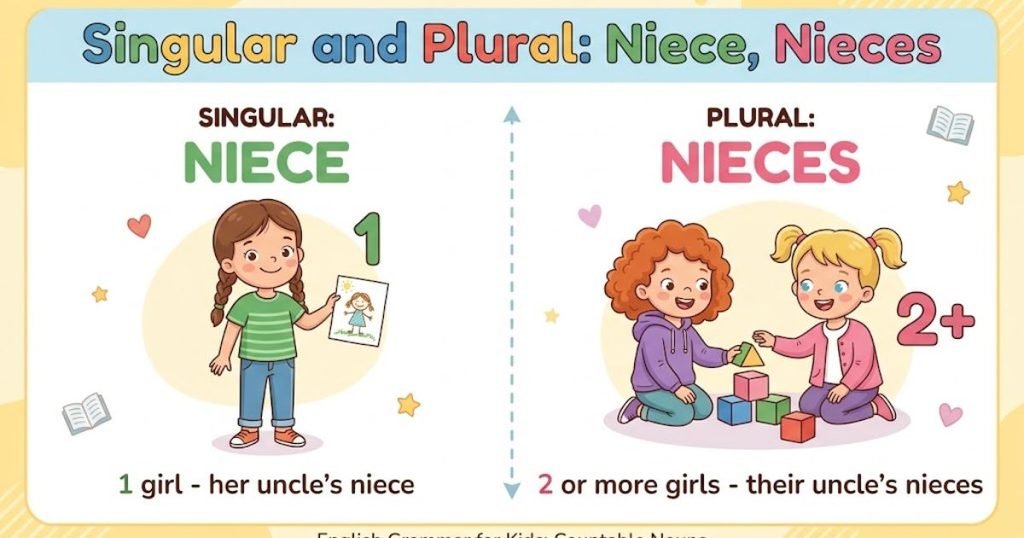
The plural of niece is formed the regular way, by adding an “s.”
- Singular: I have one niece.
- Plural: I have three nieces.
There is no irregular plural form here, unlike words such as “child” and “children.” This makes “niece” straightforward once the correct spelling is locked in.
How to Use “Niece” in a Sentence
Using “niece” correctly is simple once you understand the relationship it describes. It always refers to a female relative one generation younger, connected through a sibling.
- My niece just graduated from college.
- We are hosting a birthday party for my niece next weekend.
- Her niece works in the same industry as she does.
Niece in Everyday, Work, and Formal Writing
Because “niece” is a common family term, it shows up naturally across many types of writing.
Everyday conversation:
“My niece is visiting this weekend, so we’re planning a trip to the zoo.”
This works because it describes a simple, casual family plan.
Workplace communication:
“I’ll be out on Friday. My niece has a school event I promised to attend.”
This is appropriate for a quick, professional explanation of a personal absence.
Academic writing:
“The study examined caregiving patterns between aunts, uncles, nieces, and nephews within extended families.”
Here, “niece” functions as part of a broader kinship terminology being analyzed.
Emails:
“Attached are the photos from my niece’s graduation ceremony last month.”
This sentence works well in a personal or semi-formal email.
Formal writing:
“Under the terms of the will, the niece of the deceased is named as a beneficiary.”
Legal and formal documents often use “niece” precisely because it identifies an exact family relationship.
Common Mistakes When Spelling Niece
Here are the most frequent errors people make, along with corrections.
Incorrect: My neice is coming to visit next week.
Correct: My niece is coming to visit next week.
This happens because the writer reverses the “ie” pattern, likely influenced by other English spelling exceptions.
Incorrect: She has two neices in college.
Correct: She has two nieces in college.
The plural form follows the same correct spelling rule as the singular, just with an added “s.”
Incorrect: My neice’s birthday is in June.
Correct: My niece’s birthday is in June.
The apostrophe placement is correct here, but the base word still needs the “niece” spelling before adding possession.
These mistakes are extremely common and do not reflect poor writing skills overall. English spelling patterns are inconsistent, and this word simply requires memorization.
Words Related to Niece
A few related terms can help build a fuller picture of family vocabulary connected to “niece.”
- Nephew: the male equivalent of niece
- Aunt: a parent’s sister, or the wife of a parent’s brother
- Uncle: a parent’s brother, or the husband of a parent’s sister
- Grand-niece: the daughter of your niece or nephew
- Great-niece: another common term for the same relationship as grand-niece
- Niece-in-law: an informal term sometimes used for the niece of a spouse
Simple Tricks to Remember the Correct Spelling
If the spelling still feels tricky, a few memory tricks can help.
- Remember that “niece” rhymes with “piece,” and both follow the same “ie” spelling pattern.
- Think of the phrase “I see my niece,” which reinforces the correct letter order through sound association.
- Picture the word broken into “ni” plus “ece,” which mirrors “piece” minus the “p.”
FAQ’s
Is “neice” a real word?
No. “Neice” is not a real word in any English dictionary. The correct spelling is always “niece.”
What does “niece” mean?
“Niece” refers to the daughter of your sibling, or the daughter of your spouse’s sibling.
How do I use “niece” in a sentence?
Use it to describe this specific family relationship, such as: “My niece is starting high school this fall.”
Is there a British English version of “niece” spelled differently?
No. “Niece” is spelled the same way in both American and British English. There is no regional variation.
What is the male version of “niece”?
The male equivalent is “nephew,” referring to a sibling’s son or a spouse’s sibling’s son.
Conclusion
The spelling question here has a clear and simple answer: “niece” is correct, and “neice” is always a mistake. Whenever you are describing your sibling’s daughter, or your spouse’s sibling’s daughter, “niece” is the word you want. If you remember that it rhymes with “piece” and follows the same familiar spelling pattern, you will never second guess it again.

Smith Jason is an SEO expert with 2–3 years of experience, sharing grammar tips, confusing words, vocabulary and writing advice.










1 thought on “Niece or Neice (2026): Clear and Simple Guide for Everyone”