Many writers hesitate over “unphased” vs “unfazed” because the two words sound identical. Both look plausible on the page. The correct spelling in the sense of “not bothered” is unfazed. “Unphased” is a common misspelling, likely influenced by the familiar word “phase.” Read on for the meaning, the origin, and an easy way to remember it.
Which Is Correct, Unphased or Unfazed?
Unfazed is the correct spelling when you mean “not disturbed, worried, or rattled.” Unphased is a misspelling in that sense. Standard American dictionaries list “unfazed” for this meaning, and editors will correct “unphased” in professional writing.
The word comes from the verb “faze,” which means to disturb or unsettle someone. Add the prefix “un-” and you get an adjective describing a person who stays calm under pressure.
Example: She was unfazed by the last-minute schedule change.
What Does Unfazed Mean?
Unfazed means not shaken, not troubled, and not thrown off by something that might upset others. It describes a calm reaction to surprise, criticism, pressure, or bad news.
The word usually implies that the situation could have bothered a person, but it didn’t. Nobody is called unfazed by something trivial. You’d say a driver was unfazed by heavy traffic, but not unfazed by a green light.
A few quick examples:
- The pitcher stayed unfazed after giving up two runs.
- My manager was unfazed when the client changed the deadline again.
- Toddlers seem completely unfazed by public tantrums, even their own.
Why Do People Write Unphased?
Two things cause the mix-up: sound and association.
The words are pronounced the same. Both “unfazed” and “unphased” are said /ʌnˈfeɪzd/, with a long “a” sound and a “z” sound at the end. Since English spelling rarely matches pronunciation, your ear can’t tell you which one to write.
“Phase” is much more familiar than “faze.” Most people see “phase” often, as in “the first phase of the project” or “a phase of the moon.” When they need to spell a word that sounds like it, they reach for the version they’ve seen most. Writers sometimes call this kind of slip an eggcorn, a misspelling that feels logical even though it’s wrong.
If you’ve written “unphased,” you’re in very large company. It’s one of the most frequent spelling slips of its type.
What Part of Speech Is Unfazed?
Unfazed is an adjective. It is formed from the past participle of the verb “faze” (fazed) plus the prefix “un-,” which means “not.”
Here are the forms of the base verb:
| Form | Word | Example |
| Base verb | faze | Not much can faze her. |
| Third person | fazes | Public speaking never fazes him. |
| Present participle | fazing | The noise wasn’t fazing anyone. |
| Past tense | fazed | The news fazed the whole team. |
| Adjective | unfazed | She looked unfazed. |
Two grammar points are worth knowing:
- “Faze” is a transitive verb. It needs an object: something fazes someone. You can’t simply say “I fazed.”
- “Faze” usually appears in negative sentences or questions. People say “That didn’t faze me” far more often than “That fazed me,” although both are grammatical.
Unfazed works as a predicate adjective (“He seemed unfazed”) or before a noun (“an unfazed expression”). It is standard in both American and British English, and there is no regional spelling difference.
Where Does Unfazed Come From?
The verb “faze” goes back to an older English word, Old English fēsian, which meant to drive away or frighten. Over time, dialect forms such as “feeze” developed, and “faze” became established in American English in the 1800s with its modern sense of disturbing or disconcerting someone.
“Phase” has a completely different history. It comes through French and Latin from a Greek word meaning “appearance,” and it originally referred to the visible stages of the moon. That is why “phase” means a stage or period.
These are two unrelated words that happen to sound alike. Neither one is a variant of the other. That is the deeper reason “unphased” doesn’t work for “not bothered”: a “phase” has nothing to do with being disturbed.
Unfazed vs Unphased at a Glance
This table shows how the two spellings compare.
| Term | Correct? | Meaning | Use |
| Unfazed | Yes | Not disturbed or rattled | Everyday and formal writing |
| Unphased | Not for “not bothered” | Not divided into phases (technical) | Only in specialized fields |
| Faze | Yes | To disturb or unsettle | Often in negative statements |
| Phase | Yes | A stage or period | Projects, cycles, planning |
Read Related Post: Triple vs Tripple: Which Is the Correct Spelling? The Complete Guide
When Does Unphased Have a Legitimate Use?
“Unphased” isn’t a nonsense string. It can be built legitimately from “phased,” meaning arranged in stages, plus “un-.” In that case it means not phased, or not broken into phases.
You’ll mostly find this in technical writing. In genetics, for example, researchers talk about unphased data, meaning genetic information that hasn’t been sorted by which chromosome copy a variant sits on. Engineers might describe an unphased rollout, a launch that wasn’t staged.
Here’s an example: The team preferred an unphased launch so every store opened on the same day.
Even here, it’s rare in general writing. If you mean “calm and not bothered,” the technical sense doesn’t apply, and “unfazed” is the word you want.
How Do You Use Unfazed in a Sentence?
The best way to feel comfortable with the word is to see it in different settings.
Everyday conversation
- “I thought the dog would be scared, but he was totally unfazed by the vacuum.”
- “Are you kidding? I’m unfazed by a little rain.”
Workplace and email
- “The client remained unfazed by the revised timeline, so we can proceed.”
- “Please don’t worry. I’m unfazed by the extra review round.”
Academic writing
- “The participants appeared unfazed by the increase in task difficulty.”
Formal and business writing
- “The company was unfazed by the regulatory changes and maintained its forecast.”
Casual writing
- “She walked into that meeting completely unfazed. I was sweating for her.”
The academic example is correct because “unfazed” describes an observed reaction, which suits neutral research language. The business example works because the phrase “unfazed by” is a standard pairing for organizations as well as people.
What Are Common Mistakes With Unfazed and Unphased?
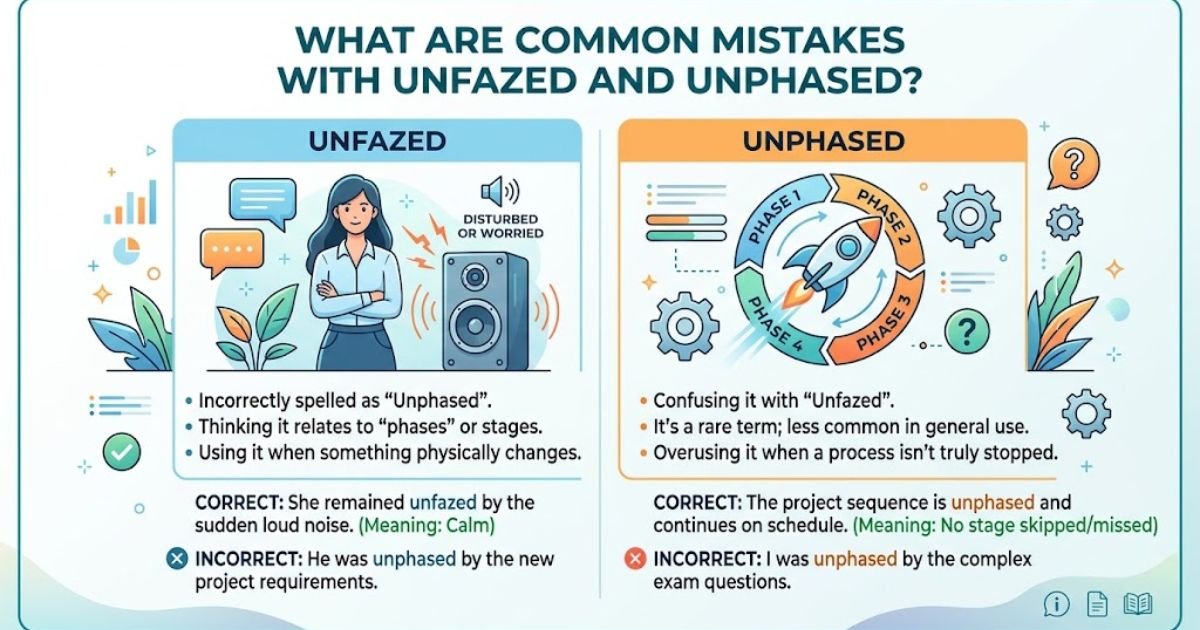
These mistakes are normal, and they show up in emails, essays, and published articles alike.
Mistake 1: Using “unphased” for “not bothered”
Incorrect: He was unphased by the criticism.
Correct: He was unfazed by the criticism.
The word you want comes from “faze,” not “phase.”
Mistake 2: Writing “fazed” as “phased” in the verb form
Incorrect: The delay didn’t phase her.
Correct: The delay didn’t faze her.
The same confusion affects the verb. When the meaning is “to disturb,” the spelling is “faze.”
Mistake 3: Using “faze” when you mean “phase out”
Incorrect: The company will faze out the old model.
Correct: The company will phase out the old model.
Here the meaning is to remove gradually, in stages, so “phase” is correct.
Mistake 4: Confusing “unfazed” with “unphrased”
Incorrect: She remained unphrased.
Correct: She remained unfazed.
“Unphrased” isn’t a standard word, so watch for stray letters.
What Words Mean Almost the Same as Unfazed?
Several words overlap with “unfazed,” though each has its own flavor.
- Unbothered: casual and modern, often used in conversation.
- Unflappable: describes someone who stays calm as a personality trait, not just in one moment.
- Undaunted: suggests courage in the face of a challenge.
- Unruffled: calm on the surface, often used for appearance.
- Composed: controlled and poised.
- Untroubled: free from worry.
Opposites include rattled, shaken, flustered, and disconcerted.
There is one important difference. “Unfazed” describes the reaction to a specific event, while “unflappable” describes a lasting trait. A person can be unfazed today without being unflappable in general.
How Can You Remember the Right Spelling?
Here are three simple tricks.
- Match the “z” sound. “Unfazed” has a z in it, and the word ends in a z sound. The “ph” spelling is the wrong choice because it makes an f sound in “phase.”
- Think “faze” means “frazzle.” Both are short, a bit sharp, and both involve being disturbed. If something could fluster you, “faze” is your verb.
- Ask if a stage is involved. If you’re talking about stages or cycles, use “phase.” If you’re talking about feelings, use “faze.”
A quick test: replace the word with “not bothered.” If the sentence still makes sense, you want unfazed.
FAQ’s
Is “unphased” ever correct?
Not in the sense of “not bothered.” “Unphased” is acceptable only in technical contexts where it means “not divided into phases,” such as genetics or project planning. For everyday writing, use “unfazed.”
What does “unfazed” mean?
Unfazed means calm and not disturbed by something that might upset other people. For example: The speaker was unfazed by the technical glitch and kept going.
Is “unfazed” one word or two?
It is one word, with no hyphen: “unfazed.” Don’t write “un-fazed” or “un fazed.”
Can I say “fazed” without a negative?
Yes. “Fazed” is a real word, and you can say, “The sudden change fazed him.” It appears less often than the negative form, but it is grammatically correct.
How do you pronounce unfazed?
It is pronounced “un-FAYZD,” with the stress on the second syllable. The “z” sound comes at the end, and “unphased” would sound exactly the same.
The One Thing to Remember
When you mean “not bothered,” write unfazed, and save “phase” for stages and cycles. The two words sound alike but come from different roots and mean different things.
If you’re ever unsure, ask yourself whether the sentence is about a feeling or a stage. Feelings get “faze,” and stages get “phase.”

Smith Jason is an SEO expert with 2–3 years of experience, sharing grammar tips, confusing words, vocabulary and writing advice.










1 thought on ““Unphased” vs “Unfazed”: Which Spelling Is Correct?”