If you keep typing “who’s” when you mean “whose,” you are not alone. These two words sound exactly the same, which is why spell check often misses the mistake entirely. Here is the short answer: “whose” shows possession, and “who’s” is a contraction of “who is” or “who has.” Everything else in this guide builds on that one rule.
The Quick Answer: Whose vs Who’s in One Sentence
Use “whose” when you are asking or telling who owns something. Use “who’s” only when you can replace it with “who is” or “who has.” If that replacement sounds wrong in your sentence, “whose” is the word you need.
For example:
- “Whose phone is this?” (asking who owns the phone)
- “Who’s calling?” (asking who is calling)
That single substitution test solves almost every mix up between these two words.
What Does “Whose” Mean?
Whose is a possessive pronoun. It asks or tells who something belongs to, similar to how “his,” “her,” or “their” work in a sentence. You use it right before a noun to show ownership or a close relationship.
Examples:
- “Whose keys are on the counter?”
- “I met a woman whose book just became a bestseller.”
- “The company whose logo you designed just went public.”
Notice that “whose” is always followed by a noun (keys, book, logo). That pattern is one of the easiest ways to spot it.
What Does “Who’s” Mean?
Who’s is a contraction. It combines “who” with either “is” or “has.” The apostrophe signals that a letter or letters are missing, exactly like in “it’s” (it is) or “she’s” (she has).
Examples:
- “Who’s coming to the party tonight?” (who is)
- “Who’s already finished the assignment?” (who has)
- “Do you know who’s in charge here?” (who is)
If you can swap in “who is” or “who has” and the sentence still makes sense, “who’s” is correct.
The Core Difference Between Whose and Who’s
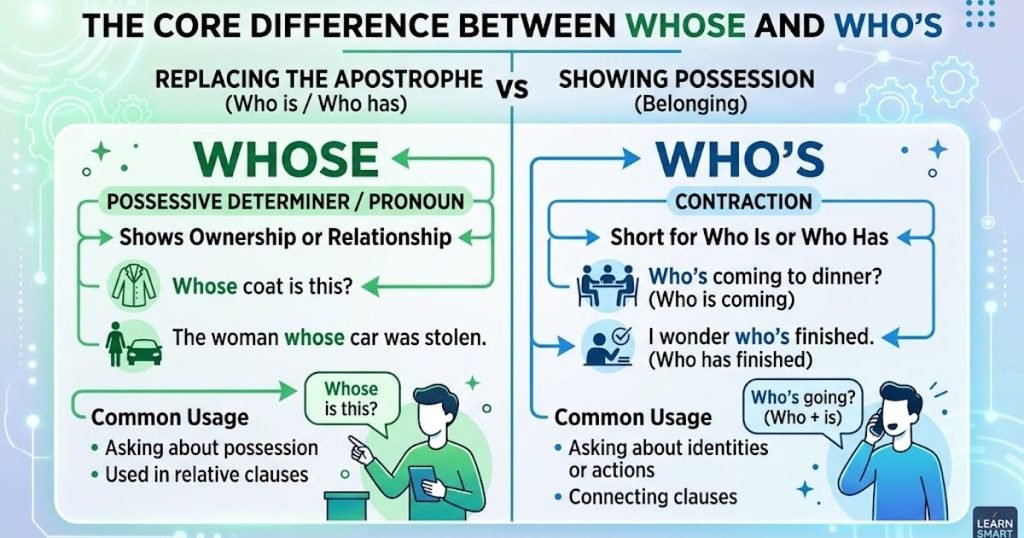
The real difference comes down to grammar function, not meaning in the everyday sense. “Whose” shows possession. “Who’s” is short for a subject and a verb. They are not interchangeable, even though they are pronounced identically.
| Term | Correct? | Meaning | Use |
| Whose | Yes | Shows possession or belonging | “Whose bag is this?” |
| Who’s | Yes | Contraction of “who is” or “who has” | “Who’s ready to go?” |
Both words are correct English. Neither one is a mistake by itself. The error only happens when you use one in place of the other.
Read Related Post: Curtesy or Courtesy: Which Spelling Is Correct?
Why Do People Confuse Whose and Who’s?
The confusion exists because English usually adds an apostrophe and “s” to show possession, as in “the dog’s bowl” or “Maria’s car.” Based on that pattern, it seems logical that “who’s” should mean “belonging to who.” It does not. “Whose” already carries that possessive meaning on its own, without an apostrophe, much like “his,” “hers,” and “its” also skip the apostrophe when showing ownership.
Part of Speech and Grammar Behind Each Word
Whose functions as a possessive determiner (sometimes called a possessive pronoun) and can also introduce a relative clause, as in “the man whose car was towed.” It never changes form for singular or plural, and it works the same way in questions and statements.
Who’s is a contraction made from a pronoun (“who”) plus a verb (“is” or “has”). Because it is really two words joined together, its correctness depends entirely on whether “who is” or “who has” fits the sentence.
Pronunciation Note
Both words are pronounced the same way: “hooz.” There is no audible difference, which is exactly why the mix up is so common in writing. Spoken English never reveals the mistake. Written English always does.
How to Use “Whose” Correctly in a Sentence
Use “whose” directly before a noun to show that the noun belongs to, or is connected to, someone or something.
- Everyday conversation: “Whose turn is it to do the dishes?”
- Workplace communication: “I need to know whose approval is required before we launch.”
- Academic writing: “The study, whose results surprised researchers, will be published next month.”
- Email: “Whose calendar should I check for availability?”
- Formal writing: “The author whose work we are analyzing wrote extensively about identity.”
In each case, “whose” is immediately followed by a noun (turn, approval, results, calendar, work), which confirms it is doing its job correctly.
How to Use “Who’s” Correctly in a Sentence
Use “who’s” whenever you mean “who is” or “who has.” Try the substitution before you commit to the apostrophe.
- Everyday conversation: “Who’s driving to the game later?” (who is)
- Workplace communication: “Who’s finished the quarterly report?” (who has)
- Academic writing: “Who’s responsible for this theory is still debated among historians.” (who is)
- Business writing: “Who’s signing off on the new vendor contract?” (who is)
- Casual writing: “Guess who’s back in town!” (who is)
Run each sentence through the “who is” or “who has” test, and the meaning holds up every time.
Common Mistakes with Whose and Who’s
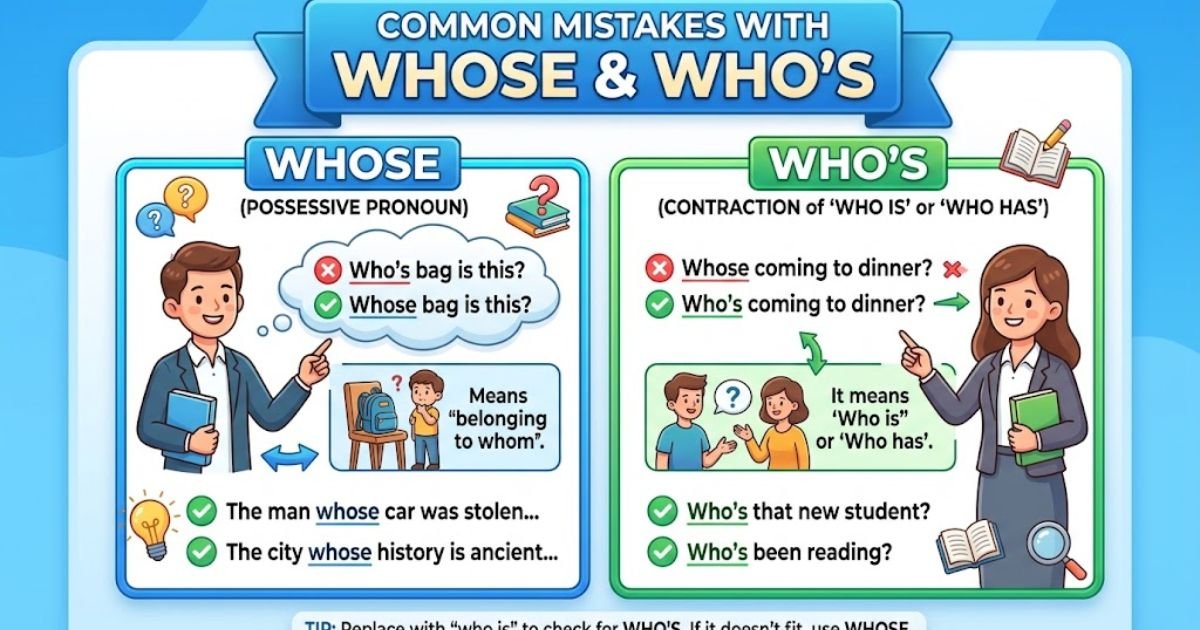
Incorrect: “Who’s bike is blocking the driveway?” Correct: “Whose bike is blocking the driveway?” This sentence asks who owns the bike, so it needs the possessive “whose,” not the contraction.
Incorrect: “I don’t know whose going to the meeting.” Correct: “I don’t know who’s going to the meeting.” Here the sentence means “who is going,” so the contraction “who’s” is required.
Incorrect: “Do you know who’s book this is?” Correct: “Do you know whose book this is?” “Book” is the possessed noun, which signals that “whose” is the right choice.
A simple habit fixes most of these errors: before you write “who’s,” mentally expand it to “who is” or “who has.” If the sentence breaks, switch to “whose.”
Related Words and Grammar Patterns
Understanding “whose” and “who’s” gets easier when you see them alongside similar word pairs in English:
- Its vs it’s: “its” shows possession, “it’s” means “it is” or “it has,” following the exact same pattern.
- Their vs they’re: “their” shows possession, “they’re” means “they are.”
- Your vs you’re: “your” shows possession, “you’re” means “you are.”
- Whom: used as an object pronoun, often confused with “who” but unrelated to the whose/who’s issue.
Once you notice this pattern across multiple word pairs, “whose” versus “who’s” stops feeling like an isolated rule and starts feeling like part of a larger, predictable system.
A Simple Trick to Remember the Difference
Before typing “who’s,” pause and ask yourself: “Can I replace this with ‘who is’ or ‘who has’?” If yes, keep the apostrophe. If no, remove it and use “whose” instead. This one habit prevents nearly every mistake with these two words, whether you are writing a quick text or a formal report.
FAQ’s
Is “whose” only used for people?
No. “Whose” can refer to people, animals, or things. For example: “The building, whose windows were recently replaced, looks much brighter now.”
Is “who’s” ever used as a possessive?
No. “Who’s” is always a contraction of “who is” or “who has.” It never shows possession, even though the apostrophe might suggest otherwise.
How do I know which one to use in a question?
Try substituting “who is” or “who has” into the question. “Who’s coming?” works because “Who is coming?” makes sense. “Whose coat is this?” would not work as “Who is coat is this,” which confirms “whose” is correct there.
Does British English treat “whose” and “who’s” differently?
No. Both American and British English follow the same rule: “whose” for possession, “who’s” for the contraction. This is one grammar point where the two dialects fully agree.
Can “whose” refer to a group or organization?
Yes. For example: “The team whose project won the award celebrated all weekend.” Here “whose” connects the possessive idea to a collective noun.
Conclusion
The difference between “whose” and “who’s” comes down to one simple test. If you can swap in “who is” or “who has” and the sentence still makes sense, use “who’s.” If the sentence is about ownership or belonging, use “whose.” Keep that substitution trick in mind, and you will get it right every time, no matter how the sentence is structured.

Smith Jason is an SEO expert with 2–3 years of experience, sharing grammar tips, confusing words, vocabulary and writing advice.









1 thought on “Whose or Who’s (2026): Easy Guide to Understand the Difference”