
You are writing about someone who moved countries, and your cursor stops. Emigrate or immigrate? The two words look almost identical, sound almost identical, and describe the same trip. The confusion is normal, because the difference is not about the person at all.
It is about direction. Use “emigrate” when someone leaves a country, and “immigrate” when someone arrives in a country. Both words are correct English.
The Short Answer: Emigrate vs Immigrate
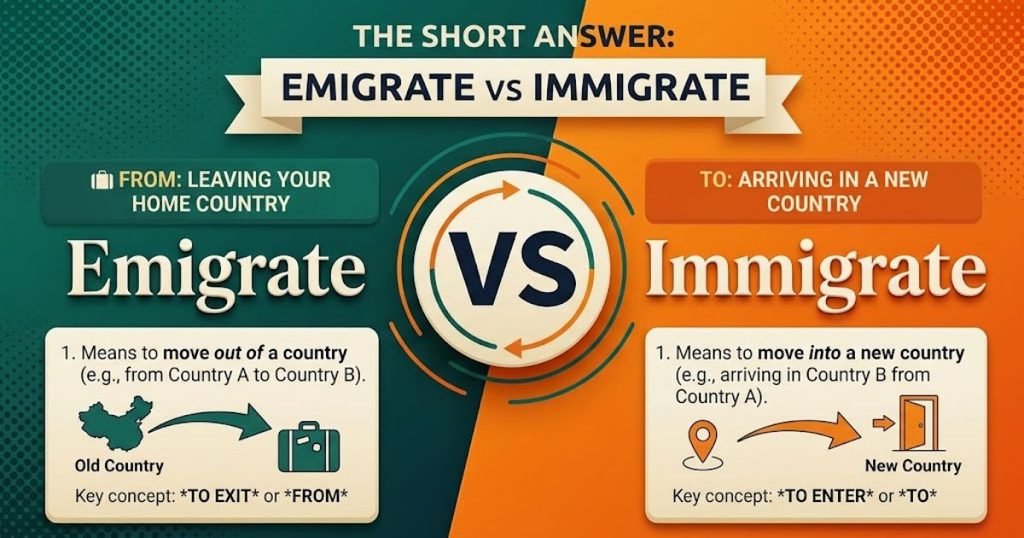
“Emigrate” means to leave your home country to live somewhere else. “Immigrate” means to come into a new country to live there permanently.
The same move can be described with either verb, depending on which end of the journey you are standing at. A woman who leaves Manila for Toronto emigrates from the Philippines and immigrates to Canada. One person, one flight, two accurate verbs.
The quickest test: if the sentence points at the country being left behind, use emigrate. If it points at the country being entered, use immigrate.
What Does Emigrate Mean?
Emigrate is a verb that means to leave your own country in order to settle in another one. The focus is on departure and on the place of origin.
Because the emphasis falls on leaving, emigrate usually pairs with the preposition from:
- My grandparents emigrated from Poland after the war.
- Thousands of engineers emigrated from the country during the recession.
Emigrate implies a permanent or long term move, not a vacation or a work trip. You do not emigrate to Miami for a weekend. You also do not emigrate within your own country. Moving from Texas to Oregon is relocating, not emigrating.
What Does Immigrate Mean?
Immigrate is a verb that means to come into a country that is not your own in order to live there. The focus is on arrival and on the destination.
Because the emphasis falls on entering, immigrate almost always pairs with the preposition to:
- Her parents immigrated to the United States in 1994.
- He immigrated to Australia on a skilled worker visa.
Like emigrate, it carries the sense of settling rather than visiting. Tourists, students on short exchanges, and business travelers do not immigrate. People who intend to build a life in the new country do.
Emigrate or Immigrate: Side by Side Comparison
| Word | Correct? | Meaning | Direction | Typical Preposition | Example |
| Emigrate | Yes | To leave your home country to settle elsewhere | Out of a country | from | She emigrated from Brazil in 2018. |
| Immigrate | Yes | To enter a new country to live there | Into a country | to | She immigrated to Portugal in 2018. |
| Migrate | Yes | To move from one place to another, often seasonally or in groups | Either, or neither | to, from, between | Workers migrate to the coast each summer. |
Neither emigrate nor immigrate is a misspelling of the other. They are two separate verbs with two separate jobs.
Read Related Post: Monogamy vs Polygamy: Meaning, Differences, and Examples
The Grammar Behind Both Verbs
Both words are intransitive verbs, which means they normally do not take a direct object. You do not “immigrate something.” The verb stands on its own and is followed by a prepositional phrase.
Here are the forms, which follow the standard regular pattern:
| Base | Third person singular | Present participle | Past tense and past participle |
| emigrate | emigrates | emigrating | emigrated |
| immigrate | immigrates | immigrating | immigrated |
Notice the spelling detail that trips people up: emigrate has one m, and immigrate has two. That double letter comes straight from the prefix, and it is the single most reliable spelling clue in the pair.
Both verbs are neutral in register. They work in a text message, a college essay, or a legal document without sounding stiff or slangy.
Which Preposition Goes With Each Verb?
This is where most real confusion lives, and where a lot of online advice oversimplifies.
“Emigrate from” and “immigrate to” are the standard pairings. They match the built in direction of each word.
However, “emigrate to” is also correct and very common. When you name the destination after emigrate, you are still emphasizing the act of leaving, with the new country mentioned as extra information:
- In 1912, his family emigrated to Argentina.
- Many writers emigrated to Paris during that decade.
You can even use both prepositions in one sentence: She emigrated from Vietnam to France.
What you should avoid is “immigrate from” as a way of describing the departure. It is not technically impossible, since you can say “immigrants from Mexico,” but as a verb phrase it muddles the direction. If the country you are naming is the one being left, emigrate is the cleaner choice.
Where Emigrate and Immigrate Come From
Both verbs trace back to the Latin verb migrare, meaning to move or to shift position. English simply borrowed the root twice, with two different prefixes attached.
Emigrate comes from Latin emigrare, built from the prefix e- (a form of ex-, meaning “out of”) plus migrare. Out plus move equals move out.
Immigrate comes from Latin immigrare, built from the prefix in- (meaning “into”) plus migrare. The n in in- assimilated to m before the m of migrare, which is exactly why the word has a double m today. That spelling is not random. It is a fossil of Latin pronunciation.
Once you see the prefixes, the whole pair stops being a memory problem and becomes a logic problem you can solve in about two seconds.
How to Pronounce Emigrate and Immigrate
Both words carry the stress on the first syllable, and both end with the same grate sound.
- emigrate: EM ih grayt
- immigrate: IM ih grayt
The only audible difference is the first vowel, a short e against a short i. In fast American speech those vowels can blur, which is part of why listeners hear the words as interchangeable even when the speaker is using them correctly.
The related nouns follow the same pattern: EM ih gruhnt and IM ih gruhnt, EM ih GRAY shun and IM ih GRAY shun.
Emigrate and Immigrate in Real Sentences
Everyday conversation
- My aunt immigrated to Chicago and opened a bakery.
- Half his high school class emigrated after graduation.
Workplace and business writing
- The firm helps skilled workers immigrate to Canada under the express entry program.
- We lost two designers who emigrated last year.
Academic writing
- Between 1880 and 1920, millions emigrated from southern Europe.
- Families who immigrated to industrial cities often settled near existing communities.
Why that last sentence works: the focus is on where the families arrived and what happened once they got there, so immigrated to is the natural fit. Swap in emigrated and the sentence would be pointing backward at a country the writer never names.
- I am attaching the documents my client needs in order to immigrate to the Netherlands.
Common Mistakes With Emigrate and Immigrate
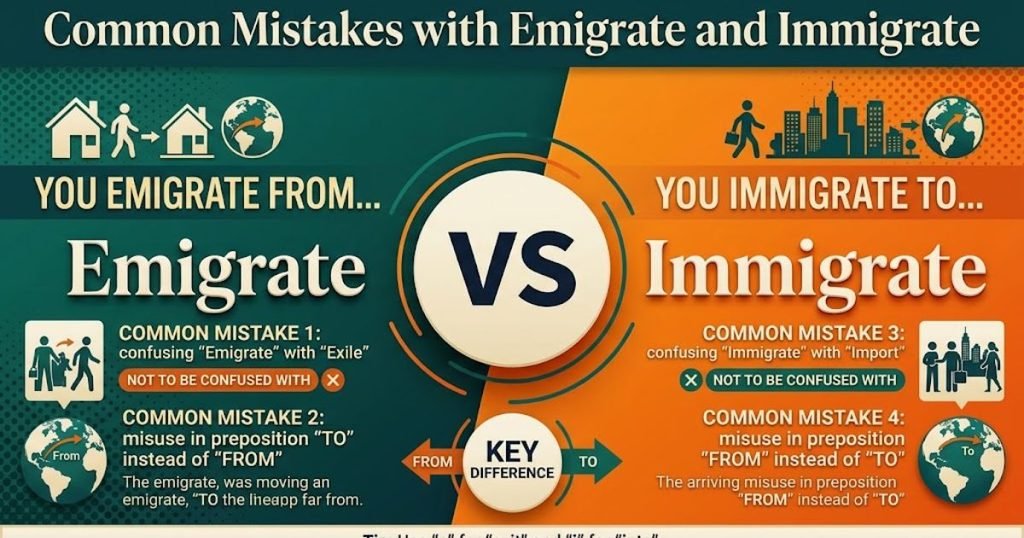
These slips are extremely common, even among fluent writers. They are worth fixing, not worrying about.
Mistake 1: Using “immigrate” for the country being left
Incorrect: He immigrated from Kenya in 2010. Correct: He emigrated from Kenya in 2010.
From points to the origin, so the verb of leaving belongs here.
Mistake 2: Assuming “emigrate to” is wrong
Incorrect assumption: “She emigrated to Spain” must be an error. Correct: She emigrated to Spain. (Also correct: She immigrated to Spain.)
Both sentences are fine. The first frames her as someone who left home. The second frames her as someone who arrived in Spain.
Mistake 3: Spelling “immigrate” with one m
Incorrect: My cousins imigrated to Ireland. Correct: My cousins immigrated to Ireland.
The double m is required. It comes from the Latin prefix and never disappears.
Mistake 4: Using either verb for moves inside one country
Incorrect: We emigrated from Ohio to Nevada. Correct: We moved from Ohio to Nevada.
Both verbs require crossing a national border.
Migrant, Emigrant, Immigrant, and Other Related Words
The noun forms follow the same directional logic as the verbs.
- Emigrant: a person who is leaving or has left their home country.
- Immigrant: a person who has come to live in a new country.
- Migrant: a person who moves from place to place, often for seasonal or temporary work.
- Emigration: the act of leaving a country to settle elsewhere.
- Immigration: the act of entering a country to settle there, and the system that governs it.
- Émigré: borrowed from French, used for someone who left their country, often for political reasons.
One person can be an emigrant and an immigrant at the same moment, described from two different vantage points. Note also that immigration dominates in official language. Countries run immigration offices, not emigration offices, because governments care most about who is coming in.
American and British English treat these words identically in spelling and meaning. The difference is frequency: American writing leans on the verb immigrate heavily, while British writing more often reaches for emigrate or a plain phrase like “moved to.”
Easy Memory Tricks So You Never Mix Them Up
Pick whichever one sticks:
- E for exit, I for in. Emigrate starts like exit. Immigrate starts like in.
- Match the prepositions. Emigrate and from both feel like leaving. Immigrate and into both start with the same sound.
- Ask where the camera is. If you are standing in the old country watching someone go, they emigrate. If you are standing in the new country watching them arrive, they immigrate.
FAQ’s
Is emigrate or immigrate correct?
Both are correct. Emigrate means to leave a country, and immigrate means to enter a country. The right choice depends on which direction your sentence emphasizes.
Can you emigrate and immigrate at the same time?
Yes. Every international move involves both. A person emigrates from one country and immigrates to another in the same journey.
What is the difference between immigrate and migrate?
Immigrate means to enter a new country to settle permanently. Migrate is broader and can describe temporary, seasonal, or repeated movement, by people or animals, sometimes within a single country.
Is it “emigrated to” or “emigrated from”?
Both are acceptable. Emigrated from names the country left behind, and emigrated to names the destination while still emphasizing the departure. You can combine them: He emigrated from Chile to Sweden.
Why does immigrate have two m’s?
The word comes from Latin immigrare, where the n of the prefix in- changed to m before migrare. The double letter has been part of the spelling ever since.
Conclusion
Emigrate and immigrate describe the same move from opposite sides of the border. Leaving is emigrating. Arriving is immigrating.
f you remember nothing else, remember this pairing: emigrate from, immigrate to. Once those two phrases feel automatic, the rest of the pair takes care of itself.

Smith Jason is an SEO expert with 2–3 years of experience, sharing grammar tips, confusing words, vocabulary and writing advice.










1 thought on “Emigrate or Immigrate: Difference, Meaning, and Correct Usage”