If you have ever paused mid sentence wondering whether you mean “monogamy” or “polygamy,” you are not alone. The two words look similar, share a Greek root pattern, and both describe marriage or relationship structures, which is exactly why people mix them up.
Here is the direct answer: monogamy means being married to or in a relationship with only one partner at a time, while polygamy means being married to more than one partner at the same time. Monogamy is the standard legal marriage structure in most Western countries, while polygamy is practiced in some cultures and religions but is illegal in many nations, including the United States.
Once you understand that single root difference, the rest of the confusion falls away. Let’s break down exactly how these words work, where they come from, and how to use them correctly.
What Does Monogamy Mean?
Monogamy is a noun that describes the practice or state of having only one spouse or romantic partner at a time. It can refer to a legal marriage or simply to a committed, exclusive relationship.
For example:
- “The couple practiced monogamy throughout their thirty year marriage.”
- “Monogamy is the legally recognized marriage structure in the United States.”
The adjective form is monogamous. Someone in a monogamous relationship has agreed, whether formally through marriage or informally through commitment, to be romantically and sexually exclusive with one person.
What Does Polygamy Mean?
Polygamy is a noun that describes the practice of having more than one spouse at the same time. It is a broader umbrella term that includes two more specific structures:
- Polygyny: one man married to multiple women.
- Polyandry: one woman married to multiple men.
The adjective form is polygamous. A polygamous marriage or society is one in which multiple spouses are legally or culturally recognized at once.
Monogamy vs Polygamy: The Core Difference
The core difference comes down to the number of spouses or partners involved at one time, not the number of relationships someone has across their lifetime.
| Term | Meaning | Number of Spouses | Common Legal Status |
| Monogamy | One partner at a time | One | Legal in most countries |
| Polygamy | Multiple partners at the same time | Two or more | Illegal in most Western countries, legal or culturally accepted in parts of Africa, the Middle East, and Asia |
| Polygyny | One husband, multiple wives | Three or more people total | Practiced in some regions under specific religious or cultural systems |
| Polyandry | One wife, multiple husbands | Three or more people total | Rare, practiced in a small number of communities |
Neither monogamy nor polygamy is a misspelling or an incorrect word. Both are legitimate, dictionary recognized English terms. The confusion between them is conceptual rather than grammatical: readers mix up which one refers to “one” and which refers to “many.”
Read Related Post: Extended vs Immediate Family: What Is the Difference?
Grammar Breakdown: Part of Speech, Spelling, and Forms
Both words follow a predictable pattern in English, which makes them easier to remember once you see the structure.
Monogamy
- Part of speech: noun
- Adjective form: monogamous
- Adverb form: monogamously
- Plural: monogamy is typically used as an uncountable noun, so it does not take a plural form in standard usage
Polygamy
- Part of speech: noun
- Adjective form: polygamous
- Adverb form: polygamously
- Plural: also treated as uncountable in most contexts
Neither word has an irregular spelling pattern once you notice the prefix difference. The “mono” and “poly” prefixes carry the meaning, and the “gamy” root stays constant.
Where Do These Words Come From?
Both terms come from Greek roots, and understanding the prefixes makes the meaning almost self explanatory.
- Mono comes from the Greek word for “one” or “single.”
- Poly comes from the Greek word for “many” or “several.”
- Gamos comes from the Greek word for “marriage.”
So monogamy literally breaks down to “one marriage” and polygamy breaks down to “many marriages.” This same “gamos” root appears in related English words like bigamy (two marriages) and exogamy (marriage outside a specific group).
How to Pronounce Monogamy and Polygamy
Pronunciation trips up a lot of English learners because the stress falls on the second syllable in both words, not the first.
- Monogamy: muh-NOG-uh-mee
- Polygamy: puh-LIG-uh-mee
Notice that the “g” sound stays soft in both, and the ending “-amy” rhymes with “family” in cadence, not in sound.
Correct Usage in Everyday Sentences
Here is how native US English speakers actually use these words across different contexts.
Everyday conversation “They chose monogamy because it fit their values as a couple.”
Academic writing “Anthropologists have documented societies that practice both monogamy and polygamy, often shaped by economic and religious factors.”
Workplace or professional writing This topic rarely appears in workplace communication, but it can surface in HR policy discussions or academic research summaries: “The report on marriage structures across cultures compared rates of monogamy and polygamy in the surveyed regions.”
Formal or legal writing “Polygamy remains illegal under US federal law, while monogamy is the only legally recognized marital structure.”
Casual writing “Honestly, monogamy just makes more sense to me, but I get why other cultures see it differently.”
Each of these sentences uses the noun form directly. If you want to describe a person or relationship rather than the practice itself, switch to the adjective form: “a monogamous couple” or “a polygamous household.”
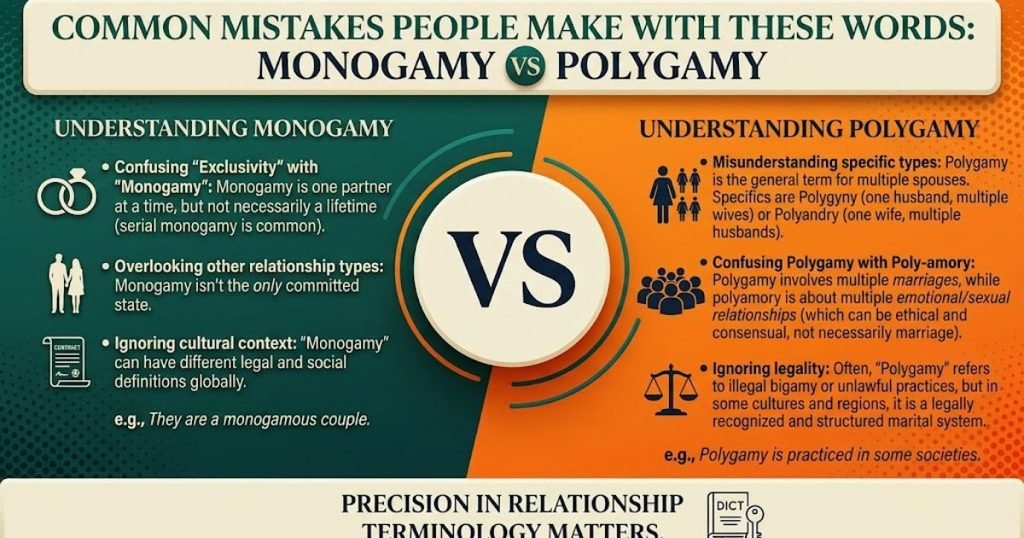
Common Mistakes People Make With These Words
Mistake 1
Incorrect: “They live in a monogamy relationship.” Correct: “They live in a monogamous relationship.”
Monogamy is the noun. When describing a relationship, marriage, or person, you need the adjective form, monogamous.
Mistake 2
Incorrect: “Polygamy people believe in multiple marriage.” Correct: “People who practice polygamy believe in marriage to multiple spouses.”
Polygamy cannot directly modify a noun like “people.” Use a phrase such as “people who practice polygamy” or the adjective “polygamous.”
Mistake 3
Incorrect: “He is a polygamy husband.” Correct: “He is a polygamous husband.”
Again, this mixes up the noun and adjective forms. A simple test: if the word comes right before a noun to describe it, you need the “-ous” adjective ending.
Mistake 4
Incorrect: Using “polygamy” and “polyamory” interchangeably. Correct: These are different concepts. Polygamy refers specifically to multiple marriages, usually within a religious or legal framework. Polyamory refers to having multiple consensual romantic relationships, which may or may not involve marriage or legal recognition.
Related Terms Worth Knowing
Understanding a few neighboring terms will help you talk about relationship structures with more precision.
- Bigamy: being legally married to two people at the same time, typically without the second marriage being legally recognized. This is illegal in most countries, including the US.
- Polyandry: a form of polygamy where one woman has multiple husbands.
- Polygyny: a form of polygamy where one man has multiple wives.
- Polyamory: consensual, non marital relationships with multiple partners, distinct from legally structured polygamy.
- Serial monogamy: having monogamous relationships one after another over time, rather than being in one relationship for life.
Practical Guidance: Which Word Should You Use?
Ask yourself what you are actually describing:
- If you are talking about a marriage or relationship structure involving exactly one partner at a time, use monogamy (noun) or monogamous (adjective).
- If you are talking about a marriage structure involving more than one spouse at the same time, use polygamy (noun) or polygamous (adjective).
- If you need to specify the gender pattern of a polygamous relationship, use polygyny for multiple wives or polyandry for multiple husbands.
- If the relationships are consensual but not legally structured as marriage, consider whether polyamory is the more accurate term.
FAQ’s
Is polygamy legal in the United States?
No. Polygamy is illegal under US federal and state law, though informal polygamous living arrangements exist in some communities without full legal marriage recognition for all partners.
What is the opposite of monogamy?
The direct opposite is polygamy, since monogamy refers to one partner and polygamy refers to multiple partners at once.
Is monogamy the same as being faithful?
Not exactly. Monogamy describes the relationship structure itself, meaning one partner at a time. Faithfulness, or fidelity, describes whether someone honors the exclusivity that monogamy requires. A person can be in a monogamous relationship and still be unfaithful.
How do you use “polygamous” in a sentence?
You can write: “The documentary followed a polygamous family living in a rural community.” Here, “polygamous” describes the family structure directly.
Is polygamy the same as polyamory?
No. Polygamy specifically refers to multiple marriages, often within religious or cultural systems. Polyamory refers to having multiple consensual romantic relationships without necessarily involving marriage.
Conclusion
The simplest way to remember the difference: mono means one, poly means many, and gamy points back to marriage. Monogamy describes a single exclusive partnership, while polygamy describes a marriage involving more than one spouse at the same time. Keep that root pattern in mind, and you will never mix these two words up again.

Smith Jason is an SEO expert with 2–3 years of experience, sharing grammar tips, confusing words, vocabulary and writing advice.









1 thought on “Monogamy vs Polygamy: Meaning, Differences, and Examples”