Have you ever paused mid-sentence, fingers hovering over the keyboard, wondering if it’s “tying” or “tieing”? You’re not imagining things. The word breaks a spelling pattern you probably learned in school, and that’s exactly why it trips people up.
Here’s the short version: “tying” is the correct spelling. “Tieing” is never correct in standard English.
The Quick Answer: Tying Is Correct
“Tying” is the only correct spelling of the present participle and gerund form of the verb “tie.” It means the act of fastening, securing, or connecting something, or reaching an equal score or result.
“Tieing” is a common misspelling that does not appear in dictionaries or accepted writing standards. If you remember one rule from this article, remember this: drop the silent e in “tie” before adding -ing.
What Does “Tying” Mean?
“Tying” is the present participle and gerund form of the verb “tie.” Depending on context, it can mean:
- Fastening something with a knot or bow, such as tying shoelaces.
- Securing two or more things together, such as tying a boat to a dock.
- Connecting or linking ideas, such as tying a conclusion back to an introduction.
- Reaching the same score or result as someone else, such as two runners tying for first place.
In every case, the spelling stays the same. Context changes the meaning, not the letters.
Why “Tieing” Feels Right (And Why It’s Wrong)
Most English learners are taught a simple habit: keep the base word intact and just add the ending. That works for words like “seeing” or “agreeing.” So it feels natural to assume “tie” plus “-ing” should be “tieing.”
The problem is that English has a separate rule for short words ending in a silent e, and “tie” falls into a special category of words ending in -ie. Instead of just adding the suffix, the spelling changes the ie to a y first. That one small shift is where the confusion starts, and it’s also the entire answer to this whole question.
Read Related Post: Studying vs Studing: Which Spelling Is Correct? Easy Rule.
The Spelling Rule: Dropping the Silent E Before -ing
Here is the actual rule, stated plainly:
For verbs ending in -ie, change the ie to y before adding -ing.
So “tie” becomes “tying.” “Lie” becomes “lying.” “Die” becomes “dying.” This is a recognized, consistent pattern in English spelling, not an exception invented for this one word.
Compare that to typical silent e verbs, where you simply drop the final e:
- “Make” becomes “making.”
- “Write” becomes “writing.”
“Tie” does not follow that simpler pattern because it ends in ie, not a single silent e after a consonant. That distinction is exactly why “tieing” looks logical but isn’t.
Where the Word “Tie” Comes From
The word “tie” comes from the Old English word tēag or tēah, related to a cord or rope used for fastening. Over centuries, English spelling shifted and simplified, eventually settling on the modern four letter form “tie.”
The -ing ending itself comes from Old English -ung and -ende, which were used to form nouns and participles from verbs. When these two older patterns combined with short -ie verbs like “tie,” “lie,” and “die,” English speakers standardized the y substitution to keep the words easier to read and pronounce. That standardization is why “tying” has remained fixed for a very long time.
How to Pronounce “Tying”
“Tying” is pronounced TY-ing, rhyming with the word “trying.” The stress falls on the first syllable, and the y takes on a long i sound, exactly like the word “tie” itself.
There is no pronunciation difference between “tying” (correct) and the misspelled “tieing,” since the misspelling doesn’t reflect an actual alternate pronunciation. It’s purely a written error.
Tying vs Tieing: Quick Comparison
| Term | Correct? | Meaning | Use |
| Tying | Yes | Fastening, securing, or matching a score | Standard spelling in all contexts |
| Tieing | No | Not a recognized word | Common misspelling, avoid in all writing |
There is no formal or informal context, American or British, where “tieing” is considered acceptable.
How to Use “Tying” in a Sentence
“Tying” functions as a verb (in continuous tenses) or a gerund (acting like a noun). Here’s how that plays out:
- As part of a continuous verb tense: “She is tying her shoes before the race.”
- As a gerund: “Tying knots is a useful skill for sailors.”
Both uses are grammatically correct and common in everyday American English.
Real Life Examples of “Tying” in Context
Everyday conversation: “Can you help me with tying this bow? I always mess it up.”
Workplace communication: “We’re tying the new marketing plan to last quarter’s sales data.” This works because “tying” here means connecting two ideas, a common use in business writing.
Academic writing: “The researcher spent the final paragraph tying her findings back to the original hypothesis.”
Emails: “I’m tying up a few loose ends on the report and will send it by Friday.”
Formal writing: “The committee is tying future funding decisions to measurable outcomes.”
Casual writing: “We ended up tying for the high score in the game.” This example shows the “equal result” meaning, distinct from the fastening meaning, though the spelling never changes.
Common Mistakes With “Tying” and “Tieing”
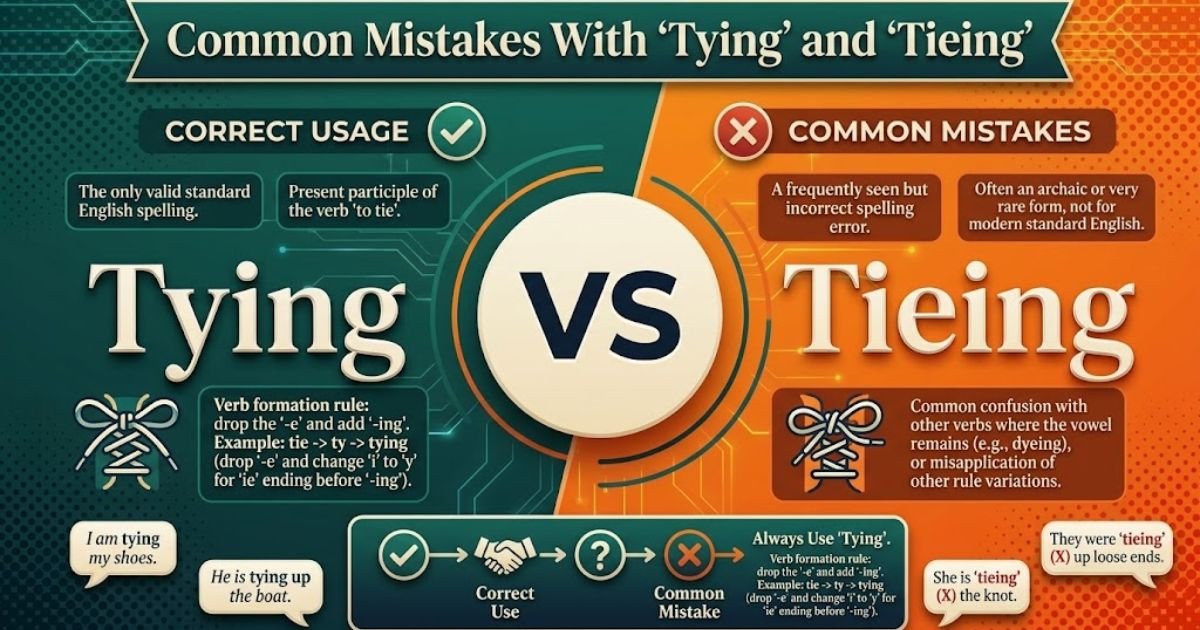
Incorrect: She is tieing her hair back before the interview. Correct: She is tying her hair back before the interview. The verb “tie” drops the e and swaps ie for y before adding -ing, so “tieing” is never correct.
Incorrect: The two teams ended up tieing in the final round. Correct: The two teams ended up tying in the final round. This mistake often happens because writers assume the base spelling of “tie” should stay untouched, but the -ing rule overrides that instinct.
Incorrect: He’s tieing the boat to the dock. Correct: He’s tying the boat to the dock. Even in casual or quickly typed messages, autocorrect on most devices will flag “tieing,” which is a useful signal that the spelling is wrong.
Related Words: Tied, Ties, and Tie-Breaker
Understanding related forms of “tie” makes the whole pattern easier to remember:
- Tie (base verb or noun): “Tie your shoes.” / “He wore a blue tie.”
- Tied (past tense): “They tied the score in the last minute.”
- Ties (present tense, third person singular, or plural noun): “She ties her hair up every morning.” / “He owns several ties.”
- Tying (present participle or gerund): covered throughout this article.
- Tie-breaker (noun): a deciding round or question used when scores are equal.
Notice that only the -ing form requires the ie to y change. “Tied” and “ties” both keep the standard spelling of “tie” without alteration.
A Simple Trick to Never Misspell It Again
If you want a quick mental shortcut, remember this: “tie” plus “-ing” always becomes “tying,” never “tieing.”
You can also link it to two other common words that follow the exact same rule: “lie” becomes “lying,” and “die” becomes “dying.” If you already spell those two correctly, you already know the rule for “tying” too.
FAQ’s
Is “tieing” ever correct?
No. “Tieing” is not a recognized spelling in any standard or dictionary form of English.
What does “tying” mean?
“Tying” means fastening or securing something, connecting related ideas, or reaching an equal score or outcome with someone else.
How do I use “tying” in a sentence?
Use it as part of a continuous verb tense or as a gerund, such as “He is tying his shoelaces” or “Tying the ribbon took practice.”
Why does “tie” change to “tying” instead of “tieing”?
Because verbs ending in -ie replace the ie with y before adding -ing, matching the same pattern found in “lie” to “lying” and “die” to “dying.”
Is there a British English difference for “tying”?
No. American and British English both use “tying” as the only correct spelling.
Conclusion
The next time you’re fastening a shoelace, wrapping up a report, or describing a game that ended in a draw, you can write “tying” with full confidence. One rule covers it every time: drop the ie, add a y, then add -ing.

Smith Jason is an SEO expert with 2–3 years of experience, sharing grammar tips, confusing words, vocabulary and writing advice.










1 thought on “Tying or Tieing? The Right Way to Spell It”