
If you have ever paused mid sentence wondering whether it is “studying” or “studing,” you are not alone. This mix up happens because English spelling rules for adding “-ing” are not always obvious. Here is the short answer: “studying” is the only correct spelling. “Studing” is not a real word.
The Quick Answer: Studying Is Correct, Studing Is Not
“Studying” is the correct spelling in every context. It is the present participle and gerund form of the verb “study.” “Studing” is a common misspelling that results from dropping a letter, and it has no meaning or accepted use in English, whether in casual writing, academic work, or professional communication.
If you remember nothing else from this article, remember this: study becomes studying, never studing.
Why Do People Misspell Studying as Studing?
The confusion usually comes from how the word sounds when spoken quickly. In casual speech, “studying” can sound like it only has two syllables instead of three, which nudges some writers toward dropping the “y” before adding “-ing.”
Another reason is pattern confusion with other verbs. Words like “die” become “dying,” and “tie” becomes “tying,” so some learners assume every “y” ending word drops a letter before “-ing.” Study does not follow that pattern, and that is exactly where the mistake happens.
What Does Studying Mean?
Studying means the act of applying your mind to learning something, usually through reading, practicing, reviewing, or researching. It can refer to:
- Reading textbooks or notes to prepare for an exam
- Researching a topic in depth
- Practicing a skill with focused attention
- Analyzing something carefully to understand it
For example, a student studying for a chemistry test is reviewing material to understand and remember it.
Studying: Grammar Breakdown
Understanding the grammar behind “studying” makes the spelling rule much easier to remember.
Part of speech: “Studying” functions as either a present participle (used in verb tenses) or a gerund (used as a noun).
Base verb: study
Verb type: Regular verb, but with a spelling change when adding “-ing”
Here are the full verb forms for reference:
| Form | Word |
| Base form | study |
| Present participle / Gerund | studying |
| Past tense | studied |
| Past participle | studied |
| Third person singular | studies |
Notice that “studying” keeps the “y” from “study,” while “studied” changes the “y” to “i” before adding “-ed.” These are two different spelling rules, and mixing them up is another common source of errors.
Read Related Post: 13rd vs 13th: Which Is Correct? Simple Grammar Rule
The Spelling Rule: Why Studying Keeps the Y
English has a general spelling rule for verbs ending in a consonant plus “y”: when adding “-ing,” the “y” stays exactly as it is. You only change or drop the “y” when adding suffixes like “-ed” or “-es.”
This is different from suffixes like “-ed,” where the “y” often changes to “i” (study becomes studied, try becomes tried). The “-ing” suffix is an exception to that pattern because English avoids placing two vowels together in a way that would create an awkward or unreadable spelling.
So the rule for “-ing” endings is simple: keep the “y,” then add “-ing.” Study plus ing equals studying, no letters dropped, no letters changed.
Studying vs Studing: Side by Side Comparison
| Term | Correct? | Meaning | Use |
| Studying | Yes | Actively learning or reviewing material | Standard word for describing the act of studying, in any tense or context |
| Studing | No | No accepted meaning | Never correct; typically a misspelling of “studying” |
How to Pronounce Studying Correctly
“Studying” is pronounced as three syllables: STUD-ee-ing (/ˈstʌd.i.ɪŋ/). Saying it slowly can help reinforce the correct spelling, since the missing syllable in “studing” is one clue that something is off.
If you tend to misspell the word, try sounding out each syllable separately before you write it: stud, dy, ing.
Studying in a Sentence: Real Examples
Seeing “studying” used naturally in different settings makes it easier to remember the correct form.
Everyday conversation: “I can’t hang out tonight, I’m studying for my driving test.”
Academic writing: “The research paper focuses on students studying abroad and how it affects their language skills.”
Workplace communication: “She spent the weekend studying the quarterly reports before the meeting.”
Email: “Thanks for the notes. I’ll be studying them closely before Thursday’s presentation.”
Formal writing: “Studying historical patterns allows economists to make more informed predictions.”
Casual writing: “He’s been studying French on his phone for a month now.”
Each of these sentences uses “studying” as either a gerund (acting like a noun, as in “studying abroad”) or a present participle (part of a verb tense, as in “she spent the weekend studying”).
Common Mistakes People Make With This Word
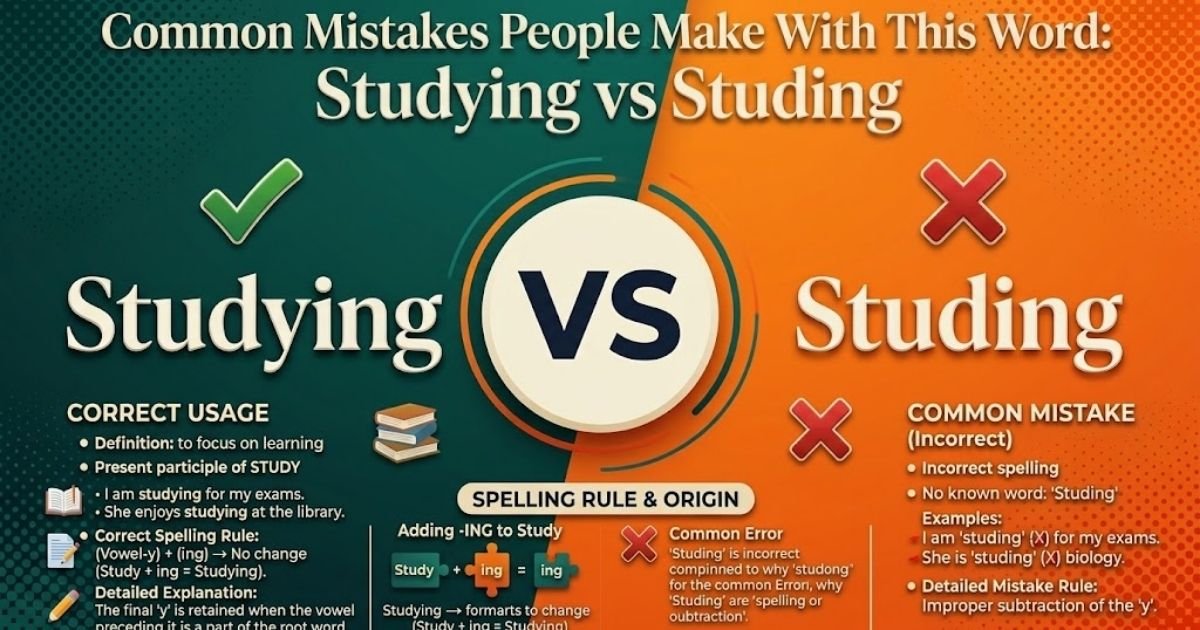
Incorrect: I am studing for my exam tomorrow. Correct: I am studying for my exam tomorrow. Explanation: This is a straightforward misspelling caused by dropping the “y” before “-ing.” Study keeps its “y” in this form.
Incorrect: She has been studing English for two years. Correct: She has been studying English for two years. Explanation: The present perfect continuous tense requires “studying,” not “studing,” since there is no verb form called “study” that drops the “y” for “-ing.”
Incorrect: He studyed all night before the test. Correct: He studied all night before the test. Explanation: This mistake goes the other direction. Some writers keep the “y” for the past tense instead of changing it to “i.” Remember, “-ing” keeps the “y,” but “-ed” changes it.
Mixing these two rules up is extremely common, so if you have made this mistake before, you are in good company.
Related Words and Forms
Understanding a few related words can reinforce correct spelling habits:
- Study (base verb and noun)
- Studied (past tense and past participle)
- Studies (third person singular verb, or plural noun)
- Studious (adjective describing someone devoted to studying)
- Student (a person who studies)
- Research (a related activity, though more formal and investigative)
None of these words drop the “y” before “-ing,” since “studying” is the only “-ing” form in this group.
Is There Ever a Case Where Studing Is Acceptable?
No. “Studing” has no recognized use in standard American or British English. It does not appear in dictionaries, style guides, or accepted usage references. If you see it in writing, it is almost always a typo or spelling error, not an alternate form of the word.
Quick Tips to Avoid This Mistake
- Say the word out loud before writing it: STUD-ee-ing has three syllables.
- Remember that “-ing” keeps the “y” in words ending with a consonant plus “y.”
- Double check autocorrect, since some tools do not catch this specific error.
- If you are unsure, picture the base word “study” first, then simply add “ing” without removing anything.
FAQ’s
Is “studing” a word?
No. “Studing” is not a recognized English word. It is a misspelling of “studying.”
What is the correct way to spell studying?
The correct spelling is studying, with the “y” from “study” kept in place before adding “-ing.”
Why doesn’t studying drop the Y like other words ending in Y?
English keeps the “y” before “-ing” for verbs ending in a consonant plus “y.” The “y” only changes or drops before suffixes like “-ed” or “-es,” not “-ing.”
How do you use “studying” in a sentence?
Use it to describe the ongoing act of learning, for example: “I am studying for my final exams this week.”
Is “studying” a noun or a verb?
It can function as both. As a gerund, it acts like a noun (“Studying is essential for success”). As a present participle, it functions as part of a verb phrase (“I am studying tonight”).
Conclusion
“Studying” is always correct, and “studing” is always wrong. The rule is simple: keep the “y” from “study” and add “-ing,” no letters dropped. Once you associate the correct three syllable pronunciation with the spelling, this mistake becomes easy to avoid for good.

Smith Jason is an SEO expert with 2–3 years of experience, sharing grammar tips, confusing words, vocabulary and writing advice.










1 thought on “Studying vs Studing: Which Spelling Is Correct? Easy Rule.”