If you have ever paused mid sentence and wondered whether it is “writing” or “writting,” you are not alone. This mix up happens because of a small spelling rule that trips up even confident English speakers. Here is the short answer: “writing” is the correct spelling. “Writting” is not a real word in English, no matter how it looks or sounds.
The Quick Answer: Which Spelling Is Correct
“Writing” is always correct. It is the present participle and gerund form of the verb “write,” and it appears in dictionaries, textbooks, and every reputable style guide. “Writting” with a double T is a common misspelling, not an alternate or informal version. If you remember one thing from this article, remember that “writing” only has one T.
What “Writing” Actually Means
“Writing” refers to the act of forming letters, words, or symbols to communicate, or to the activity of composing text such as stories, emails, or reports. It can function as a verb (“She is writing a novel”) or as a noun (“Her writing is clear and direct”). Because it describes both an action and a skill, you will see it constantly in everyday, academic, and professional contexts.
Why People Misspell It as “Writting”
The confusion usually comes from a spelling pattern called consonant doubling. In many English verbs, you double the final consonant before adding “-ing,” such as “run” becoming “running” or “stop” becoming “stopping.” Writers sometimes apply that same rule to “write” out of habit, which produces the incorrect “writting.” The rule does not apply here because “write” ends in a silent “e,” and that changes how the suffix is added.
The Grammar Rule Behind the Spelling
English has a reliable pattern for words ending in a silent “e.” When you add “-ing” to a verb like “write,” you drop the final “e” and add the suffix directly, giving you “writing.” You do not double the “t” because the silent “e” already signals that the preceding vowel is long, so no extra consonant is needed to protect the pronunciation.
Compare that to short vowel verbs like “sit” or “run,” which have no silent “e” at the end. Those verbs double their final consonant to keep the vowel sound short: “sitting,” “running.” “Write” follows a completely different pattern, which is exactly why “writting” feels tempting but is still wrong.
Part of Speech and Sentence Roles
“Writing” can serve two grammatical roles, and understanding both helps you use it with confidence.
- As a present participle, it pairs with a form of “to be” to show ongoing action: “I am writing a letter.”
- As a gerund, it acts like a noun and can be the subject or object of a sentence: “Writing takes practice.”
There is no plural form of “writing” when it refers to the general activity, though “writings” can refer to a collection of written works, such as “the writings of a historical author.”
Read Related Post: Tying or Tieing? The Right Way to Spell It
Pronunciation Guide
“Writing” is pronounced WRY-ting, with two syllables and a soft “t” sound that often comes across like a quick “d” in casual American speech. This is a normal feature of US English pronunciation, not a spelling clue, so do not let the way it sounds convince you to add an extra letter.
Where the Word Comes From
“Writing” traces back to the Old English verb “writan,” which originally meant to scratch or carve marks, reflecting how early writing was etched into surfaces like wood or stone. Over centuries, the meaning shifted from physical carving to the broader concept of recording language, and the modern spelling “write” developed through Middle English. The “-ing” suffix itself is a native English ending used to form participles and gerunds, and it attached to “write” the same way it attaches to most other English verbs.
Writing vs Writting at a Glance
| Term | Correct? | Meaning | Use |
| Writing | Yes | The act of composing text or forming written language | Standard verb and noun form in all contexts |
| Writting | No | Not a recognized English word | Common misspelling; always replace with “writing” |
Real Life Examples of Correct Usage
Everyday conversation: “I love writing in my journal before bed.”
Workplace communication: “Please finish writing the report before Friday’s meeting.”
Academic writing: “Writing a thesis requires careful planning and research.”
Email: “I’m writing to follow up on our conversation from last week.”
Business writing: “Clear writing helps clients understand our proposals quickly.”
Casual writing: “She’s always writing little notes to herself.”
Each example uses “writing” as either a participle describing ongoing action or a gerund acting as a noun, and in every case the single “t” spelling is correct regardless of tone or formality.
Common Mistakes and How to Fix Them
Incorrect: I am writting a new chapter tonight. Correct: I am writing a new chapter tonight. The verb “write” drops its silent “e” before “-ing,” so no letter is doubled.
Incorrect: Her writting improved a lot this year. Correct: Her writing improved a lot this year. Even as a noun describing skill or output, the spelling never changes to a double “t.”
Incorrect: Thank you for writting back so quickly. Correct: Thank you for writing back so quickly. This mistake often shows up in emails and messages where people type quickly and rely on muscle memory from other “-ing” verbs.
Related Words and Forms
Understanding related terms can reinforce the correct spelling and expand how you use the word.
- Write: the base verb, as in “I write every morning.”
- Wrote: the simple past tense, as in “I wrote a letter yesterday.”
- Written: the past participle, as in “I have written three drafts.”
- Writer: a person who writes, especially professionally.
- Rewriting: revising a piece of writing, which follows the same silent “e” dropping rule.
Notice that none of these related forms ever double the “t,” which confirms that “writting” does not fit anywhere in the word family.
American English vs British English: “Writing” or “Writting”
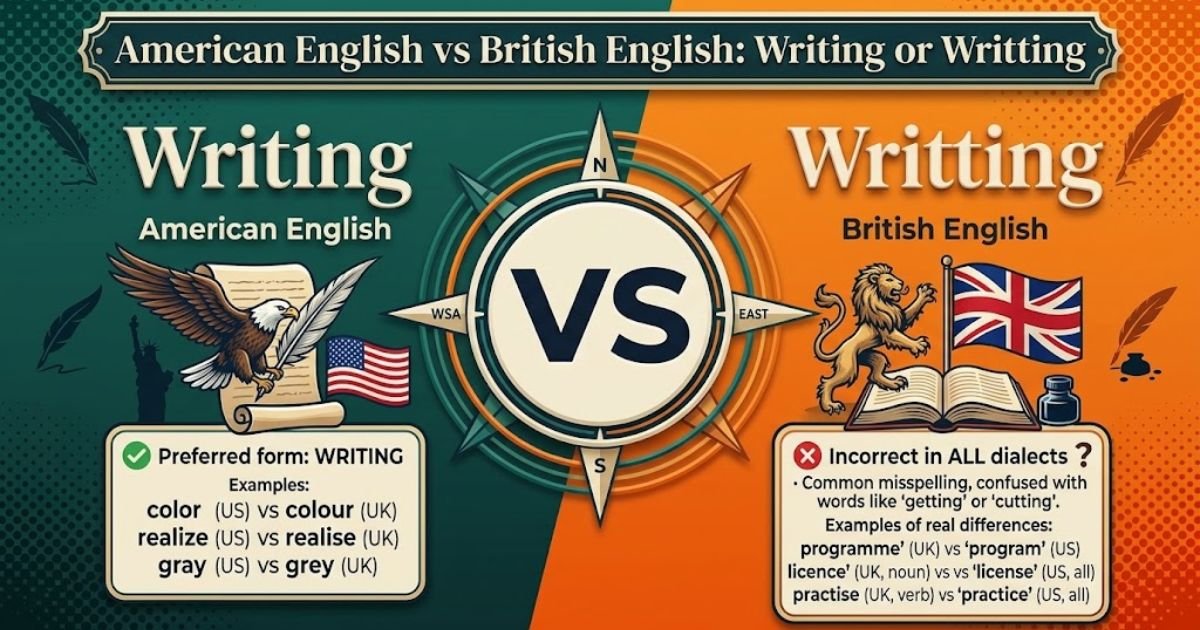
There is no difference between American and British English when it comes to this spelling. Both varieties use “writing” with a single “t,” so this is not a regional spelling variant like “color” versus “colour.” If you see “writting” anywhere, it is simply an error, not a British alternative.
Practical Tips to Avoid the Mistake
A few habits can help you avoid this misspelling permanently.
- Remember the rule: silent “e” verbs drop the “e” and do not double the final consonant.
- Say the word slowly and picture the base verb “write” losing only its final “e.”
- Use spell check, but do not rely on it completely, since some autocorrect tools miss context specific errors.
- Practice with similar words like “riding” from “ride” or “hoping” from “hope,” which follow the identical pattern.
FAQ’s
Is “writting” ever correct?
No. “Writting” is not a recognized spelling in any dictionary or standard English usage. It should always be corrected to “writing.”
What does “writing” mean?
“Writing” means the act of forming words to communicate, or the resulting text itself, such as an essay, letter, or story.
How do I use “writing” in a sentence?
Use it after “is,” “am,” or “are” to show ongoing action, as in “I am writing an email,” or as a subject or object, as in “Writing helps me think clearly.”
Why do people add an extra “t” to “writing”?
People often apply the consonant doubling rule from short vowel verbs like “run” or “sit,” but “write” ends in a silent “e” and follows a different spelling pattern.
Is “writing” a noun or a verb?
It can be both. As a verb form, it shows ongoing action (“She is writing”). As a noun, it refers to the activity or its result (“Good writing takes revision”).
Conclusion
“Writing” is the only correct spelling, and “writting” is simply a spelling slip caused by mixing up two different English suffix rules. Once you remember that “write” drops its silent “e” instead of doubling its final letter, you will never second guess this word again.

Smith Jason is an SEO expert with 2–3 years of experience, sharing grammar tips, confusing words, vocabulary and writing advice.










1 thought on “Writing or Writting: Never Get Confused Again”