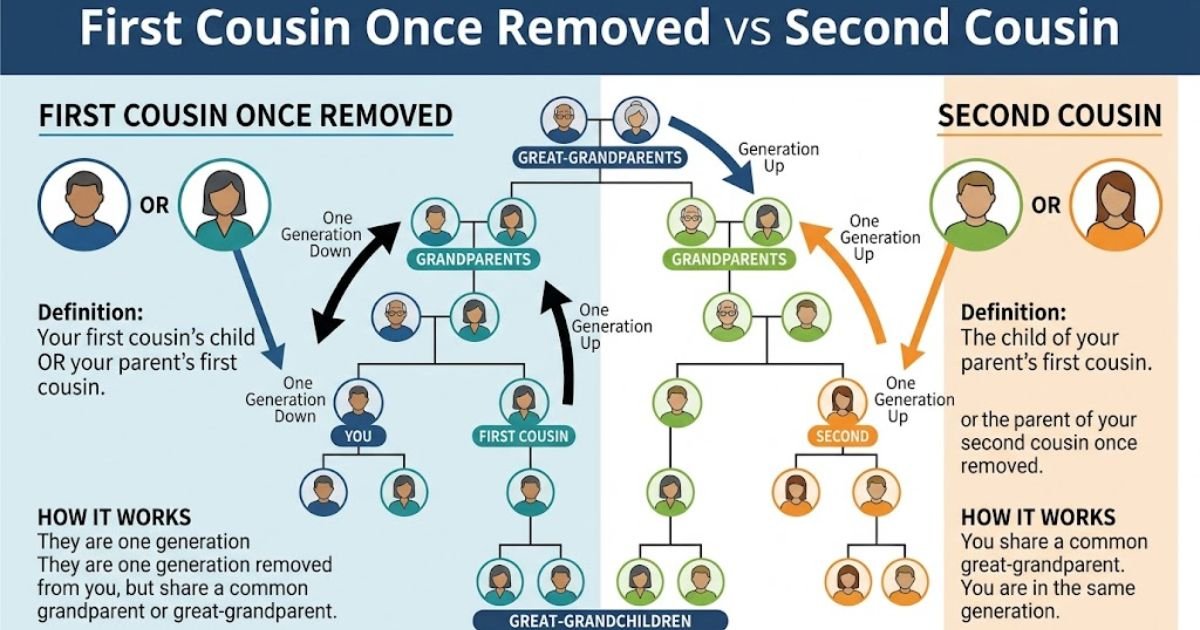
Family trees get confusing fast, and few labels cause more mix-ups than these two. You hear “second cousin” at a reunion, someone else says “once removed,” and suddenly nobody is sure who is related to whom. The confusion happens because both terms describe distant cousins, but they measure the relationship in completely different ways.
The short answer: a second cousin is someone in your own generation who shares a great-grandparent with you, while a first cousin once removed is someone who shares a grandparent’s line with you but is one generation apart, such as your parent’s first cousin or your first cousin’s child.
Once you separate those two ideas (same generation vs. different generation) the whole system becomes much easier to map out.
What Does “Second Cousin” Mean?
A second cousin is a blood relative who shares a great-grandparent with you, but not a grandparent. You and your second cousin are the same number of generations removed from that shared ancestor, which is why you’re both called “cousins” without any extra qualifier.
Think of it as a matching pattern:
- First cousins share a grandparent.
- Second cousins share a great-grandparent.
- Third cousins share a great-great-grandparent.
Each step back adds one “great” to the ancestor and moves the relationship out by one cousin level. Second cousins are always in the same generation as each other, meaning they’re typically close in age and sit at the same level of the family tree.
What Does “First Cousin Once Removed” Mean?
A first cousin once removed is a relative who is connected to you through a first cousin relationship, but across a generation gap. The word removed signals that gap. It does not mean the person is distant emotionally; it’s a technical term for a generational difference.
There are two common ways this relationship happens:
- Your parent’s first cousin is your first cousin once removed.
- Your first cousin’s child is your first cousin once removed.
In both cases, the “first cousin” part of the relationship exists somewhere in the family line, but one person belongs to an older or younger generation than the other.
The Core Difference, Side by Side
The real distinction between these two terms comes down to generation versus ancestor distance. Second cousin describes how far back your shared ancestor is. Once removed describes how far apart your generations are.
| Term | Shared Ancestor | Same Generation? | Example |
| First cousin | Grandparent | Yes | Your aunt’s child |
| Second cousin | Great-grandparent | Yes | Your grandparent’s sibling’s grandchild |
| First cousin once removed | Grandparent (through a first cousin) | No, one generation apart | Your first cousin’s child, or your parent’s first cousin |
| Second cousin once removed | Great-grandparent (through a second cousin) | No, one generation apart | Your second cousin’s child |
Notice that “removed” can attach to any cousin level. It’s not exclusive to first cousins. You can have a third cousin twice removed or a second cousin once removed. The number before “cousin” tracks the ancestor distance, and the number before “removed” tracks the generation gap.
Read Related Post: Treck or Trek: Correct Word, Meaning, and Easy Examples
Grammar and Word Formation
Both phrases are noun phrases, and both function as kinship terms rather than standard adjectives, so they follow their own set of conventions.
“Cousin” is a countable noun. It pluralizes normally: cousins, second cousins, first cousins once removed. Notice that when you pluralize a “removed” phrase, the “s” goes on “cousin,” not on “removed”: first cousins once removed is correct, not first cousin once removeds.
“Once removed” functions as a postpositive modifier, meaning it comes after the noun it modifies instead of before it, similar to “attorney general” or “notary public.” You would never write “once removed first cousin.”
“Removed” here is a past participle used in an idiomatic, specialized sense. It doesn’t mean taken away; it means shifted or separated by a generation. This usage dates back centuries in English genealogical writing and has no everyday equivalent outside family relationship terms.
For higher numbers, use ordinal words for the cousin level (first, second, third) and cardinal-style adverbs for the removal (once, twice, three times removed). So you’d write “third cousin twice removed,” never “third cousin second removed.”
Where Does “Removed” Come From?
The genealogical use of “removed” traces back to English legal and heraldic writing from the 1500s, where it described a step or degree of separation in a lineage, similar to how “remove” was used to describe moving a rank or position in old English usage. Over time this specialized sense settled into family-tree vocabulary and stayed largely unchanged, which is part of why it can sound old-fashioned or confusing to modern ears.
How to Pronounce Both Terms
Neither phrase has unusual pronunciation, but people sometimes stumble over stress and rhythm.
- Second cousin: SEK-uhnd KUZ-in. Stress falls on the first syllable of each word.
- First cousin once removed: FURST KUZ-in wuns ri-MOOVD. “Removed” is pronounced with two syllables, ri-MOOVD, not REE-moovd.
There’s no British versus American difference in pronunciation here. Both phrases are used and pronounced the same way in US and UK English, though the underlying counting system (sometimes called “civil law” cousin counting) is shared across both varieties.
Correct Usage in Real Sentences
Here’s how native English speakers actually use these terms in different contexts.
Everyday conversation “My second cousin and I ended up at the same summer camp without even realizing we were related.”
Workplace communication “I should mention that the new hire is my first cousin once removed, so I recused myself from the interview panel.”
Academic or historical writing “Genealogists tracing the family estate found that the two branches reconnected through a marriage between second cousins in 1861.”
Casual texting “Turns out that guy from the wedding is my first cousin once removed lol, small world.”
Formal introductions “I’d like you to meet my first cousin once removed, who flew in from overseas for the reunion.”
In each case, the phrase functions as a noun describing the relationship, and it slots into a sentence the same way “brother” or “neighbor” would.
Common Mistakes People Make
Incorrect: “She’s my first cousin removed.” Correct: “She’s my first cousin once removed.” The number of times removed (once, twice, three times) is required. Leaving it out makes the relationship unclear.
Incorrect: “He’s my second cousin once removed because our grandparents were siblings.” Correct: “He’s my first cousin once removed because our grandparents were siblings.” If your shared ancestor is a grandparent (through a sibling of your grandparent), the relationship runs through the first cousin line, not the second cousin line.
Incorrect: “We’re second cousins” (when the ancestor connection is actually a great-great-grandparent). Correct: “We’re third cousins.” People often round distant relationships down to “second cousin” as a catch-all term, but the label should match the actual shared ancestor.
Incorrect: “My once removed cousin.” Correct: “My first cousin once removed.” “Once removed” cannot stand alone or move in front of the noun; it needs the cousin number attached and stays after “cousin.”
Related Family Terms Worth Knowing
A few nearby terms come up often once you’re comfortable with these two:
- First cousin: shares a grandparent, same generation.
- Double cousin: cousins related through both parents’ sides, not just one.
- Cousin-german: an older, mostly historical term for a first cousin.
- Kissing cousin: an informal American phrase for any distant relative you know well enough to greet warmly, not a precise genealogical term.
- Removed cousin: not standard phrasing; the correct form always states the number of times removed.
A Simple Way to Figure Out Any Cousin Relationship
If you ever need to work out a cousin relationship on the spot, this two-step approach works for any degree:
- Find the closest common ancestor shared by both people, and count how many generations each person is from that ancestor.
- The smaller number minus one gives you the cousin degree (first, second, third). The difference between the two numbers gives you how many times removed.
For example, if you’re three generations from a shared ancestor and your relative is four generations from that same ancestor, you’re second cousins (3 minus 1) once removed (4 minus 3).
FAQ’s
Is “first cousin once removed” the same as “second cousin”?
No. These describe different relationships. A first cousin once removed shares a grandparent’s line with you across a generation gap, while a second cousin shares a great-grandparent with you in the same generation.
Can my first cousin once removed be older or younger than me?
Yes, either is possible. If the relationship comes from your parent’s first cousin, that person is usually older. If it comes from your first cousin’s child, that person is usually younger.
Is “second cousin once removed” a real term?
Yes. It describes someone who shares a great-grandparent with you through a second cousin connection, but is one generation apart, such as your second cousin’s child.
Why do people confuse these two terms so often?
Both phrases describe distant relatives outside the immediate family, and both sound formal, so people often use them interchangeably even though they measure different things: ancestor distance versus generation gap.
What do I call my grandparent’s first cousin?
That person is your first cousin twice removed, since two generations separate you from the original first cousin relationship.
COnclusion
A second cousin shares your generation and a great-grandparent with you, while a first cousin once removed shares a grandparent’s line with you but sits one generation apart.
Once you separate “how far back” from “how far apart,” these labels stop being confusing and start making sense on any family tree.

Smith Jason is an SEO expert with 2–3 years of experience, sharing grammar tips, confusing words, vocabulary and writing advice.










1 thought on “First Cousin Once Removed vs Second Cousin: What’s the Difference?”