
You typed a sentence, paused, and stared at the word. Is it “treck” or “trek”? This mix up happens because the word sounds like it could carry an extra “c,” the way “check” or “deck” do. The correct spelling is trek. “Treck” is not a real English word, and you should avoid it in any writing.
Quick Answer: Is It “Treck” or “Trek”?
Trek is the correct spelling. It means a long, difficult journey, often made on foot. “Treck” is a common misspelling with no accepted use in standard English, whether you are writing an email, a school paper, or a text message.
If you remember nothing else from this article, remember this: trek has one “c,” not two letters “ck” doubled up in that odd way. There is no version of this word that includes “treck.”
What Does Trek Mean?
Trek is a noun and a verb. As a noun, it describes a long, often strenuous journey, especially one made by walking. As a verb, it describes the act of making that journey.
Here are the core meanings:
- A long, physically demanding trip, often through rough terrain
- A slow or tiring journey of any kind, used loosely in casual speech
- To travel on foot over a long distance
People use trek both literally (hiking through mountains) and figuratively (a tiring commute or a long process at work). Both uses are standard.
Why Do People Misspell Trek as Treck?
The confusion usually comes from English spelling patterns. Words like “check,” “deck,” “neck,” and “peck” all end in “-eck,” so it feels natural to assume “trek” should follow the same pattern.
But trek is a shorter, older loanword that never picked up that spelling convention. It keeps a simple, compact form: t-r-e-k. No English dictionary lists “treck” as an alternate or informal spelling.
Trek vs Treck at a Glance
| Term | Correct? | Meaning | Use |
| Trek | Yes | A long, difficult journey; to travel on foot | Standard in all writing |
| Treck | No | Not a recognized English word | Avoid entirely |
There is no situation, formal or informal, where “treck” is the accepted choice.
Read Related Post: To or Too: Clear Difference, Meaning, and Usage
Grammar of the Word Trek
Trek functions as both a noun and a verb, which is useful to know before you use it in a sentence.
As a noun:
- Singular: trek (“It was a long trek to the summit.”)
- Plural: treks (“They have completed several treks in Nepal.”)
As a verb:
- Base form: trek (“We trek every summer.”)
- Present participle: trekking (with a doubled “k”)
- Past tense: trekked (also with a doubled “k”)
- Third person singular: treks (“She treks through the hills each weekend.”)
Notice that the verb forms double the final consonant before adding “-ing” or “-ed.” This follows a standard English spelling rule for short words ending in a single vowel plus a single consonant, similar to “stop” becoming “stopping.” This doubling is correct and expected, and it should not be confused with the incorrect “treck” spelling.
Pronunciation of Trek
Trek is pronounced the same way whether it is a noun or a verb: trehk, rhyming with “check” and “deck.” The vowel sound is short, like the “e” in “bed.”
This is likely another reason “treck” feels tempting. Since the word rhymes with “check” and “deck,” writers sometimes borrow that spelling pattern by mistake. Pronunciation and spelling do not always match in English, and this is one of those cases.
Where the Word Trek Comes From
Trek entered English from Afrikaans, where “trek” meant to pull or haul, often referring to journeys made by ox wagon across long, rough distances in southern Africa during the 19th century. Afrikaans borrowed the word from Dutch, where “trekken” carries a similar meaning of pulling or traveling.
English speakers adopted the word in the 1800s to describe difficult overland journeys, and its meaning later broadened to cover any long, arduous trip, including modern recreational hiking. The spelling has stayed consistent with its Afrikaans and Dutch roots: a single “k,” no “c.”
How to Use Trek in a Sentence
Trek fits naturally into everyday speech, professional writing, and formal documents. Here is how to use it correctly in each form:
- Noun (singular): “The trek to base camp took three days.”
- Noun (plural): “We are planning two treks this year, one in spring and one in fall.”
- Verb (base form): “Every June, our team likes to trek through the national park.”
- Verb (past tense): “Last year, they trekked across the entire ridge in one weekend.”
- Verb (present participle): “She is trekking through South America this month.”
In each case, the spelling stays anchored to “trek,” never “treck,” regardless of tense or form.
Real Life Examples of Trek
Seeing the word in different contexts makes the correct usage easier to remember.
Everyday conversation: “That grocery run felt like a trek with how crowded the parking lot was.”
Workplace communication: “The trek to the new office building takes about twenty minutes from the train station.”
Academic writing: “The study documents the seasonal trek of caribou herds across the tundra.”
Email: “Thanks for making the trek out here for the meeting, I know it’s a long drive.”
Business writing: “Our logistics team completed a two week trek through the supply chain sites in the region.”
Casual writing: “We trekked for six hours before finally reaching the waterfall.”
Each of these sentences uses “trek” naturally, whether the journey is literal or figurative. None of them would work with “treck.”
Common Mistakes With Trek and Treck
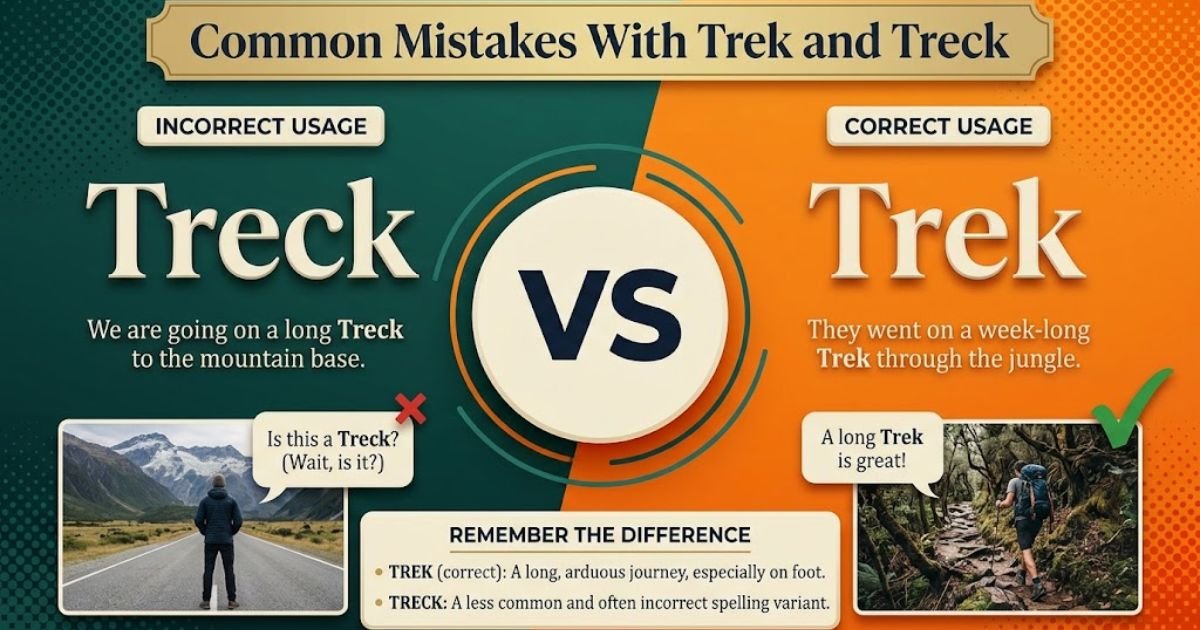
Here are the most frequent errors people make, along with corrected versions.
Incorrect: We went on a treck through the forest. Correct: We went on a trek through the forest. This is the most common mistake. Writers add an extra “c” out of habit, likely influenced by words like “check” or “deck.”
Incorrect: She trecked across the desert alone. Correct: She trekked across the desert alone. The verb form should double the “k,” not add a “c.” Remember: trek becomes trekked, not trecked.
Incorrect: It’s going to be a long treck to get there. Correct: It’s going to be a long trek to get there. Even in casual speech or texting, “treck” is still incorrect. Autocorrect will often catch this, but it is worth knowing the right spelling on your own.
These mistakes are common, and they are easy to fix once you know the pattern: one “k,” no “c,” ever.
Related Words and Phrases
A few related terms can help round out your understanding of trek and how it fits into everyday English:
- Hike: a shorter or more casual walk, often for recreation
- Journey: a general term for travel, not necessarily difficult or on foot
- Trekker: a person who treks, especially used for hikers on long trails
- Star Trek: the well known science fiction franchise, which uses the correct “trek” spelling in its title
- Trekking pole: a walking stick used for support on long hikes
Knowing these related words can help you use trek confidently in context, since they often appear together in travel and outdoor writing.
Practical Tips to Remember the Correct Spelling
If you tend to second guess yourself, these small tricks can help:
- Think of the phrase “trek equals track,” since both describe a path or journey, and both use a single “k.”
- Remember that “treck” has no root, no history, and no dictionary entry, so there is nothing to justify it.
- Associate the word with Star Trek, a widely known title that always spells it correctly.
- If autocorrect flags “treck,” trust it. It is not a stylistic choice, it is simply wrong.
FAQ’s
Is “treck” ever correct?
No. “Treck” is not a recognized word in any standard or informal English dictionary. Always use “trek” instead.
What does trek mean?
Trek means a long, often difficult journey, especially one made on foot. It can also be used as a verb meaning to make such a journey.
How do I use trek in a sentence?
Use it as a noun or a verb. For example: “The trek took five hours” (noun) or “We trekked through the valley” (verb).
What is the past tense of trek?
The past tense is trekked, with a doubled “k.” It is never spelled “trecked.”
Why do people confuse trek with treck?
The confusion usually comes from English words like “check” and “deck,” which end in “-eck.” Trek does not follow that pattern, even though it rhymes with those words.
Conclusion
Trek is the only correct spelling, whether you are using it as a noun for a long journey or as a verb for making one. “Treck” is a common typo with no legitimate use anywhere in English. The next time you write about a long hike, a tough commute, or a memorable journey, spell it with one “k”: trek.

Smith Jason is an SEO expert with 2–3 years of experience, sharing grammar tips, confusing words, vocabulary and writing advice.










1 thought on “Treck or Trek: Correct Word, Meaning, and Easy Examples”