Mrs. and Ms. are both correct, but they are not interchangeable. Mrs. is used for a married woman and often implies she has taken her husband’s name, while Ms. is a neutral title that works for any woman regardless of marital status. If you are unsure which title someone prefers, Ms. is the safer default in most modern writing and conversation.
What Does “Mrs.” Mean?
Mrs. is an abbreviated title placed before a woman’s name to indicate that she is married. It traditionally pairs with her husband’s surname, as in “Mrs. Robert Smith,” though today it is far more common to see it paired with the woman’s own first and last name, as in “Mrs. Sarah Smith.”
The title only applies to married women. Using it for someone who is single, divorced, or whose marital status you don’t know can come across as an assumption you shouldn’t be making.
What Does “Ms.” Mean?
Ms. is a title that does not reveal or depend on marital status. It works for married women, single women, divorced women, or any woman who simply prefers not to disclose that information. Because of this flexibility, Ms. has become the standard default title in professional, academic, and journalistic writing.
Think of Ms. as the female equivalent of Mr., which never signals whether a man is married. That parallel is exactly why Ms. was created and popularized in the first place.
Mrs. vs. Ms.: The Core Difference
The real difference comes down to what information the title communicates.
| Term | Correct? | Meaning | When to Use |
| Mrs. | Yes | Married woman | When you know she is married and this is her stated preference |
| Ms. | Yes | Marital status unspecified | Default choice, professional settings, or when unsure |
| Miss | Yes | Unmarried woman or young girl | Traditional or when specifically preferred |
Neither Mrs. nor Ms. is grammatically wrong. The mistake people make is choosing the wrong one for the situation, not using an invalid word.
Grammar and Pronunciation
Both are abbreviated titles, also called honorifics, and they function as a type of noun that precedes a proper name. Neither one stands alone as a complete word without a name attached.
Spelling and punctuation:
- Mrs. is always followed by a period in US English, since it is a shortened form of “Mistress.”
- Ms. also takes a period in American usage, though it is not technically an abbreviation of a longer word the way Mrs. is.
Pronunciation:
- Mrs. is pronounced “MISS-iz.”
- Ms. is pronounced “miz.”
Plural forms:
- The plural of Mrs. is Mmes. (short for Mesdames), though this is rarely used outside very formal writing.
- The plural of Ms. is Mses. or Mss., both uncommon in everyday use. Most writers simply rephrase the sentence to avoid pluralizing either title.
Neither title has a verb form, adjective form, or adverb form. They function strictly as titles attached to names.
Read Related Post: Ambiguous Definition Explained: Meaning, Examples, and Types
Where Did “Mrs.” and “Ms.” Come From?
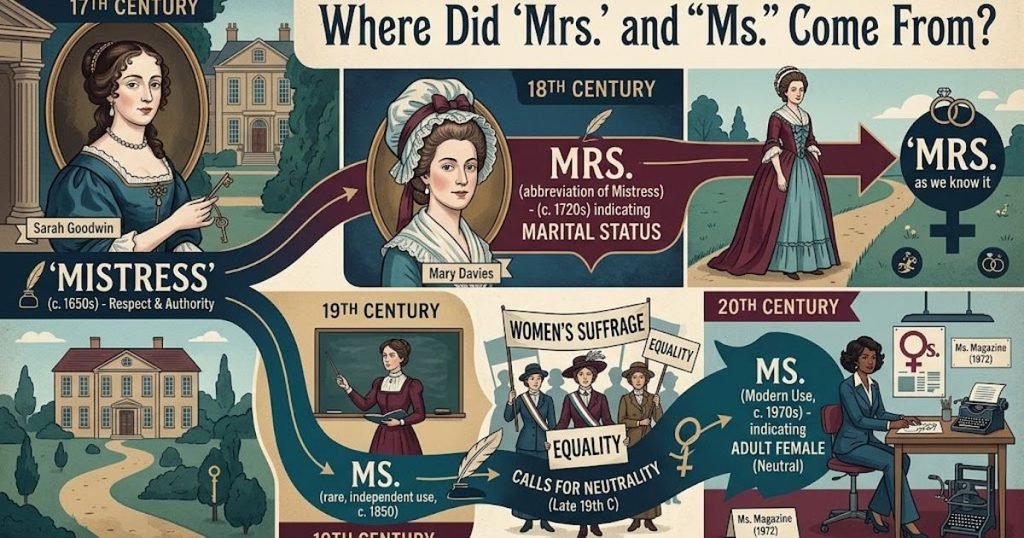
Mrs. developed as a written abbreviation of “Mistress,” a term that once simply meant a woman in a position of authority or the female head of a household, without any marital implication at all. Over centuries, “Mistress” split into different pronunciations and meanings, and the abbreviation Mrs. settled into referring specifically to married women.
Ms. has a shorter, more deliberate history. The New York Times style guide traced the earliest documented suggestion of “Ms.” to a 1901 newspaper item proposing it as a convenient title that avoided guessing a woman’s marital status. The title saw little real adoption until the 1970s, when the women’s movement pushed for its use, and Ms. magazine, founded in 1972, helped cement it in mainstream American English.
When to Use “Mrs.”
Use Mrs. when:
- You know the woman is married and she uses this title.
- You are addressing formal correspondence to a married couple, such as “Mr. and Mrs. James Carter.”
- The woman has specifically told you she prefers Mrs.
Example (everyday conversation):
“Mrs. Johnson picked her kids up from school early today.”
Example (formal writing):
“Mrs. Eleanor Whitfield will chair the committee this year.”
Both sentences work because the speaker knows the woman’s marital status and title preference.
When to Use “Ms.”
Use Ms. when:
- You don’t know a woman’s marital status.
- You’re writing in a professional, journalistic, or academic context.
- The woman prefers Ms. regardless of whether she’s married.
- You want a title that treats women the same way Mr. treats men.
Example (workplace email):
“Ms. Patel will be leading the client call on Thursday.”
Example (academic writing):
“According to Ms. Alvarez’s research, the results were inconclusive.”
Example (casual writing):
“Ms. Brooks from next door lent us her ladder.”
In each case, Ms. works whether the woman is married, single, or divorced, which is exactly the point.
Does “Mrs.” Have Any Downsides?
Mrs. isn’t incorrect, but it carries an assumption. Using it for a woman whose marital status you don’t actually know risks being wrong, and some married women simply prefer Ms. for professional or personal reasons. Neither preference is more “correct” than the other. The key is matching the title to the individual, not to a general rule.
Common Mistakes
Incorrect: Assuming every married woman prefers “Mrs.” without asking.
Correct: Default to Ms. unless you know she prefers Mrs.
Many married women, especially in professional settings, prefer Ms. This is a personal choice, not a grammar error.
Incorrect: Using “Mrs.” for a woman whose marital status is unknown.
Correct: Use Ms. Jennings until you learn her preference.
Guessing marital status can feel presumptuous, and Ms. avoids the problem entirely.
Incorrect: Writing “Mrs” without a period in American English.
Correct: Write Mrs. with a period.
US English style guides consistently require the period after this abbreviation, unlike some British style conventions.
Incorrect: Pluralizing casually as “Mrs.s” or “Ms.s.”
Correct: Rephrase the sentence, such as “the married women in attendance,” rather than forcing an awkward plural.
The formal plurals Mmes. and Mses. exist but sound stiff in everyday writing.
Related Titles Worth Knowing
- Miss: traditionally used for unmarried women or young girls, still common in some formal or Southern US contexts.
- Mr.: the male equivalent that never indicates marital status, which is the model Ms. was built to match.
- Mx.: a gender neutral title, pronounced “mix,” used by people who don’t identify within the traditional gender binary or who prefer not to specify gender at all.
- Madam or Ma’am: spoken forms of respectful address, not written titles that attach to a name.
Practical Guidance for Choosing the Right Title
When you’re not sure which title to use, follow this order of priority:
- Ask directly if the situation allows it. This is always the most reliable method.
- Check for a stated preference, such as an email signature, business card, or name tag.
- Default to Ms. in professional or written communication when no preference is known.
- Use Mrs. only when marital status and preference are both confirmed.
This approach avoids errors and shows respect for how the person wants to be addressed.
FAQ’s
Is “Ms.” only for unmarried women?
No. Ms. works for any woman regardless of marital status. That flexibility is exactly why it exists.
Is “Mrs.” outdated?
No, Mrs. is still widely and correctly used. It simply requires knowing that the woman is married and prefers that title.
Can I use “Ms.” for a married woman?
Yes. Many married women use Ms. professionally or personally, and it is always correct as a default choice.
Do “Mrs.” and “Ms.” both require a period in US English?
Yes. American English style consistently uses a period after both Mrs. and Ms.
What title should I use if I don’t know someone’s marital status?
Use Ms. It carries no assumption and works in nearly every situation.
Conclusion
Mrs. and Ms. are both correct English titles, but they carry different information: Mrs. signals marriage, while Ms. stays neutral. When in doubt, Ms. is the safest and most widely accepted default in modern US English.

Smith Jason is an SEO expert with 2–3 years of experience, sharing grammar tips, confusing words, vocabulary and writing advice.









1 thought on “Mrs Or Ms: Meaning, Usage, And Difference In US English”