
If you’ve typed “rumor” and then second-guessed yourself when you saw “rumour” somewhere else, you’re not imagining things. Both spellings exist, and seeing them used interchangeably online makes it hard to know which one is actually correct. Here’s the short version: in US English, the correct spelling is “rumor,” without the “u.” “Rumour” is the standard spelling in British English, Canadian English, and Australian English.
The Quick Answer: Rumor Is Correct in American English
“Rumor” is the correct spelling for American writers, and “rumour” is correct for British, Canadian, and Australian writers. Neither spelling is wrong. They’re regional variants of the same word, similar to “color” and “colour” or “favor” and “favour.” If you’re writing for a US audience, using US software, or following American style guides like AP or Chicago, stick with “rumor.”
What Does “Rumor” Actually Mean?
A rumor is a piece of information or a story that spreads from person to person, often without any confirmation that it’s true. It can start from a fact, a guess, or even a misunderstanding, and it tends to grow or change as more people repeat it.
For example: “There’s a rumor going around the office that the company is being sold.” Nobody has confirmed it, but people are talking about it anyway.
Rumor vs Rumour: What’s the Real Difference?

The difference isn’t about meaning. It’s entirely about geography and spelling convention. Both words:
- Refer to the exact same concept
- Function the same way grammatically
- Are pronounced the same way
The only distinction is which side of the Atlantic (or which English-speaking country) you’re writing for. This pattern shows up across dozens of English words that end in “-or” in American English and “-our” in British English, including “color/colour,” “honor/honour,” and “labor/labour.”
Is “Rumor” a Noun or a Verb?
“Rumor” works as both a noun and a verb, though the noun form is far more common.
As a noun: “The rumor spread quickly through the school.”
As a verb: “It was rumored that the singer would announce a new album.” The verb form almost always appears in the passive voice, as in “it is rumored” or “she was rumored to be.”
The plural noun form is rumors (US) or rumours (UK). There’s no irregular plural to worry about here, just the standard “s.”
Where Does the Word “Rumor” Come From?
“Rumor” traces back to the Latin word rumor, meaning noise, clamor, or general talk. It passed into English through Old French as rumour, and that spelling stuck in Britain. American English later simplified many French-influenced spellings, dropping the “u” from words like “rumour,” “color,” and “honor,” largely due to the influence of lexicographer Noah Webster in the early 1800s. Webster favored simpler, more phonetic spellings for American English, and his dictionaries helped standardize “rumor” as the American form.
How Do You Pronounce “Rumor”?
Both “rumor” and “rumour” are pronounced identically: ROO-mer (/ˈruːmər/). The spelling difference has no effect on how the word sounds. If you’re learning English, this is good news: you only need to remember one pronunciation, regardless of which spelling you use.
American English vs British English Spelling Rules
This “-or” versus “-our” pattern isn’t unique to “rumor.” It’s a broader rule that applies across American and British English:
| American English | British English |
| Rumor | Rumour |
| Color | Colour |
| Favor | Favour |
| Honor | Honour |
| Labor | Labour |
| Neighbor | Neighbour |
If you know this pattern for one word, you can generally apply it to the rest. The exception list is short, and most “-our” words in British English simply drop the “u” in American English.
Read Related Post: Mrs Or Ms: Meaning, Usage, And Difference In US English
Rumor vs Rumour: Comparison Table
| Term | Correct? | Region | Meaning |
| Rumor | Yes | American English | Unverified information passed between people |
| Rumour | Yes | British, Canadian, Australian English | Same meaning as “rumor” |
Neither spelling is a mistake on its own. The mistake only happens when the spelling doesn’t match the English variant you’re supposed to be writing in.
How to Use “Rumor” Correctly in a Sentence
Once you’ve settled on the American spelling, using “rumor” is straightforward. It typically pairs with verbs like spread, start, deny, confirm, and hear.
- “Please don’t spread that rumor before we know the facts.”
- “He started the rumor as a joke, and it got out of hand.”
- “The company denied the rumor in an official statement.”
Notice that “rumor” often appears with words signaling uncertainty, like reportedly, allegedly, or supposedly, since a rumor by definition hasn’t been confirmed.
Real-Life Examples of “Rumor” in Context
Everyday conversation: “Did you hear the rumor about the new coffee shop opening downtown?”
Workplace communication: “I want to address a rumor that’s been circulating about upcoming layoffs. It’s not accurate.”
Academic writing: “Sociologists have long studied how rumors spread within tightly connected communities.”
Email: “Just a heads up, there’s a rumor going around that the meeting got moved to Friday. Can you confirm?”
Formal writing: “The report cautions readers against treating unverified rumors as factual claims.”
Each example uses “rumor” the way a native US speaker naturally would, without forcing the word into an awkward spot.
Common Mistakes People Make With Rumor and Rumour
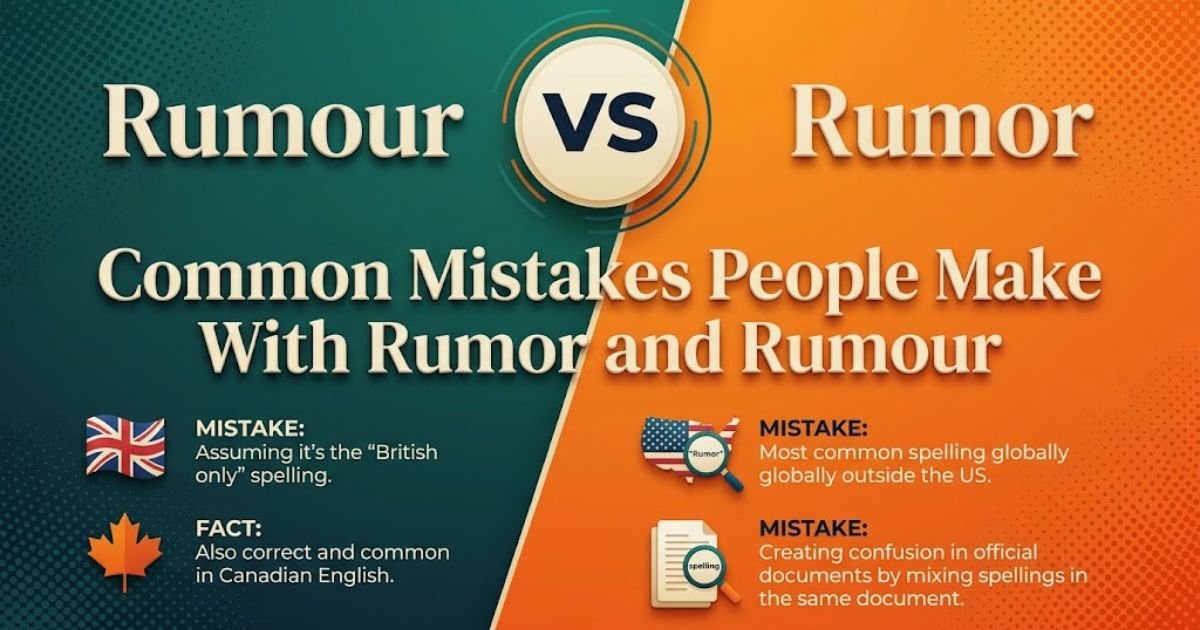
Incorrect: “I heard a rumour that the store is closing.” (in an otherwise American English document)
Correct: “I heard a rumor that the store is closing.”
This mismatch happens when writers mix British spellings into American content, often because of autocorrect settings or reading British sources.
Incorrect: “There’s a rumor that he’s rumor to be leaving the team.”
Correct: “There’s a rumor that he’s rumored to be leaving the team.”
This mistake confuses the noun form with the verb form. Remember, “rumored” is the verb, and it needs the “-ed” ending.
Incorrect: “Rumors has it that she’s moving.”
Correct: “Rumor has it that she’s moving.”
The fixed expression “rumor has it” always uses the singular form, even though it sounds like it could take a plural verb.
Related Words: Rumored, Rumormonger, and Hearsay
A few related terms show up often alongside “rumor”:
- Rumored: the verb form, as in “she is rumored to be running for office”
- Rumormonger: someone who spreads rumors, often with a negative connotation
- Hearsay: a near-synonym, especially common in legal contexts, referring to secondhand information
- Gossip: similar in meaning but usually implies personal or social details rather than broader news
Understanding these related words helps you choose the most precise term for what you’re describing.
Practical Tips to Remember Which Spelling to Use
If you’re not sure which spelling applies, ask yourself who your audience is. Writing for a US company, a US-based website, or American readers means “rumor.” Writing for a UK, Canadian, or Australian audience means “rumour.” When in doubt, check your document’s language setting or your organization’s style guide, since most word processors will flag the “wrong” version automatically once the correct regional dictionary is selected.
FAQ’s
Is “rumor” or “rumour” correct?
Both are correct, depending on your audience. “Rumor” is correct in American English, and “rumour” is correct in British, Canadian, and Australian English.
What does “rumor” mean?
A rumor is a piece of information or a story passed between people that hasn’t been confirmed as true.
How do you use “rumor” in a sentence?
Use it as a noun, as in “I heard a rumor,” or as a verb in passive form, as in “it is rumored that.”
Is “rumour” a spelling mistake?
No. “Rumour” is not a mistake. It’s the standard spelling outside the United States, so it’s only incorrect if you’re specifically writing in American English.
What’s the plural of “rumor”?
The plural is simply “rumors” in American English or “rumours” in British English.
Conclusion
If you’re writing for American readers, use “rumor.” If you’re writing for British, Canadian, or Australian readers, use “rumour.” Both spellings mean the same thing and sound identical, so the only thing you really need to remember is which audience you’re writing for.

Smith Jason is an SEO expert with 2–3 years of experience, sharing grammar tips, confusing words, vocabulary and writing advice.










1 thought on “Rumour or Rumor: Which Spelling Is Right in US English?”