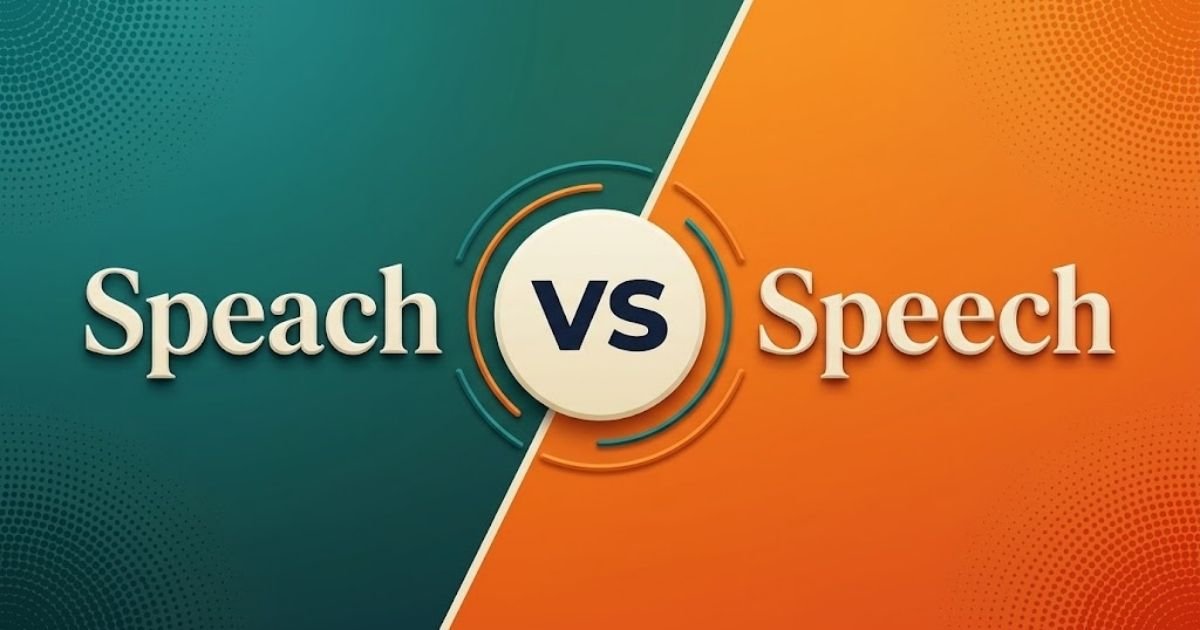
You are writing an email, a school paper, or a note for a wedding toast, and your fingers stall on one word. Is it speach or speech? The uncertainty usually comes from the way the word sounds when you say it, which doesn’t quite match how it’s spelled. Here’s the short version: speech is the correct spelling. Speach is a misspelling and does not appear in any standard dictionary.
The Quick Answer
Speech is the only correct spelling in American and British English alike. It’s a noun that refers to the ability to talk, the act of speaking, or a formal talk given to an audience. Speach is not a recognized word in any dictionary, and using it in an email, essay, or resume will read as a spelling error, not a stylistic choice.
What Speech Actually Means
Speech carries a few related meanings, and knowing them helps you use the word with confidence.
As an uncountable noun, speech refers to the general human capacity to talk. You might say someone “lost the power of speech” after an illness, meaning their ability to speak was affected.
As a countable noun, a speech is a specific talk delivered to a group, such as a graduation speech or a political speech. In this sense, the word has a plural: speeches.
Speech can also refer to a particular way of speaking, as in “her speech had a slight accent,” meaning the manner or style of talking rather than a formal address.
Why People Misspell It as Speach
The confusion almost always traces back to the related verb, speak. Because speak is spelled with “ea,” it feels natural to assume the noun form should follow the same pattern. But English spelling doesn’t always stay consistent between related words, and this is one of those exceptions.
The two words also diverged historically. Old English had separate but related forms for the verb and the noun. According to language historians, the verb traces to an Old English form close to sprecan, while the noun traces to a related but distinct form, spræc or sprǣc. Over centuries, the noun settled into the “ee” spelling we use today, while the verb kept its “ea” spelling. There is no simple rule that explains the split; it’s just one of the many quirks that make English spelling tricky for even experienced writers.
Speech vs Speak: Clearing Up the Real Confusion
Since speak is the actual source of the confusion, it helps to see the two words side by side.
| Word | Part of Speech | Meaning | Example |
| Speech | Noun | The act, ability, or manner of speaking; also a formal talk | She practiced her speech for hours. |
| Speak | Verb | To say words aloud; to communicate verbally | He will speak at the conference. |
| Speach | Not a word | Misspelling of “speech” | ❌ (avoid entirely) |
Remembering that speech is a noun and speak is a verb makes the spelling far easier to keep straight, since you can ask yourself which job the word is doing in your sentence.
Read Related Post: Studder or Stutter: Which Spelling Is Correct?
Where the Spelling Comes From
Speech developed from Old English roots connected to sprecan, the ancestor of the modern verb “speak,” and to a related Old English noun form often written as spræc or sprǣc. That root is part of a larger family of Germanic words for talking and language, related to modern German sprechen and Dutch spreken.
Through Middle English, the noun form gradually shifted to speche, and eventually settled into the modern spelling speech, while the “spr-” consonant cluster common in the older Germanic forms dropped out of English by around the 12th century. The result is a noun and verb that clearly share a family history but no longer share a spelling pattern, which is exactly why the mix-up happens so often today.
How to Pronounce Speech
Speech is pronounced /spiːtʃ/, rhyming with “reach,” “teach,” and “beach.” The long “ee” sound is actually part of what fuels the confusion, since several words with that same sound (teach, reach, beach) use the letters “ea” instead of “ee.” Speech simply doesn’t follow that pattern, and there isn’t a simpler explanation beyond that being how the word evolved.
Grammar Basics: Singular, Plural, and Related Forms
Speech is a noun, and it behaves differently depending on which meaning is intended.
When speech means the general ability to talk, it is uncountable and has no plural. You would say “his speech improved after therapy,” not “his speeches improved.”
When speech means a specific talk or address, it is countable, and the plural is speeches. You would say “the two candidates gave speeches back to back.”
Related word forms include the adjective speechless (unable to speak, often from shock or emotion) and the verb speak, along with its forms speaks, spoke, and spoken. None of these related forms use the “speach” spelling, so the rule stays consistent across the whole word family.
Is Speach Ever Acceptable?
No. Speach has no accepted use in formal writing, informal writing, texting, or any recognized English dialect. It isn’t a regional variant, an older spelling, or an alternate form used in specific fields. It is simply a spelling mistake, most often triggered by the influence of the verb “speak.” If you see “speach” used online, including in casual social media posts, it’s almost always an unintentional typo rather than a legitimate choice.
Speech in American vs British English
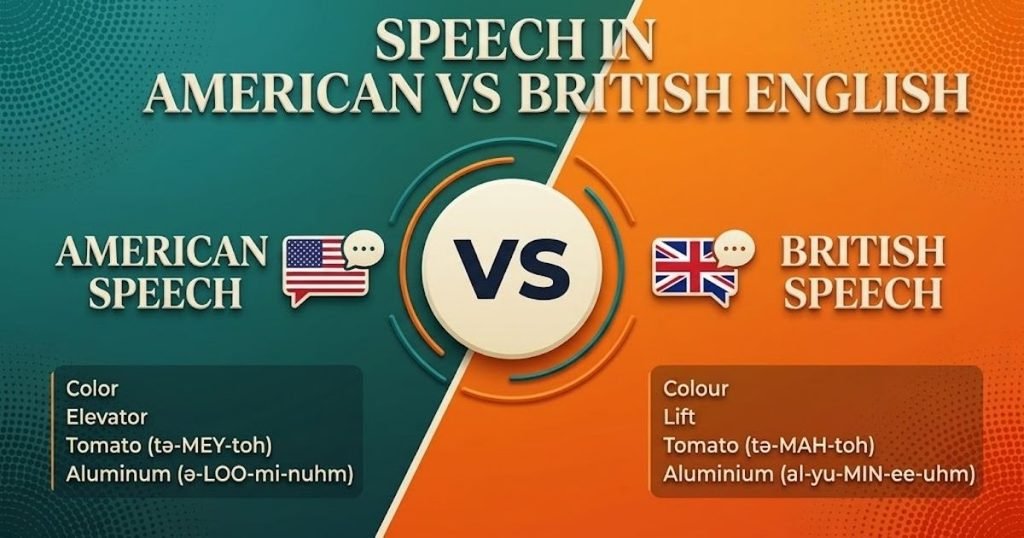
Unlike some English words that differ across regions, such as “color” versus “colour,” speech is spelled identically in American English, British English, Canadian English, and Australian English. There is no regional variant to worry about here, which makes the correct spelling even easier to remember once it clicks: there’s only one right answer, everywhere.
Real Examples of Speech Used Correctly
Everyday conversation: “I get nervous every time I have to give a speech in front of people.”
Workplace communication: “Please keep your speech to under five minutes so we stay on schedule.”
Academic writing: “The professor analyzed the rhetorical structure of the senator’s speech.”
Email: “Attached is the draft of my speech for Friday’s retirement dinner. Let me know if it needs edits.”
Formal writing: “The keynote speech addressed the company’s plans for the coming fiscal year.”
Casual writing: “Loved your best man speech, it had the whole room laughing.”
Each of these sentences uses speech as either a countable noun (a specific talk) or, in a slightly different sense, part of a set phrase describing the act of addressing an audience.
Common Mistakes to Avoid
Incorrect: She wrote her speach the night before the ceremony. Correct: She wrote her speech the night before the ceremony. The verb “speak” doesn’t determine the noun’s spelling, so don’t let it guide you here.
Incorrect: His speach impediment made public speaking difficult. Correct: His speech impediment made public speaking difficult. This phrase is a fixed term in everyday and clinical language, and it always uses the “ee” spelling.
Incorrect: I need to practice my speaches for the debate tournament. Correct: I need to practice my speeches for the debate tournament. The plural keeps the same “ee” pattern as the singular; only the ending changes.
None of these slips are unusual. English pairs like speak and speech break the typical “ea equals long ee sound” pattern, so the mistake is an easy one to make, not a sign of poor writing overall.
A Simple Trick to Remember the Spelling
One easy memory aid: think of the phrase “the teacher gave a great speech,” and notice that both “teacher” and “speech” use “ee” for that same long vowel sound, unlike “speak,” which stands apart with its “ea.” Anchoring the spelling to a word you already spell correctly, like “teach” or “reach,” can help the correct pattern stick.
FAQ’s
Is speach a real word?
No. Speach is not a recognized word in any standard English dictionary. It’s a common misspelling of speech.
What does speech mean?
Speech means the ability to talk, the act of speaking, a particular manner of speaking, or a formal talk delivered to an audience.
How do you spell the plural of speech?
The plural is speeches, as in “the candidates delivered their closing speeches.”
Why does speak use “ea” but speech uses “ee”?
The two words come from related but separate Old English roots that evolved differently over time. There’s no simple spelling rule that connects them; it’s a historical quirk rather than a logical pattern.
Is speech spelled differently in British English?
No. Speech is spelled the same way in American, British, Canadian, and Australian English, with no regional variation.
Conclusion
When you’re stuck between speach or speech, remember that only speech is correct, no matter the context, region, or level of formality. The confusion comes from the verb “speak,” but the noun has its own spelling that’s worth memorizing on its own. Once you connect speech with familiar “ee” words like teach and reach, the correct spelling becomes second nature.

Smith Jason is an SEO expert with 2–3 years of experience, sharing grammar tips, confusing words, vocabulary and writing advice.










1 thought on “Speach or Speech: Which Spelling Is Correct?”