
You just watched someone finish a marathon, land a big promotion, or walk through your front door after a long flight. You open your mouth to congratulate them, and suddenly you’re not sure which phrase fits: “you did it” or “you made it.” Both sound similar, both feel celebratory, and that similarity is exactly why people mix them up.
Both phrases are correct, but they mean different things. “You did it” celebrates an achievement or the completion of a task. “You made it” celebrates arrival, survival, or reaching a goal despite obstacles. Once you know which situation you’re in, choosing the right phrase becomes automatic.
What Does “You Did It” Mean?
“You did it” points to an action someone completed successfully. It focuses on the effort and the result of that effort.
Use it when someone:
- Finished a project
- Solved a problem
- Accomplished a goal through skill or work
Example: “You studied for weeks and passed the bar exam. You did it!”
Here, the phrase praises the accomplishment itself, not the journey to get there.
What Does “You Made It” Mean?
“You made it” usually points to arrival or survival. It often carries a sense of relief or overcoming odds, rather than simply finishing a task.
Use it when someone:
- Arrives somewhere, especially after a difficult trip
- Survives a hard situation
- Reaches a milestone after struggle
Example: “The flight got delayed three times, but you made it to the wedding.”
The emphasis here is on getting there, not on a specific skillful action.
The Core Difference Between “Did It” and “Made It”
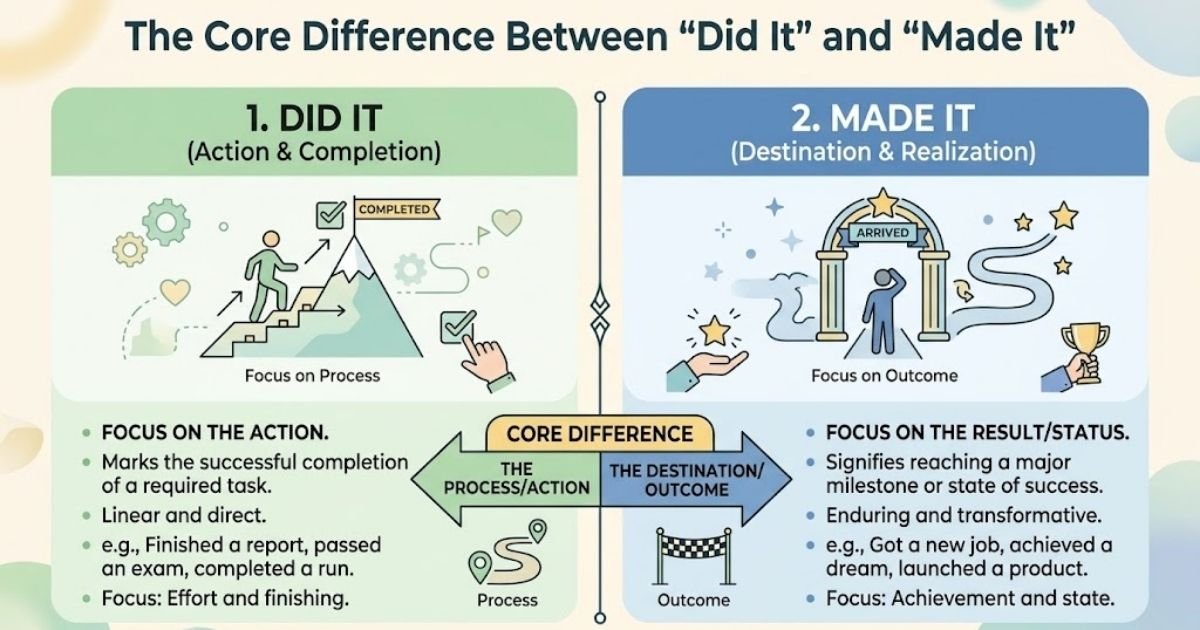
The simplest way to remember the difference: “did it” celebrates completion, “made it” celebrates arrival or survival.
“You did it” answers the question “What did you accomplish?” “You made it” answers the question “Did you get there?” or “Did you survive that?”
There’s overlap in casual speech, and native speakers sometimes use them interchangeably for general encouragement. But the core meanings stay distinct.
Grammar Breakdown: Verb Forms of “Do” and “Make”
Both phrases use the simple past tense, but they come from two different irregular verbs.
“Do” becomes “did” in the past tense: do, did, done. “Make” becomes “made” in the past tense: make, made, made.
Neither phrase requires an auxiliary verb here because “did” and “made” already carry the past tense on their own. Saying “you did made it” or similar blends is incorrect and never appears in standard English.
In terms of part of speech, “did” and “made” are both past tense main verbs, and “it” functions as the object pronoun in each sentence.
Read Related Post: Speach or Speech: Which Spelling Is Correct?
You Did It vs You Made It: Comparison Table
| Phrase | Correct? | Meaning | Typical Use |
| You did it | Yes | You accomplished or completed something | Finishing a task, winning, succeeding at a goal |
| You made it | Yes | You arrived, survived, or reached a milestone | Getting somewhere, surviving hardship, hitting a deadline |
Both phrases are grammatically correct standard English. Neither one is a mistake. The choice depends entirely on what you’re praising: the accomplishment or the arrival.
When to Say “You Did It”
Reach for “you did it” when the focus is on a specific action someone performed well.
- After a work presentation: “You did it. That pitch was flawless.”
- After a sports win: “You did it! First place, no question.”
- After finishing a creative project: “You did it, the novel is finally done.”
In each case, the person actively produced something or completed a task through their own effort.
When to Say “You Made It”
Reach for “you made it” when the focus is on reaching a place, a deadline, or surviving something difficult.
- Arriving late to a party: “You made it! We saved you a seat.”
- Recovering from illness: “The doctors weren’t sure at first, but you made it.”
- Hitting a tight deadline: “The submission closed in ten minutes. You made it.”
Notice that none of these examples describe a specific skill being performed. They describe getting through or getting to something.
Can You Use Both in the Same Situation?
Sometimes yes. If someone finishes a marathon, you could say either phrase, and both would sound natural, just with a slightly different emphasis.
“You did it” would praise the accomplishment of finishing 26.2 miles. “You made it” would praise the fact that they crossed the finish line despite exhaustion or pain.
When a situation involves both effort and struggle, native speakers often pick whichever phrase feels more emotionally accurate in the moment, and either choice is acceptable.
Real Life Examples in Everyday Conversation
Everyday conversation: “You made it just in time, the movie is about to start.”
Workplace communication: “Congratulations on closing the deal. You did it.”
Academic writing: A professor might say, “You made it through the toughest semester of the program,” when describing a student’s endurance.
Email: “I heard the launch went smoothly. You did it, and the whole team is proud.”
Business writing: “After months of negotiation, you made it to a signed contract.”
Casual writing (text message): “omg you did it!! congrats on the promotion 🎉”
Each example fits naturally because it matches the meaning of the phrase to the situation being described.
Common Mistakes to Avoid
Incorrect: “You did it to the airport right before it closed.” Correct: “You made it to the airport right before it closed.” Reason: This describes arrival under time pressure, which calls for “made it.”
Incorrect: “You made a great presentation and won the client.” Correct: “You did a great presentation and won the client,” or more naturally, “You gave a great presentation and won the client.” Reason: “Made” doesn’t pair naturally with “presentation” in this sense. “Do” or “give” fits better for describing performance of a task.
Incorrect: “You did made it.” Correct: “You made it.” Reason: Combining two past tense verbs together like this is not standard English. Only one past tense verb is needed.
These mix-ups are common because both phrases express praise, so it’s easy to reach for the wrong one under excitement.
Related Phrases and Expressions
A few related expressions carry similar celebratory tones:
- “You pulled it off” (similar to “you did it,” emphasizing difficulty)
- “You got there” (similar to “you made it,” emphasizing arrival)
- “Way to go” (general praise, not tied to arrival or completion)
- “You nailed it” (similar to “you did it,” emphasizing skill)
These phrases can substitute for “you did it” or “you made it” depending on tone and context, but they are not identical in meaning.
Formal vs Informal Usage
Both phrases work in spoken English and informal writing, such as texts, emails to colleagues, or social media captions.
In formal writing, such as academic papers or official business reports, writers typically avoid both phrases in favor of more precise language. Instead of “you made it,” formal writing might say “you successfully completed the program.” Instead of “you did it,” formal writing might say “you achieved the intended outcome.”
There is no difference between American and British English in how these phrases are used. Both are common and understood the same way in each variety of English.
Practical Guidance for Choosing the Right Phrase
Ask yourself one question before speaking: Am I praising what someone accomplished, or that they got somewhere or survived something?
If the answer is accomplishment, use “you did it.” If the answer is arrival or survival, use “you made it.” If you genuinely can’t decide, either phrase will usually be understood as a compliment, since both carry positive, congratulatory meaning.
FAQ’s
Is “you made it” grammatically correct?
Yes. “Made” is the correct simple past tense of “make,” and the phrase follows standard English sentence structure.
Is “you did it” the same as “you made it”?
No. “You did it” praises an accomplishment or completed task. “You made it” praises arrival or survival, often after a struggle.
Can I use “you did it” when someone arrives somewhere?
It’s uncommon. “You made it” is the more natural choice for arrivals, since “did it” usually refers to completing a task or action rather than reaching a place.
Which phrase is more common in celebrations?
Both are equally common. The choice depends on context: use “you did it” for achievements and “you made it” for reaching a goal or destination.
Is one of these phrases British and the other American?
No. Both phrases are standard in American and British English, and their meanings don’t change between the two.
Conclusion
“You did it” and “you made it” are both correct, and neither one is a grammar mistake waiting to happen. The real difference comes down to what you’re celebrating: an accomplishment calls for “you did it,” while arrival or survival calls for “you made it.”
Once you connect each phrase to its meaning, choosing the right one becomes second nature.

Smith Jason is an SEO expert with 2–3 years of experience, sharing grammar tips, confusing words, vocabulary and writing advice.










1 thought on “You Did It vs. You Made It: The Real Difference Explained (With Clear Examples You’ll Actually Use)”