
You started typing the word, paused, and suddenly neither spelling looked right. Is it “studder” or “stutter”? This mix up happens because the word sounds like it could have a “d” in the middle, especially when spoken quickly. Here is the short answer: “stutter” is the correct spelling. “Studder” is not a word in standard English.
The Direct Answer: Stutter Is Correct, Studder Is Not
Stutter is the only correct spelling. It means to speak with involuntary pauses, repeated sounds, or a temporary inability to get words out smoothly. Studder is a common misspelling that does not appear in any major dictionary and has no accepted meaning of its own.
If you have ever seen “studder” in a text message, a social media comment, or a rushed email, it was almost certainly a typo or a phonetic guess, not an alternate spelling.
Why People Confuse Studder and Stutter
The confusion comes from how the word sounds when spoken casually. In fast speech, the double “t” in “stutter” can soften and sound closer to a “d” sound, similar to how “butter” can sound like “budder” in casual American pronunciation. That soft “d” sound tricks the ear, and when people try to spell the word from memory, “studder” seems logical.
This is a spelling issue rooted in pronunciation, not in any real grammar rule or regional dialect difference.
What Stutter Means
Stutter (verb and noun) refers to a speech pattern involving repeated sounds, syllables, or words, along with pauses or blocks that interrupt the natural flow of speech. It can also be used more broadly to describe anything that moves in a halting, uneven way, such as an engine or a piece of machinery.
As a noun, a stutter refers to the speech condition or pattern itself. As a verb, to stutter means to speak in that halting way.
Examples:
- She has a slight stutter when she’s nervous. (noun)
- He began to stutter as soon as the interviewer asked the first question. (verb)
- The old projector stuttered before finally starting the film. (verb, non speech usage)
Studder vs Stutter: Quick Comparison
| Term | Correct? | Meaning | Use |
| Stutter | Yes | A speech pattern with repeated sounds or pauses; to speak this way | Standard English, all contexts |
| Studder | No | No accepted meaning | Common misspelling only |
Part of Speech and Grammar Basics
Stutter functions as both a noun and a verb, which is common for many English words describing speech patterns (compare “stammer,” “mumble,” or “whisper”).
Verb forms:
- Base form: stutter
- Third person singular: stutters
- Past tense: stuttered
- Past participle: stuttered
- Present participle: stuttering
Noun forms:
- Singular: stutter
- Plural: stutters (used when referring to instances of stuttering, such as “a few stutters in his speech”)
There is no irregular conjugation here. “Stutter” follows the standard pattern for regular English verbs, doubling the final consonant before adding “-ed” or “-ing” because the word ends in a stressed syllable with a single vowel before the final consonant.
Read Related Post: Useing or Using: Which Spelling Is Correct? (Simple Guide)
Where the Word Stutter Comes From
Stutter developed from Middle English “stutten” or “stoten,” related to older Germanic roots connected to the idea of pushing or striking repeatedly, which mirrors the repetitive nature of the speech pattern it describes. The word has been part of English for centuries and has always referred to interrupted or repeated speech, not to any unrelated concept.
There is no historical basis for “studder” as a variant spelling. It does not appear in older texts, dictionaries, or linguistic records as a legitimate form of the word.
How to Pronounce Stutter
Stutter is pronounced STUH-ter (/ˈstʌtər/). The stress falls on the first syllable. In casual American speech, the middle “tt” often softens into a quick tap sound, which is exactly why some people mishear it and later misspell it as “studder.” Saying the word slowly and deliberately, STUT-TER, can help reinforce the correct spelling when writing it.
Using Stutter Correctly in a Sentence
Here are natural examples across different contexts:
Everyday conversation: “My little brother used to stutter when he was excited, but he’s outgrown most of it.”
Workplace communication: “Please let the team know that Mr. Alvarez has a stutter, and give him a moment to finish his thoughts during the meeting.”
Academic writing: “Speech language pathologists often work with children who stutter to develop fluency techniques and build communication confidence.”
Email: “I stuttered a bit during the client call, but I think the presentation still landed well.”
Formal writing: “The report noted that approximately one percent of adults experience a persistent stutter.”
Casual writing: “lol I totally stuttered when I saw him, so embarrassing.”
Each of these sentences uses “stutter” naturally, without forcing the word into an awkward position.
Common Mistakes With Studder and Stutter
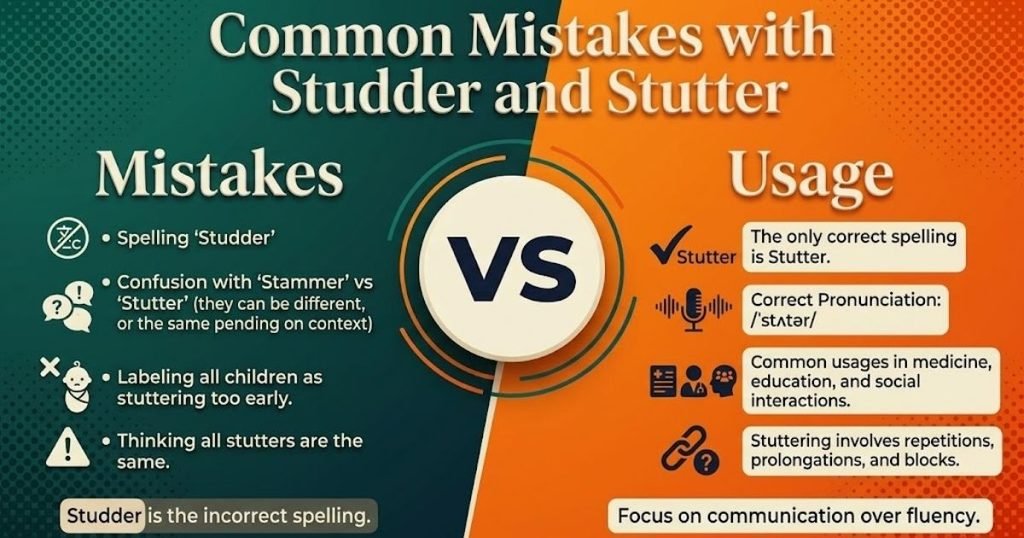
Incorrect: He has a bad studder and gets nervous speaking in public. Correct: He has a bad stutter and gets nervous speaking in public.
The word “studder” simply does not exist as a noun for this condition. Only “stutter” is correct.
Incorrect: She studdered through her whole speech. Correct: She stuttered through her whole speech.
This mistake usually comes from writing the word the way it sounds in fast speech rather than the way it’s actually spelled.
Incorrect: The engine kept studdering on cold mornings. Correct: The engine kept stuttering on cold mornings.
Even in non speech contexts, like describing a machine that starts and stops unevenly, “stutter” is still the correct word.
These are normal mistakes, and they usually disappear once you connect the spelling to the double “t” rather than the sound of a soft “d.”
Related Words and Terms
A few related words can help build a fuller picture of this topic:
- Stammer: A close synonym, especially common in British English, referring to a similar speech pattern.
- Stutterer: A person who stutters.
- Disfluency: A broader speech and language term referring to interruptions in the smooth flow of speech, including stuttering.
- Fluent: The opposite quality, describing smooth and effortless speech.
- Stutter step: An idiomatic phrase used in sports, describing a quick, broken rhythm in footwork, borrowed from the speech meaning.
Notice that “studder” does not appear anywhere in this list, because it has no legitimate related forms or established usage.
American English vs British English
There is no meaningful American versus British spelling difference here. Stutter is used and spelled the same way in both American and British English. The word “stammer” is more common in British English as a near synonym, but this is a word choice preference, not a spelling variation of “stutter” itself.
Practical Tips to Remember the Correct Spelling
- Break the word into syllables: STUT plus TER, with a clear double “t.”
- Connect it to the phrase “stutter step” from sports, which many people already spell correctly.
- Remember that words describing repeated speech sounds, like “stutter,” often contain doubled letters that reflect the repetition itself.
- If a spell checker flags “studder,” trust it. This is one case where the squiggly red line is always right.
FAQ’s
Is “studder” a real word?
No. “Studder” is not a recognized English word. It is a common misspelling of “stutter” and does not appear in standard dictionaries.
Is “stutter” spelled with one T or two?
“Stutter” is spelled with two T’s in the middle: S-T-U-T-T-E-R. Both the second and third letters after the “u” are “t.”
What does “stutter” mean?
“Stutter” means to speak with involuntary pauses, repeated sounds, or blocks in speech. It can also describe anything that moves or operates in an uneven, halting way, such as a machine.
How do I use “stutter” in a sentence?
You can use it as a verb (“He stuttered before answering”) or as a noun (“She has a mild stutter”). Both forms are grammatically correct depending on context.
Is “stammer” the same as “stutter”?
“Stammer” and “stutter” are close synonyms describing similar speech patterns. “Stammer” is more commonly used in British English, while “stutter” is more common in American English, though both are understood in either dialect.
Conclusion
Stutter is the correct spelling, always with a double “t,” and “studder” is simply a misspelling with no accepted use. The next time you’re unsure, remember the double “t” and you’ll spell it right every time.

Smith Jason is an SEO expert with 2–3 years of experience, sharing grammar tips, confusing words, vocabulary and writing advice.










1 thought on “Studder or Stutter: Which Spelling Is Correct?”