If you have ever typed “useing” and had your screen light up with a red squiggly line, you are not alone. Here is the short answer: “using” is the correct spelling. “Useing” is always a misspelling, in every context, in every form of English. Once you understand the one small spelling rule behind it, you will never second guess it again.
Is It “Useing” or “Using”? The Quick Answer
“Using” is correct. “Useing” is incorrect. There is no situation, formal or informal, American or British, where “useing” is accepted. The confusion happens because English speakers sometimes forget that a silent “e” at the end of a base word usually gets dropped before adding “-ing.” “Use” follows that exact pattern.
Why Do People Misspell “Using” as “Useing”?
Most people who write “useing” are not careless. They are actually applying a spelling instinct that works for many other words, just not this one.
English has a rule that when you add certain endings, you keep the base word intact. Think of words like “agreeing” or “seeing,” where the “e” stays. Because those words look similar to “use,” it is easy to assume “use” should behave the same way. It does not, and that mismatch is where the mistake comes from.
What Does “Using” Mean?
“Using” is the present participle and gerund form of the verb “to use.” It describes the act of employing something for a purpose, whether that is a tool, a method, a resource, or a skill.
As a verb form, “using” can:
- Show an ongoing action (“I am using my laptop right now.”)
- Act as a noun, known as a gerund (“Using a calculator saved time.”)
- Modify another noun as part of a phrase (“the using of outdated equipment”)
In every one of these roles, the spelling stays the same: u-s-i-n-g.
The Spelling Rule Behind “Use” to “Using”
Here is the rule in plain terms: when a verb ends in a silent “e,” you generally drop that “e” before adding a suffix that starts with a vowel, such as “-ing,” “-ed,” or “-able.”
“Use” ends in a silent “e.” The letter is not pronounced on its own, it simply signals that the “u” says its long vowel sound. Because “-ing” begins with a vowel, the silent “e” gets removed.
That gives you:
- use + ing → using (not useing)
- use + able → usable (not useable, though “useable” is a rare accepted variant in some dictionaries)
- use + er → user (not useer)
“Useing” breaks this rule by keeping a letter that grammar convention says should be dropped.
Read Related Post: Devide or Divide: Which Spelling Is Correct?
Does “Useing” Have Any Legitimate Use?
No. Unlike some confusing word pairs where both spellings are valid in different contexts, this is not one of them. “Useing” is not a word in standard American or British English, and no major dictionary lists it as an alternate spelling. If you see it in writing, it is simply a typo or a spelling error, nothing more.
“Using” vs “Useing” Comparison Table
| Term | Correct? | Meaning | Use |
| Using | Yes | Present participle/gerund of “use” | “She is using a new app to track expenses.” |
| Useing | No | Not a word | Always a misspelling; replace with “using” |
How to Pronounce “Using”
“Using” is pronounced YOO-zing, with two syllables. The “s” sounds like a “z,” which is common in English when “s” sits between two vowel sounds, similar to how “cause” and “reason” are pronounced.
There is no pronunciation version that matches “useing,” which is another clue that the spelling does not exist in real usage.
Correct Usage of “Using” in Sentences
Here is how “using” naturally shows up across different types of writing.
Everyday conversation: “I’ve been using this coffee maker for years and it still works great.”
Workplace communication: “We are using a new project management tool starting Monday.”
Academic writing: “The researchers analyzed the data using a standard statistical model.”
Emails: “Thanks for using our services. Let us know if you have questions.”
Business writing: “By using automation, the company reduced processing time by half.”
Formal writing: “The committee approved the proposal after using the updated guidelines.”
Casual writing: “I’m just using whatever I have in the fridge tonight.”
Each example places “using” right where a native speaker expects it, either following a form of “to be” or standing alone as a gerund.
Common Mistakes with “Using” and “Useing”
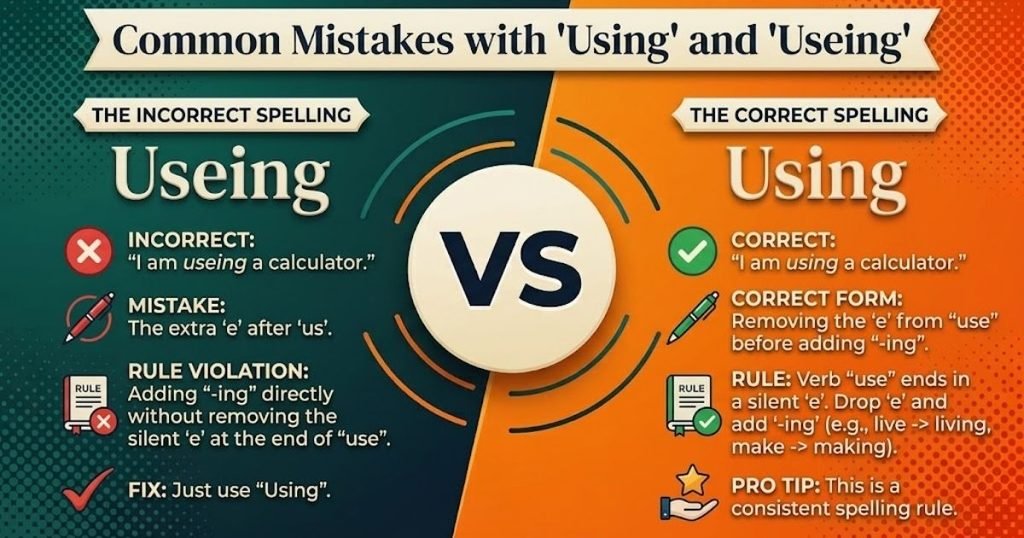
Incorrect: She is useing her phone to take notes. Correct: She is using her phone to take notes. The silent “e” in “use” is dropped before “-ing,” so “useing” adds an extra letter that does not belong.
Incorrect: Useing public transportation saves money. Correct: Using public transportation saves money. Even at the start of a sentence, the rule does not change. “Using” keeps the same spelling in every position.
Incorrect: He solved it by useing a shortcut. Correct: He solved it by using a shortcut. Some writers add the extra “e” out of habit from other “-ing” words. Practicing the silent “e” rule helps this stick.
Other Verb Forms of “Use” You Should Know
Understanding the full verb pattern makes “using” easier to remember for good.
- Base form: use
- Present participle/gerund: using
- Past tense: used
- Past participle: used
- Third person singular: uses
Related words that follow the same silent “e” pattern include hoping (from “hope”), writing (from “write”), and making (from “make”). If you can remember one of these, you can apply the same logic to “using.”
American English vs British English: Any Difference?
There is no difference between American and British English here. “Using” is the correct spelling in both varieties. The silent “e” dropping rule before “-ing” is a shared feature of standard English spelling, not a regional variation like “color” versus “colour.”
Practical Tips to Remember the Correct Spelling
A few simple tricks can help the correct spelling stick:
- Remember the pattern: silent “e” plus “-ing” almost always means the “e” disappears.
- Compare it to “hope” becoming “hoping.” If that spelling feels natural, “using” should too.
- Read the word aloud. “Useing” looks like it should have three syllables, which does not match how the word actually sounds.
- Use spell check as a backup, but understanding the rule means you will not need it.
FAQ’s
Is “useing” ever correct?
No. “Useing” is not a recognized word in English. The correct spelling in all contexts is “using.”
What does “using” mean?
“Using” means employing something for a purpose. It is the “-ing” form of the verb “use,” as in “using a tool” or “using a method.”
How do I use “using” in a sentence?
Place it after a helping verb like “is,” “are,” or “was,” or use it as a gerund. Example: “They are using a new strategy this quarter.”
Why does “use” drop the “e” before “-ing” but other words don’t?
Words that end in a silent “e” typically drop it before a suffix starting with a vowel, like “-ing.” “Use” follows this common pattern, along with words such as “write” (writing) and “hope” (hoping).
Is “usable” or “useable” correct?
“Usable” is the standard and most widely accepted spelling. “Useable” appears as a secondary variant in a few dictionaries, but “usable” is the preferred choice in American English.
Conclusion
The takeaway is simple: “using” is correct, and “useing” is always a spelling mistake. Remembering that “use” drops its silent “e” before “-ing,” just like “hope” becomes “hoping,” is all you need to get this right every time.

Smith Jason is an SEO expert with 2–3 years of experience, sharing grammar tips, confusing words, vocabulary and writing advice.










1 thought on “Useing or Using: Which Spelling Is Correct? (Simple Guide)”