
You typed the word, looked at it twice, and something felt off. Was it “devide” or “divide”? This mix-up happens because the “di” sound at the start tricks the ear into expecting an “e” instead of an “i.” The correct spelling is divide. “Devide” is not a word in standard English and should never be used in writing.
Once you know that, the next question is how to use divide correctly. This guide covers the meaning, pronunciation, grammar forms, and real examples so you never second-guess the spelling again.
Is It Devide or Divide?
Divide is the only correct spelling. “Devide” is a common misspelling that shows up in searches, texts, and rough drafts, but it has no accepted use in American or British English. No dictionary lists “devide” as an alternate spelling or informal variant.
If you remember one rule, remember this: divide starts with “di,” the same prefix found in words like distant, direct, and diagram. That connection can help you lock in the spelling for good.
What Does Divide Mean?
Divide is a verb (and sometimes a noun) that means to split something into separate parts, or to separate people by opinion or circumstance. It can apply to:
- Physical objects (dividing a cake into slices)
- Numbers (dividing 20 by 4)
- Groups of people (a divided community)
- Abstract ideas (a divide in opinion)
As a noun, “divide” refers to the gap or separation itself, as in “the digital divide” or “a political divide.”
Why Do People Misspell Divide as Devide?
The mistake usually comes from one of three habits:
- Phonetic guessing. The unstressed first syllable in divide sounds close to “duh” or “deh,” which makes “de” feel like a reasonable guess.
- Autocorrect gaps. Some keyboards do not flag “devide” because it resembles real words like “deride” or “decide.”
- Cross-language influence. Speakers of languages where similar words start with a “de” sound sometimes carry that pattern into English.
None of these reasons make “devide” acceptable in formal or informal writing. It is simply a spelling error to correct, not a regional variation to preserve.
Divide vs Devide: Quick Comparison
| Term | Correct? | Meaning | Use |
| Divide | Yes | To split into parts or separate | Standard verb and noun in all contexts |
| Devide | No | Not a recognized word | Never; always replace with “divide” |
Read Related Post: Realy or Really: Which Spelling Is Correct?
Grammar Breakdown of Divide
Understanding how divide functions in a sentence makes it easier to use correctly and remember its spelling.
Part of speech: Divide is primarily a verb, though it also works as a noun.
Verb forms:
- Base form: divide
- Third-person singular: divides
- Past tense: divided
- Past participle: divided
- Present participle (gerund): dividing
Example conjugation in context:
- “I divide the tasks evenly.”
- “She divides her time between two jobs.”
- “They divided the profits last quarter.”
- “We have been dividing the workload since January.”
As a noun: “The divide between the two teams grew wider after the meeting.” Here, divide describes a gap or separation, not an action.
How to Pronounce Divide
Divide is pronounced dih-VIDE (/dɪˈvaɪd/), with the stress on the second syllable. The first syllable is short and unstressed, which is exactly why the spelling trips people up. Say it slowly, and you will notice the emphasis clearly lands on “vide,” not the opening sound.
American English vs British English
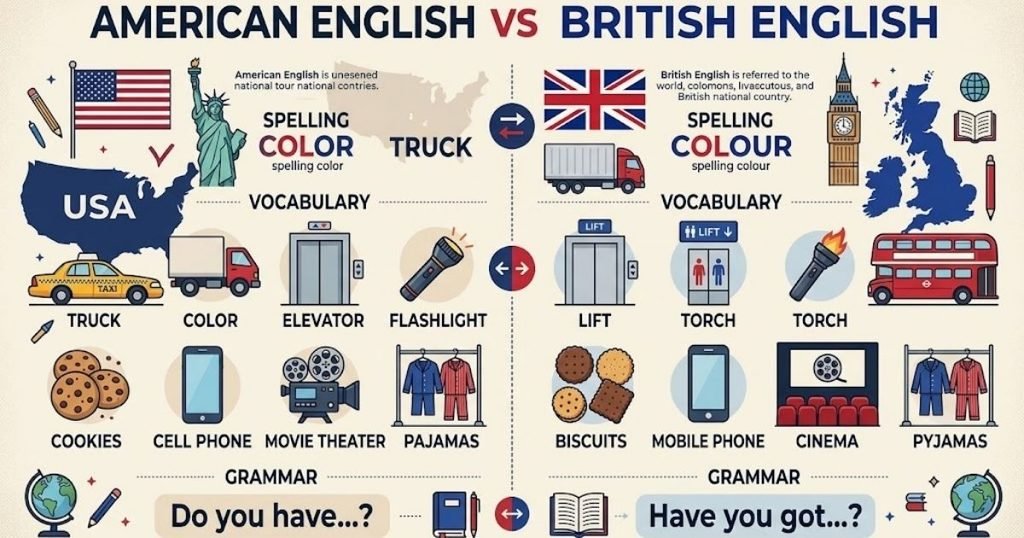
Divide is spelled the same way in both American and British English. There is no regional variant, so this is one spelling you can use with total confidence no matter where your audience is located.
Correct Usage of Divide in Sentences
Here are natural examples across different contexts.
Everyday conversation: “Let’s divide the pizza into eight slices so everyone gets some.”
Workplace communication: “Can you divide the client list between the two of us before Friday?”
Academic writing: “The researchers divided participants into three test groups based on age.” This works because “divided” clearly shows a completed action applied to a defined group, which is standard in academic reporting.
Email: “I’ve divided the report into three sections for easier review.”
Business writing: “The company plans to divide its operations into separate regional divisions by next quarter.”
Formal writing: “A clear divide exists between the two proposed policies.”
Casual writing: “We divided up the chores so nobody gets stuck doing everything.”
Common Mistakes With Divide
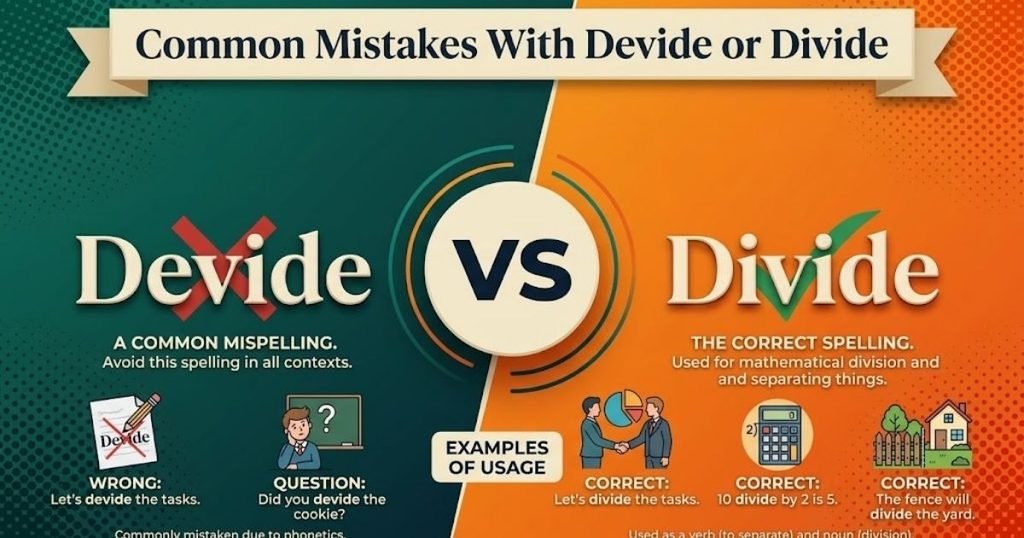
Incorrect: I need to devide this into two parts. Correct: I need to divide this into two parts. This is the core spelling error. “Devide” should always be replaced with “divide.”
Incorrect: She devided the money equally. Correct: She divided the money equally. The same misspelling carries into the past tense. Adding “-ed” does not fix the root spelling problem.
Incorrect: There is a big devide between the two opinions. Correct: There is a big divide between the two opinions. This shows the noun form is also affected. The spelling stays “divide” whether it functions as a verb or a noun.
Incorrect: We are devideing the responsibilities. Correct: We are dividing the responsibilities. Note that the gerund form drops the final “e” before adding “-ing,” so it becomes “dividing,” not “divideing” or “devideing.”
Related Words and Terms
A few related terms often appear alongside divide:
- Division: the noun form describing the act or result of dividing, as in math or organizational structure
- Divisible: an adjective meaning capable of being divided
- Divisor: the number by which another number is divided
- Subdivide: to divide something that has already been divided
- Undivided: not separated, or given full attention, as in “undivided attention”
None of these related words use the “devide” spelling either. The correct root “divide” carries through every form.
How to Remember the Correct Spelling
A simple memory trick: think of the word “diverse,” which also starts with “di” and relates to separation or difference. If you can spell diverse correctly, you can apply the same first-syllable pattern to divide.
Another option is to break the word into “di” plus “vide,” and remember that “di” often signals separation in English (as in “divide,” “diverge,” and “distinguish”).
FAQ’s
Is devide a real word?
No. “Devide” is not a recognized English word. It is a misspelling of “divide” and should not appear in any formal or informal writing.
What does divide mean?
Divide means to split something into separate parts or to create a separation, whether that is a physical object, a number, or a group of people with different opinions.
How do you use divide in a sentence?
Use divide as a verb to describe splitting something apart, such as “Please divide the bill among the four of us.” Use it as a noun to describe a gap, such as “There is a clear divide in public opinion.”
Is it divide or devide when talking about division in math?
It is always divide, as in “divide 12 by 3.” The spelling does not change based on context, whether you are talking about math, groups, or opinions.
Why does devide sound correct even though it isn’t?
The unstressed first syllable in divide is pronounced closely to “de,” which makes “devide” feel phonetically logical even though it is spelled incorrectly.
Conclusion
Divide is the only correct spelling, and “devide” should be treated as a typo to fix, not a valid alternative. Keep the “di” at the start in mind, and you will spell it correctly every time.

Smith Jason is an SEO expert with 2–3 years of experience, sharing grammar tips, confusing words, vocabulary and writing advice.










1 thought on “Devide or Divide: Which Spelling Is Correct?”