You want to write a sentence about taking someone to court, and suddenly you freeze. Is it “suing” or “sueing”? Both look plausible, and spellcheck doesn’t always catch the mistake fast enough to stop you from typing it in an email. Here’s the short version: “suing” is the correct spelling, and “sueing” is a common misspelling that should be avoided in any formal or professional writing.
Is It Suing or Sueing? The Quick Answer
“Suing” is correct. It is the present participle (the “-ing” form) of the verb “sue,” which means to start a legal action against someone. “Sueing” is not a recognized spelling in standard American or British English. If you remember one rule from this article, remember this: when a verb ends in a silent “e,” you usually drop that “e” before adding “-ing.” That single rule explains the entire spelling question.
What Does “Suing” Mean?
“Suing” describes the ongoing or continuous action of filing a lawsuit against a person, business, or organization. It comes from the verb “sue,” which means to pursue a legal claim in court.
You’ll typically see “suing” used in sentences that describe an action in progress, such as “She is suing her former employer,” or after certain verbs, like “He considered suing the contractor.”
Why Is “Sueing” Incorrect?
“Sueing” breaks a basic spelling rule of English. When a verb ends in a silent “e” and you add a suffix that starts with a vowel (like “-ing”), the silent “e” is dropped. “Sue” becomes “suing,” not “sueing,” for the same reason “make” becomes “making” and not “makeing.”
There is no dictionary, style guide, or legal reference that lists “sueing” as an accepted variant. It shows up online mostly because the double vowel pattern (u-e-i) feels unfamiliar, so writers instinctively want to keep the “e” for clarity. That instinct is understandable, but it isn’t correct.
The Grammar Rule Behind Dropping the Silent E
This rule is one of the more consistent ones in English spelling, and it applies to hundreds of verbs, not just “sue.”
The rule: If a verb ends in a single silent “e,” drop the “e” before adding a suffix that begins with a vowel, such as “-ing,” “-ed,” or “-able.”
Here’s how that plays out with similar verbs:
- Sue → Suing (not sueing)
- Hope → Hoping (not hopeing)
- Dance → Dancing (not danceing)
- Argue → Arguing (not argueing)
Notice the pattern. “Argue” is especially useful for comparison, since it also ends in “ue” and follows the exact same rule as “sue.” If you can remember that “arguing” only has one “e,” you can remember that “suing” works the same way.
There are exceptions to the silent “e” rule elsewhere in English (words like “dyeing” keep the “e” to avoid confusion with “dying”), but “sue” is not one of them. There is no competing word that “suing” could be confused with, so the standard rule applies cleanly.
Where Does the Word “Sue” Come From?
“Sue” entered English through Old French “suivre,” meaning “to follow” or “to pursue,” which itself traces back to the Latin “sequi,” meaning “to follow.” The legal sense of “sue,” meaning to bring a lawsuit, developed from this idea of following up on a claim or pursuing justice through the courts.
This origin is also why related words like “pursue,” “ensue,” and “sequel” share that same Latin root. They are all connected by the idea of following or continuing something, whether that’s a legal case, a story, or a chain of events.
How Do You Pronounce “Suing”?
“Suing” is pronounced SOO-ing (two syllables). The “u” carries the long “oo” sound from “sue,” and the “-ing” is added directly after it without inserting any extra sound for the missing “e.”
A helpful way to check your pronunciation is to say “sue” on its own first, then add “-ing” right to the end: sue plus ing equals suing. There is no separate “eh” sound anywhere in the word.
Suing vs Sueing: Quick Comparison
| Term | Correct? | Meaning | Use |
| Suing | Yes | Present participle of “sue”; taking legal action | Standard spelling in all contexts, formal and informal |
| Sueing | No | Not a recognized word | Common misspelling; avoid in any writing |
Read Related Post: Trailer or Trailor: Which Spelling Is Correct and Why?
How to Use “Suing” Correctly in a Sentence
“Suing” typically appears in one of a few grammatical patterns:
- As part of a continuous verb tense: “The company is suing its former partner.”
- After certain verbs that take a gerund: “She avoided suing him directly and settled instead.”
- As a noun-like form (gerund) acting as the subject of a sentence: “Suing over a minor dispute rarely pays off.”
In each case, the spelling stays the same. “Suing” does not change form based on tense placement; only the surrounding helping verbs shift (is suing, was suing, will be suing).
Real Examples of “Suing” in Everyday Use
Everyday conversation: “My neighbor is suing the landlord over the broken heating system.”
Workplace communication: “Legal has confirmed we are not suing the vendor at this time, but we’re keeping the option open.”
Academic writing: “The case study examines the risks small businesses face when suing larger competitors.”
Email: “Before suing, we recommend sending a formal demand letter to the other party.”
Business writing: “Suing a client should always be a last resort after mediation has failed.”
Casual writing: “Honestly, suing over $50 isn’t worth the hassle.”
Each of these examples uses “suing” in a natural, grammatically correct way, whether the tone is formal or relaxed.
Common Mistakes People Make With “Suing”
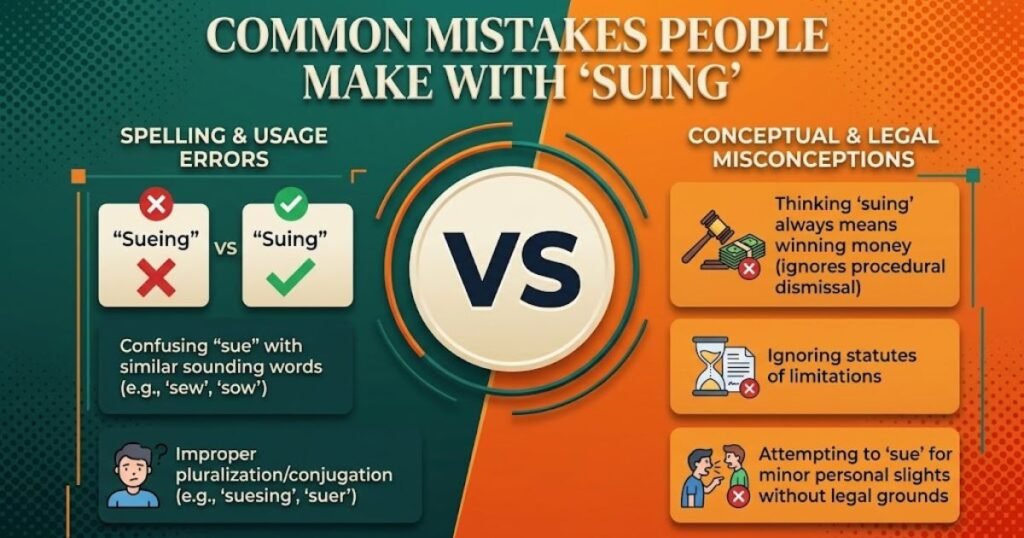
Incorrect: She is sueing her old roommate for damages. Correct: She is suing her old roommate for damages. The extra “e” is unnecessary and not a recognized spelling.
Incorrect: They’re planning on sueing the manufacturer. Correct: They’re planning on suing the manufacturer. Even in casual speech patterns like “planning on,” the verb form doesn’t change.
Incorrect: He mentioned sueeing us if the contract fell through. Correct: He mentioned suing us if the contract fell through. Adding two “e”s compounds the same original error.
These mistakes are common because “sue” is a short word, and short words with unusual letter combinations (like “ue”) often trip up even experienced writers. It’s a normal slip, not a sign of poor grammar overall.
Related Words and Legal Terms
Understanding “suing” is easier when you see it alongside related words:
- Sue (base verb): to bring legal action
- Sued (past tense): “He sued the airline last year.”
- Lawsuit (noun): the formal legal action itself
- Plaintiff: the person who files the lawsuit
- Defendant: the person being sued
- Litigation: the general process of taking legal action through the courts
Knowing these related terms helps you use “suing” accurately within a broader legal or everyday context.
Tips to Remember the Correct Spelling
If you tend to second-guess yourself, try one of these memory tricks:
- Compare it to “argue” and “arguing.” Both drop the “e” the same way.
- Say the word out loud slowly: sue, then ing. There’s no room for an extra “e” in the sound.
- Remember that English almost always drops a silent “e” before “-ing,” and “sue” doesn’t break that pattern.
Frequently Asked Questions
Is “sueing” ever correct?
No. “Sueing” is not a standard or accepted spelling in American or British English. “Suing” is the only correct form.
What does “suing” mean?
“Suing” means taking legal action against a person, business, or organization, usually by filing a lawsuit in court.
How do I use “suing” in a sentence?
Use it after a helping verb to show ongoing action, such as “They are suing the company for breach of contract.”
Why do people misspell “suing” as “sueing”?
The double vowel pattern in “sue” makes some writers feel like the “e” should stay before “-ing,” but standard English spelling rules require dropping it, just as with “argue” becoming “arguing.”
Is “suing” formal or informal?
“Suing” works in both formal legal writing and everyday conversation. The word itself isn’t casual or formal; the surrounding sentence determines the tone.
Final Takeaway
“Suing” is the only correct spelling, and it follows the same silent “e” rule that turns “argue” into “arguing.” Whenever you’re unsure, picture the base verb “sue,” drop the final “e,” and add “-ing.” That one small habit will keep “sueing” out of your writing for good.

Smith Jason is an SEO expert with 2–3 years of experience, sharing grammar tips, confusing words, vocabulary and writing advice.










1 thought on “Suing or Sueing: Which Spelling Is Correct?”