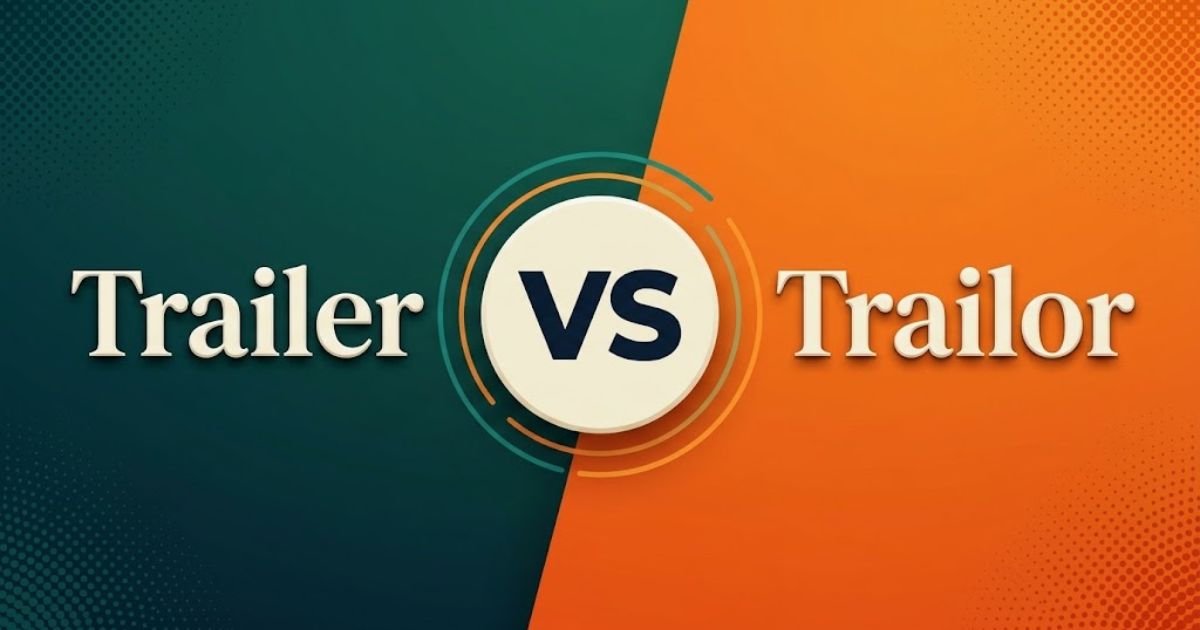
You typed “trailor” into a text message, paused, and thought: that doesn’t look right. You’re not wrong to pause. The correct spelling is trailer, and “trailor” is simply a misspelling with no accepted use in standard English. If you remember nothing else from this page, remember that one rule.
The Quick Answer: Trailer Is Correct, Trailor Is Not
Trailer is the only correct spelling in American and British English. It refers to a vehicle towed behind another vehicle, a preview clip for a movie or show, or the act of something that trails behind something else.
Trailor does not appear in any major dictionary, including Merriam-Webster, Oxford, or Cambridge. It’s not a regional variant, not an older spelling, and not an acceptable alternative in formal or informal writing. It’s a spelling error, usually caused by mixing up the “-er” ending with “-or,” which is common in English because both endings show up constantly in other words.
Why People Confuse Trailer and Trailor
The mix-up happens because English uses both “-er” and “-or” endings to describe a person or thing that does something. Words like actor, director, and sailor end in “-or.” Words like teacher, driver, and trailer end in “-er.” There’s no simple rule that tells you which ending applies to which word, so people often guess based on similar-sounding words they already know.
“Trailor” likely gets reinforced by its resemblance to “sailor,” a word with a nearly identical sound but a different origin and spelling pattern. Once a misspelling starts to look familiar, it becomes easy to repeat.
What Trailer Actually Means
Trailer is a noun (and sometimes a verb) with several related meanings, all connected to the idea of something that follows or trails behind.
- A towed vehicle: An unpowered vehicle pulled by a car, truck, or tractor, used to haul cargo, boats, campers, or livestock.
- A movie or show preview: A short promotional clip shown before a film or released online to generate interest.
- A mobile home: In casual American English, “trailer” is sometimes used informally for a manufactured home, though “mobile home” or “manufactured home” is the more neutral and accurate term.
- A plant that trails: In gardening, a “trailer” describes a plant that grows along the ground or spills over the edge of a container, such as ivy or certain petunias.
- A verb form: As a verb, “trailer” can mean to transport something using a trailer, as in “We trailered the boat to the lake.”
All of these meanings share the same spelling. There is no context, industry, or region where “trailor” is the accepted form.
Trailer vs Trailor: Comparison Table
| Term | Correct? | Meaning | Use |
| Trailer | Yes | Towed vehicle, movie preview, trailing plant, or verb meaning to tow | Standard in all writing, formal and informal |
| Trailor | No | No recognized meaning | Never correct; always a spelling mistake |
Read Related Post: Cocoon or Cacoon? Which Spelling Is Correct?
Grammar Breakdown: Part of Speech and Forms
Trailer is primarily a noun. It also functions as a verb in specific contexts, such as transporting a boat or camper.
- Singular: trailer
- Plural: trailers (a regular plural, formed by simply adding “s”)
- Verb forms: trailer, trailers, trailered, trailering
There is no irregular spelling change when the word takes a suffix. You don’t drop a letter or double a consonant, which makes the word fairly predictable once you know the base spelling is “trailer” and not “trailor.”
Where the Word Trailer Comes From
Trailer comes from the verb trail, which entered English from Old French trailler, meaning to tow or drag along. The “-er” suffix was added to describe something that does the trailing, or something that is trailed behind another object.
The vehicle sense of “trailer” became common in the early 1900s as horse-drawn and later motor-drawn carts became widespread. The movie preview sense developed later, in the 1910s and 1920s, when theaters began showing short promotional clips after the main feature, literally “trailing” the film. Over time, theaters moved these clips before the main feature, but the name stuck even though the placement changed.
There is no legitimate historical spelling of the word as “trailor.” It has consistently been spelled with “-er” since it entered common use.
How to Pronounce Trailer
Trailer is pronounced TRAY-ler (/ˈtreɪ.lər/), with stress on the first syllable. The pronunciation is identical whether you’re talking about a moving truck’s trailer, a movie trailer, or a mobile home.
Because “trailer” and “trailor” would sound exactly the same if “trailor” were a real word, pronunciation gives you no clue about which spelling is correct. This is one of the reasons the mistake is so easy to make and so easy to miss when reading your own writing.
Correct Usage in Real Sentences
Here’s how “trailer” shows up naturally across different types of writing.
Everyday conversation “Can you back the trailer up a little more? It’s not lined up with the hitch.”
Workplace communication “The delivery driver said the trailer won’t be unloaded until tomorrow morning.” This works in a logistics or warehouse context, where “trailer” refers to a semi-truck’s cargo unit.
Academic writing “Manufactured housing, often referred to informally as a trailer, has become a significant part of the affordable housing conversation in rural areas.” Academic writing favors the more formal term “manufactured housing” but may reference the informal word when discussing common usage.
Emails “Attached is the trailer for the new product launch video. Let me know if the pacing feels right.”
Business writing “Our fleet includes twelve refrigerated trailers used exclusively for perishable goods.”
Formal writing “The film’s trailer generated over ten million views within its first week of release.”
Casual writing “We hitched up the trailer and hit the road before sunrise.”
Every one of these examples uses the same spelling, “trailer,” regardless of tone or formality. There’s no version of English where “trailor” fits any of these sentences correctly.
Common Mistakes and How to Avoid Them
Incorrect: We loaded the boat onto the trailor. Correct: We loaded the boat onto the trailer. The word “trailor” doesn’t exist. Even though it sounds identical to “trailer,” it’s an unrecognized spelling in every dictionary.
Incorrect: Have you seen the new movie trailor yet? Correct: Have you seen the new movie trailer yet? This is the most common context where the misspelling appears, likely because the word gets typed quickly on phones or social media.
Incorrect: The truck was pulling a heavy trailor full of equipment. Correct: The truck was pulling a heavy trailer full of equipment. This mistake often happens when writers unconsciously borrow the “-or” pattern from similar-sounding words like “sailor” or “tailor.”
A simple trick to avoid the error: think of the verb trail. Add “-er,” the same way you’d add “-er” to “teach” to get “teacher.” If you can connect the word back to its root verb, the correct ending becomes easier to remember.
Words That Follow a Similar Pattern
A few related or similarly structured words can help you keep the spelling straight:
- Tailor: a person who makes or alters clothing (correctly spelled with “-or,” unlike trailer)
- Sailor: a person who works on or sails a ship (also “-or”)
- Trail: the root verb, meaning to follow behind or drag
- Trailing: the present participle form, as in “a trailing vine”
- Trailered: past tense of the verb, as in “The camper was trailered across three states”
Notice that “tailor” and “sailor” are correctly spelled with “-or,” which is exactly why they get confused with “trailer.” They rhyme and follow different spelling patterns, and English doesn’t give you a consistent rule to sort them out. You simply have to memorize each one.
Practical Guidance for Remembering the Correct Spelling
If you tend to second-guess this word, try one of these memory tricks:
- Connect it to trail: trailer is something that trails, just like teacher is someone who teaches.
- Remember that “-or” endings often apply to a person’s job or role (actor, sailor, tailor, doctor), while “trailer” is not a job title, it’s an object or action.
- If you’re editing your own writing, use your word processor’s spell checker, since “trailor” will almost always be flagged as incorrect.
Frequently Asked Questions
Is “trailor” ever correct?
No. “Trailor” is not a recognized word in any standard or specialized English dictionary. It’s always a misspelling of “trailer.”
What does “trailer” mean?
“Trailer” refers to a vehicle towed behind another vehicle, a short preview clip for a movie or show, or, informally, a mobile home. It can also function as a verb meaning to transport something by towing it.
Why do so many people misspell trailer as trailor?
The confusion comes from similar-sounding words like “sailor” and “tailor,” which end in “-or.” English doesn’t have a consistent rule for choosing between “-er” and “-or,” so the spelling gets guessed rather than known.
How do I use “trailer” correctly in a sentence?
Use it as a noun for the towed vehicle or preview clip: “We watched the trailer before the movie started.” Use it as a verb for transporting something: “They trailered the jet ski to the marina.”
Is “trailer” spelled differently in British English?
No. “Trailer” is spelled the same way in both American and British English. There is no regional variant that uses “trailor.”
The Bottom Line
Trailer is correct. Trailor is not a word, no matter how natural it might look after typing quickly or comparing it to words like “sailor” or “tailor.” The next time you’re unsure, picture the root verb “trail” and add “-er,” the same pattern you’d use for “teacher” or “driver.” That one mental shortcut is enough to get it right every time.

Smith Jason is an SEO expert with 2–3 years of experience, sharing grammar tips, confusing words, vocabulary and writing advice.