If you have ever paused mid sentence wondering whether to write “submission” or “submittion,” you are not alone. The confusion usually comes from how the word sounds when spoken quickly. Here is the short answer: “submission” is the only correct spelling. “Submittion” is not a real word in English, no matter how common the typo has become online.
Is It Submission or Submittion?
“Submission” is correct. “Submittion” is a misspelling and does not appear in any standard English dictionary. People often write “submittion” because they mentally double the “t” from the verb “submit,” the same way words like “committed” or “transmitted” double their consonants. Submission simply does not follow that pattern.
What Does Submission Actually Mean?
Submission is a noun with two common meanings:
- The act of presenting something for review, approval, or consideration (a job application, an essay, a form, or a manuscript).
- The act of accepting someone else’s authority, control, or decision, often used in phrases like “submission to authority.”
Both meanings come from the same root idea: yielding or offering something to another party for a decision.
Why Do People Write “Submittion” Instead?
The mistake happens for a simple reason. English speakers hear the “sh” sound in submission and instinctively try to match the spelling pattern of other “-mit” verbs that double the final consonant before adding a suffix, such as:
- Commit → committed
- Transmit → transmitted
- Permit → permitted
Since those words double the “t,” it feels natural to assume submit should too. But submission drops the double “t” and adds “-ssion” instead, which is a completely different suffix pattern rooted in Latin.
Submission vs Submittion: Quick Comparison Table
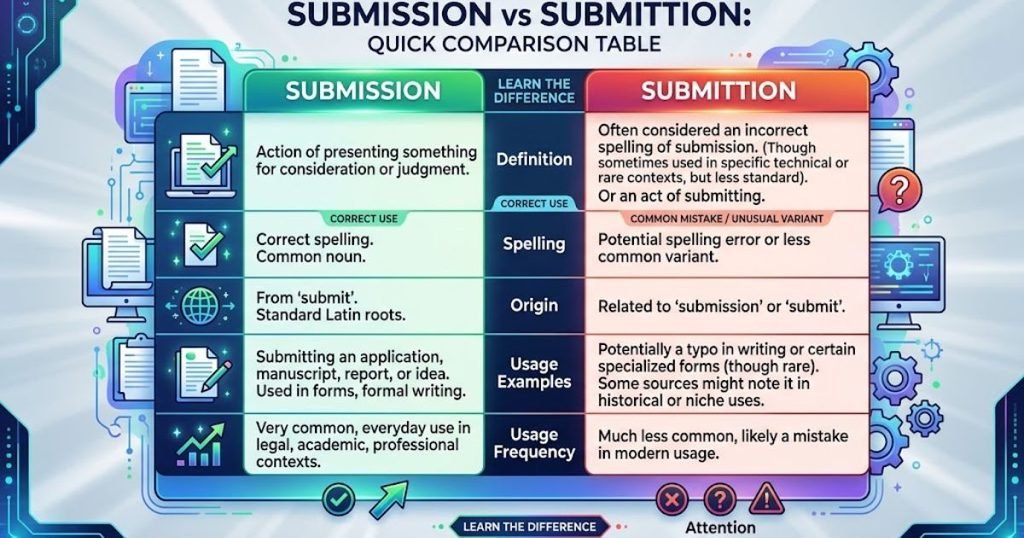
| Term | Correct? | Meaning | Use in a Sentence |
| Submission | Yes | Presenting something for review, or yielding to authority | “Please complete your submission by Friday.” |
| Submittion | No | Not a recognized word | Never used correctly |
Read Related Post: Suing or Sueing: Which Spelling Is Correct?
Grammar Breakdown of “Submission”
Part of speech: Noun
Pronunciation: sub-MISH-un (three syllables, stress on the second syllable)
Plural form: submissions (used when referring to multiple entries, applications, or files)
Related verb: submit (base form), submits (present tense, third person), submitted (past tense), submitting (present participle)
Related adjective: submissive (describing a person or tone that yields to authority)
Related adverb: submissively
Submission itself has no verb form. If you need a verb, use “submit,” not “submission” or “submittion.”
Where Does the Word “Submission” Come From?
Submission traces back to the Latin word submissio, formed from submittere, meaning “to send under” or “to yield.” The prefix sub- means “under,” and mittere means “to send.” Over time, the word passed into Old French as submission before entering English with essentially the same spelling it has today.
This Latin origin explains why the noun form uses “-ssion” instead of doubling the “t.” The suffix comes directly from the Latin -io ending, not from an English spelling rule about doubled consonants.
American English Usage
In American English, “submission” is spelled the same way in both formal and informal writing. There is no British English variation for this particular word. Unlike some words that differ across dialects (such as “color” versus “colour”), submission stays consistent worldwide.
How to Use “Submission” Correctly in a Sentence
Here are real examples across different contexts.
Everyday conversation: “Did you get the submission form for the photo contest?”
Workplace communication: “Your expense report submission is due before the end of the month.”
Academic writing: “Late submissions will not be graded unless a valid excuse is provided.”
Email: “Thank you for your submission. Our editorial team will review it within two weeks.”
Business writing: “The submission process includes uploading your resume and a short cover letter.”
Formal writing: “The court reviewed the defendant’s submission before issuing a ruling.”
Each of these sentences uses submission correctly because it refers either to something presented for review or, in the legal example, a formal argument offered for consideration.
Common Mistakes to Avoid
Incorrect: “Please send your submittion before the deadline.” Correct: “Please send your submission before the deadline.” This mistake happens because the writer doubles the “t” out of habit from verbs like “committed.”
Incorrect: “I already submittioned my application.” Correct: “I already submitted my application.” Here the writer mixed up the noun and verb forms. “Submitted” is the correct past tense verb.
Incorrect: “The submittion guidelines are on the website.” Correct: “The submission guidelines are on the website.” Again, this is simply the double “t” habit carrying over from unrelated verbs.
None of these mistakes are unusual. English spelling patterns are inconsistent, and it is easy to apply a rule from one word family to another that does not follow it.
Related Words You Should Know
- Submit (verb): to present something for approval or to yield to authority
- Submitted (past tense verb): “She submitted her resignation letter.”
- Submissive (adjective): showing a willingness to yield or obey
- Resubmission (noun): submitting something again after an initial rejection
- Application (noun): often used alongside submission in job or school contexts
- Entry (noun): a common synonym for submission in contest or competition settings
Understanding these related forms makes it easier to remember that submission is the noun anchor for the whole word family, and none of its relatives use a double “t” either.
Practical Tips to Remember the Correct Spelling
- Think of the phrase “submission has one T and two S’s,” similar to “mission” or “permission.”
- Remember that submission rhymes with mission, permission, and admission, all of which follow the same “-ssion” pattern without a doubled consonant before the suffix.
- If you are ever unsure, swap in a word you already spell correctly, like “permission.” If “permittion” looks wrong to you, “submittion” should look wrong too.
FAQ’s
Is “submittion” ever correct?
No. “Submittion” is not a recognized English word in any dictionary or formal context. It should always be replaced with “submission.”
What does “submission” mean in simple terms?
It means presenting something for review or approval, such as an application, essay, or form. It can also mean yielding to someone else’s authority or decision.
How do I use “submission” in a sentence?
Use it as a noun referring to something you send in for consideration. Example: “The magazine accepts short story submissions year round.”
Why do so many people misspell “submission” as “submittion”?
Because verbs like “commit” and “permit” double their final consonant before certain suffixes, writers often assume “submit” follows the same pattern. It does not, since the noun form uses “-ssion” instead.
Is “submission” a formal or casual word?
It works in both. You will see it in casual conversation, workplace emails, academic settings, and formal legal writing without any change in spelling or meaning.
Conclusion
“Submission” is the only correct spelling, and “submittion” should never appear in your writing. The easiest way to remember it is to compare it with familiar words like “permission” and “mission,” which share the same “-ssion” ending without a doubled consonant. Once that connection clicks, you will never second guess this spelling again.

Smith Jason is an SEO expert with 2–3 years of experience, sharing grammar tips, confusing words, vocabulary and writing advice.










1 thought on “Submission vs Submittion: Learn The Correct Spelling”