If you’re staring at a sentence and wondering whether it should read “the sun is shinning” or “the sun is shining,” you’re not alone. This mix-up happens constantly, and the confusion makes sense once you see why it happens.
Shining Is Correct: Here’s the Quick Answer
“Shining” is the correct spelling when you’re talking about giving off light, brightness, or a glow. It comes from the verb shine. “Shinning” is also a real word, but it means something completely different: it comes from the verb shin, meaning to climb something by gripping it with your hands and legs, like shinning up a rope or a tree. For almost every situation involving light, sunshine, or brightness, you want shining, not shinning.
What Does “Shining” Mean?
Shining describes something that gives off light or reflects it brightly. It’s the present participle of the verb shine, and it can also work as an adjective.
You’ll see it used in phrases like:
- The stars are shining tonight.
- She has a shining smile.
- He gave a shining example of leadership.
In each case, “shining” points to brightness, either literal (light, stars, sun) or figurative (a shining example, a shining moment).
What Does “Shinning” Mean?
Shinning is the present participle of shin, a verb that means to climb using your arms and legs, usually gripping a pole, rope, or tree trunk. It has nothing to do with light.
Examples of correct use:
- The firefighter was shinning up the pole in seconds.
- Kids love shinning up trees in the backyard.
- He shinned up the ladder to fix the roof.
This word shows up far less often in everyday writing, which is part of why people mistakenly use it when they actually mean “shining.”
Shining vs Shinning: The Key Difference
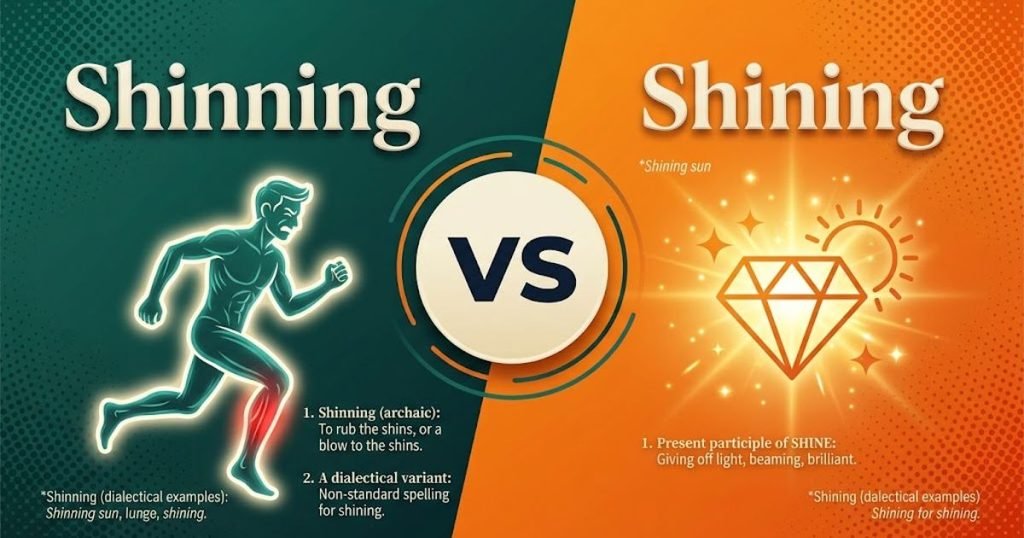
The core difference comes down to which base verb each word comes from:
- Shine (give off light) → shining
- Shin (climb by gripping) → shinning
Both words are spelled with double consonants or single consonants based on a basic English spelling pattern, and that pattern is exactly where the confusion starts.
Why This Confusion Happens
English has a spelling rule that decides whether you double the final consonant before adding -ing. The rule depends on the vowel sound in the base word:
- If the verb ends in a single consonant after a long vowel sound (like shine, with a long “i”), you drop the silent e and add -ing: shine → shining.
- If the verb ends in a single consonant after a short vowel sound (like shin, with a short “i”), you double the consonant before adding -ing: shin → shinning.
Since “shine” and “shin” look almost identical on the page, it’s easy to apply the wrong pattern. Most people default to doubling the “n” out of habit, which produces the misspelling “shinning” when they actually mean “shining.”
Where These Words Come From
Shine traces back to the Old English word scīnan, meaning to give light or glow, which itself comes from an older Germanic root related to brightness. This origin explains why “shine” has stayed connected to light and radiance for centuries.
Shin as a verb developed later from the noun shin, referring to the front part of the lower leg. The verb sense (to climb by gripping with the arms and legs) grew out of the physical motion of pressing your shins against something while climbing.
Read Related Post: Vendor vs Vender: Which Spelling Is Actually Correct?
How to Pronounce Each Word
The pronunciation difference matches the spelling difference:
- Shining is pronounced with a long “i” sound, like in “shine”: SHY-ning.
- Shinning is pronounced with a short “i” sound, like in “shin” (the body part): SHIN-ing.
If you say the word out loud and hear a long “i,” you want shining. If you hear a short “i,” you’re talking about shinning.
Shining vs Shinning at a Glance
| Term | Correct? | Meaning | Example Use |
| Shining | Yes | Giving off or reflecting light; also used figuratively for excellence | The moon was shining brightly. |
| Shinning | Yes (different word) | Climbing by gripping with hands and legs | He shinned up the flagpole. |
Both spellings are valid English words. The mistake isn’t that one is fake, it’s that people use “shinning” when they mean the light related word “shining.”
How to Use “Shining” Correctly (with Examples)
Shining works as a present participle (part of a verb phrase) or as an adjective.
Everyday conversation:
“Look how the lake is shining under that sunset.”
Workplace communication:
“Her presentation was a shining moment for the whole team.”
Academic writing:
“The study offers a shining example of rigorous methodology.”
Email or business writing:
“Thank you for your shining performance on the Q3 project.”
Casual writing:
“My shoes were shining after I finally cleaned them.”
In each sentence, “shining” connects to brightness, whether literal or used as praise for something excellent.
How to Use “Shinning” Correctly (with Examples)
Shinning almost always appears alongside a physical climbing action, often paired with “up.”
Everyday conversation:
“The cat went shinning up the tree to escape the dog.”
Descriptive or narrative writing:
“He was shinning up the drainpipe before anyone noticed he’d left the yard.”
Instructional or technical writing:
“Linemen are trained in shinning techniques for climbing utility poles safely.”
Because this word describes a specific physical action, you’ll rarely need it outside of stories, instructions, or descriptions involving climbing.
Common Mistakes to Avoid
Incorrect: The sun was shinning through the window.
Correct: The sun was shining through the window.
Explanation: Sunlight relates to the verb “shine,” so it needs the single “n” spelling, “shining.”
Incorrect: She has a shinning personality.
Correct: She has a shining personality.
Explanation: A bright, appealing personality is a figurative use of light, which calls for “shining.”
Incorrect: He was shining up the tree to grab the kite.
Correct: He was shinning up the tree to grab the kite.
Explanation: Climbing a tree by gripping it is the verb “shin,” not “shine,” so this rare case actually calls for “shinning.”
These mix-ups aren’t a sign of poor grammar skills. The words look nearly identical, and the spelling rule behind them is easy to forget under normal writing conditions.
Related Words Worth Knowing
A few related terms can help reinforce the distinction:
- Shine (base verb, present tense): The trophy shines on the shelf.
- Shone/Shined (past tense of shine): The light shone through the fog.
- Shin (noun): He bruised his shin on the coffee table.
- Shinned (past tense of shin): She shinned up the rope in record time.
- Gleaming, glowing, radiant (synonyms for shining in the light sense)
Keeping these related forms in mind makes it easier to remember which base verb you’re actually working from.
FAQ’s
Is “shinning” ever correct?
Yes. “Shinning” is correct when describing the act of climbing by gripping something with your hands and legs, such as shinning up a pole or tree. It is not correct as a substitute for “shining” when talking about light.
What does “shining” mean?
“Shining” means giving off or reflecting light, or, figuratively, standing out as excellent or admirable, as in a “shining example.”
How do I use “shining” in a sentence?
Use it to describe light or brightness, literal or figurative: “The stars were shining over the quiet field.”
Why do people confuse shining and shinning?
The confusion comes from an English spelling rule about doubling consonants before “-ing.” Since “shine” and “shin” look similar, writers often double the “n” out of habit, even when they mean the light related word.
Which spelling should I use for sunlight, stars, or brightness?
Always use shining. Any reference to light, glow, or brightness takes the single “n” spelling.
Conclusion
When you’re describing light, brightness, or something impressive, the correct word is shining. Save shinning for the specific case of climbing something by gripping it with your hands and legs. If you remember that “shine” gives you “shining” and “shin” gives you “shinning,” you’ll never second guess this one again.

Smith Jason is an SEO expert with 2–3 years of experience, sharing grammar tips, confusing words, vocabulary and writing advice.










1 thought on “Shinning vs Shining: The Correct Spelling?”