Good, this confirms my understanding: “nosy” is the standard/preferred spelling, and “nosey” is a recognized (if less common) variant spelling, not an outright error. Now I’ll write the article per the spec.# Nosey or Nosy: Which Spelling Is Correct
If you’ve paused mid-sentence wondering whether to write “nosey” or “nosy,” you’re not alone. The two spellings look almost identical and sound exactly the same, which makes the mix-up easy to understand. Here’s the short answer: “nosy” is the standard, preferred spelling, while “nosey” is a recognized but far less common variant.
The Quick Answer
“Nosy” is correct in nearly every context, especially in American English. It means overly curious about other people’s business, often in a way that feels intrusive. “Nosey” isn’t a typo or a grammar mistake exactly, but it’s a minor variant spelling that shows up more in casual writing and in British English than in formal or professional American writing. If you’re not sure which to use, “nosy” is always the safer choice.
What “Nosy” Actually Means
“Nosy” is an adjective that describes someone who pries into other people’s affairs, asks too many personal questions, or shows an unwelcome interest in things that don’t concern them. It carries a mildly negative tone, though it’s often used playfully rather than as a harsh insult.
For example, a “nosy neighbor” is someone who watches the street a little too closely. A “nosy coworker” might ask about your salary or your weekend plans in a way that feels overly personal. The word describes behavior, not a formal diagnosis of character, so it’s usually light criticism rather than a serious accusation.
Is “Nosey” Wrong?
Not exactly. “Nosey” is best described as a secondary spelling rather than an error. Dictionaries like Merriam-Webster and Collins list “nosey” as a recognized variant of “nosy,” and it appears often enough in published writing, especially from British sources, that it can’t be called a true misspelling.
That said, “nosy” is by far the more common and widely accepted form, particularly in the United States. If you’re writing anything formal, such as an email to a manager, a school paper, or a business document, “nosy” is the safer and more polished choice.
Nosy vs. Nosey: Quick Comparison Table
| Term | Correct? | Region | Best Used For |
| Nosy | Yes, standard spelling | American and British English | All writing, especially formal contexts |
| Nosey | Yes, but a minor variant | More common in British English | Casual writing, informal speech |
Read Related Post: Shiny vs Shiney: Which Spelling Is Correct
Why Two Spellings Exist for the Same Word
The confusion largely comes from the word “nose.” Since being “nosy” involves figuratively sticking your nose into someone else’s business, it feels natural to spell the word the way you’d spell other “-ey” additions, similar to how “clay” becomes “clayey.” Add to that the fact that “nosy” and “nosey” are pronounced identically, and the spelling mix-up becomes almost inevitable.
English also has a habit of tolerating small spelling variations that develop over time, especially when a word is based on a common root like “nose.” Over the years, “nosey” picked up enough use, particularly in the UK, to be accepted as a legitimate variant rather than fading out as an outright mistake.
Grammar Breakdown
“Nosy” functions as a standard adjective, and it follows regular adjective rules in English.
- Base form: nosy
- Comparative: nosier
- Superlative: nosiest
Notice that when adding endings, the “y” changes to “i” before adding a suffix that starts with a vowel, which is a standard spelling pattern in English (similar to “happy” becoming “happier” and “happiest”).
There is no widely used adverb form of “nosy.” Writers typically restructure the sentence instead, such as “She asked in a nosy way” rather than inventing an adverb like “nosily,” which does technically exist but is rarely used in everyday writing.
Where the Word Comes From
“Nosy” developed from the noun “nose,” combined with the “-y” suffix that turns nouns into descriptive adjectives, the same pattern seen in words like “messy” (from “mess”) or “greasy” (from “grease”). The connection makes sense: someone who is “nosy” is figuratively poking their nose into matters that aren’t theirs.
The word has been in common use since at least the 1800s, and its meaning has stayed remarkably consistent over time. It has always referred to unwanted curiosity about other people’s private affairs.
How to Pronounce “Nosy” (or “Nosey”)
Both spellings are pronounced the same way: NOH-zee. The stress falls on the first syllable, and the ending sounds like the “-y” in “cozy” or “rosy.” Since the pronunciation never changes based on spelling, sound alone won’t help you decide which version to write. That decision comes down to spelling convention, not phonetics.
American English vs. British English
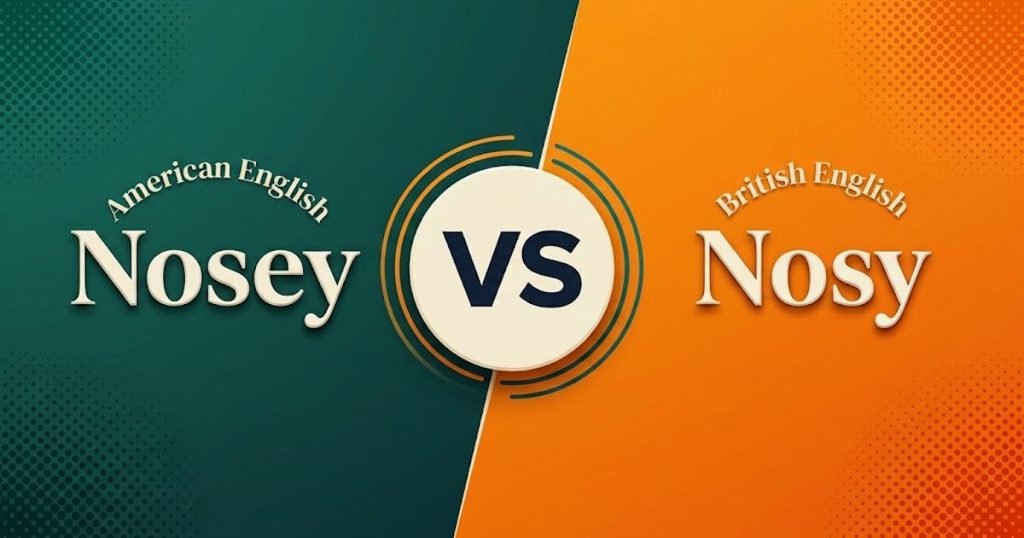
This is one of the clearer cases where regional preference plays a role.
In American English, “nosy” is strongly preferred, and most US style guides, newspapers, and dictionaries default to it. “Nosey” appears occasionally but is considered the less standard option.
In British English, “nosey” shows up more frequently in everyday writing, news articles, and casual speech, though “nosy” is still widely used and understood. Neither spelling is considered wrong in the UK, but usage is more evenly split than it is in the US.
If you’re writing for a specifically British audience, “nosey” won’t look out of place. If you’re writing for an American audience or unsure of your readership, “nosy” is the more universally accepted choice.
Real Life Examples
Everyday conversation:
“Don’t be so nosy, it’s none of your business who I’m texting.”
Workplace communication:
“I don’t mean to sound nosy, but is everything okay with the project timeline?”
Academic writing:
“The character’s nosy behavior drives much of the novel’s plot, as her curiosity repeatedly puts her in dangerous situations.”
Email:
“Sorry if this is a nosy question, but did the client ever get back to you about the contract?”
Business writing:
“Customer feedback described the survey questions as overly nosy, which likely contributed to the low completion rate.”
Casual writing:
“My neighbor is the nosiest person on the block; she knows everyone’s business before they do.”
Each of these examples uses “nosy” naturally, without forcing the word into an unnatural sentence. Notice how the tone stays mild and even a little humorous, which fits the word’s typical usage.
Common Mistakes to Avoid
Incorrect: “She’s always so noisy about what other people are doing.”
Correct: “She’s always so nosy about what other people are doing.”
This mix-up happens because “noisy” and “nosy” look and sound somewhat alike, but they mean completely different things. “Noisy” refers to sound, while “nosy” refers to curiosity about other people’s business.
Incorrect (in most formal writing): “The report described the questions as nosey and unprofessional.”
Correct: “The report described the questions as nosy and unprofessional.”
This isn’t a hard error, but in formal or professional writing, “nosy” is the stronger, more expected choice. Using “nosey” here isn’t wrong, but it may look slightly inconsistent with standard American usage.
Related Words and Terms
A few related words and phrases often come up alongside “nosy”:
- Nose in (phrasal verb): to intrude into something
- Stick one’s nose in: to interfere in someone else’s business
- Inquisitive: a more neutral or positive synonym
- Snoopy: a close synonym with a similar playful tone
- Prying: a more formal synonym, often used in writing
These words can help you vary your language when “nosy” starts to feel repetitive in a piece of writing.
Practical Guidance: Which Should You Use?
If you want one simple rule to remember, use this: default to “nosy” unless you have a specific reason to write “nosey.” A specific reason might include writing dialogue for a British character, matching the style of a British publication, or intentionally using a more casual tone. Outside of those situations, “nosy” is the spelling that will look correct to the widest audience.
FAQ’s
Is “nosey” a real word?
Yes. “Nosey” is a recognized variant spelling of “nosy,” listed in major dictionaries. It’s not a made up word or an outright error, just a less common form.
What does “nosy” mean?
“Nosy” describes someone who is overly curious about other people’s business, often in a way that feels intrusive or unwelcome.
How do I use “nosy” in a sentence?
You can use it as a straightforward adjective, such as: “He’s too nosy for his own good, always asking about things that don’t concern him.”
Is “nosy” or “nosey” British or American?
“Nosy” is preferred in American English. “Nosey” is more common in British English, though both spellings are understood in either region.
What’s the plural or verb form of “nosy”?
“Nosy” doesn’t have a plural form since it’s an adjective, not a noun. Its comparative and superlative forms are “nosier” and “nosiest.”
Conclusion
When deciding between “nosey” or “nosy,” reach for “nosy” as your default. It’s the spelling most dictionaries, style guides, and American readers expect, while “nosey” remains an accepted but secondary variant, more common in British English than American English. Remember that one simple rule, and you’ll never second guess this spelling again.

Smith Jason is an SEO expert with 2–3 years of experience, sharing grammar tips, confusing words, vocabulary and writing advice.










1 thought on “Nosey or Nosy: Which Spelling Is Correct”