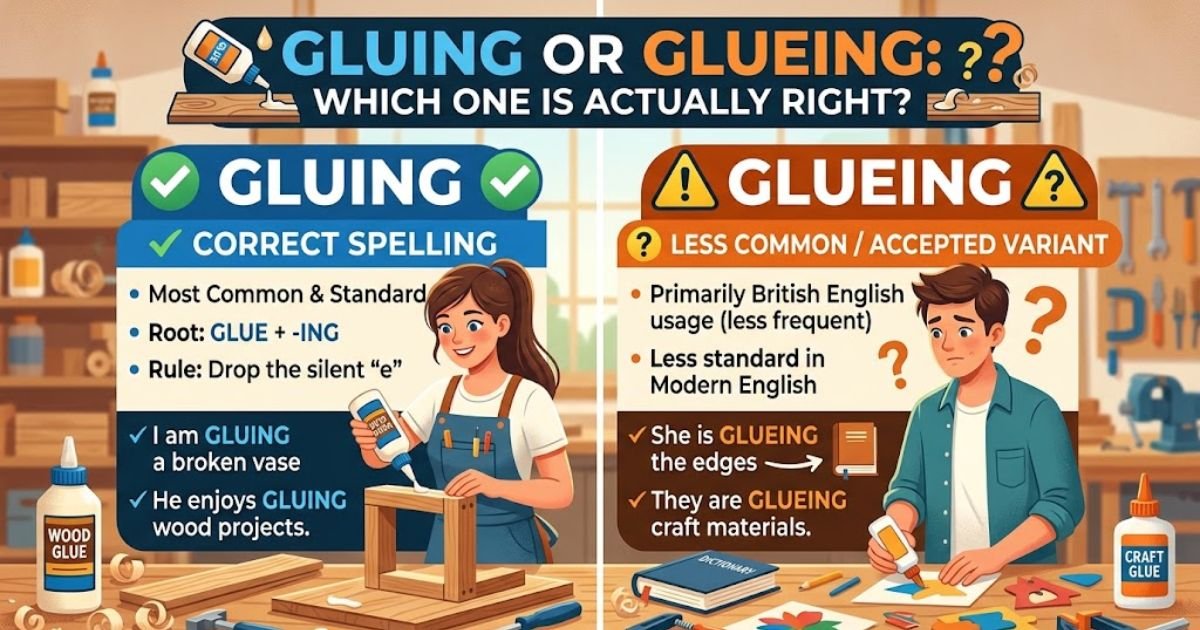
You are repairing a chair, you type the word, and your spell checker hesitates. Is it gluing or glueing? The confusion comes from the silent e in glue, which stays in the noun but usually disappears before -ing. Here is the answer: gluing is the standard spelling in American English. Glueing exists as a rare variant, but it is not the form to choose.
What Is the Correct Spelling, Gluing or Glueing?
The correct and standard spelling is “gluing.” It is the form used in American English, and it is also the dominant form in British English.
Use “gluing” in school papers, emails, product instructions, resumes, and anything else where you want clean, expected spelling. No style guide will mark it down.
“Glueing” is a minor variant. Some dictionaries list it, but writers rarely use it, and most editors will change it to “gluing.”
What Does Gluing Mean?
Gluing is the present participle of the verb “glue.” It describes the action of joining things with an adhesive.
Here is how it works in a sentence:
- She is gluing the broken handle back onto the mug.
- Gluing the pieces together took longer than building the model.
In the first sentence, “gluing” works as part of a continuous verb phrase (is gluing). In the second, it works as a gerund, which is an -ing word that acts like a noun. Both uses take the same spelling.
“Gluing” can also be figurative. A person who is “gluing together a plan” is assembling it from scattered parts.
Is Glueing Ever Correct?
Glueing is not exactly an error, but it is not recommended. It appears as a less common variant in some dictionaries, and you will occasionally see it in older texts or in British writing.
The practical rule is simple. If you are writing for a US audience, use “gluing.” If you are writing for a British audience, “gluing” is still the safer and more common choice.
Treat “glueing” the way you would treat an unusual spelling of any familiar word. It is understandable, but it makes readers pause, and clear writing should not make people pause over spelling.
| Term | Correct? | Meaning | Use |
| Gluing | Yes, standard | Joining with adhesive (present participle or gerund of “glue”) | Use in all writing, US and UK |
| Glueing | Rare variant | Same meaning | Avoid unless a style guide or a dictionary you must follow requires it |
| Glued | Yes | Past tense and past participle | Use for completed actions |
| Glues | Yes | Third person singular present, or plural noun | Use for “he glues” or “strong glues” |
Why Does Gluing Drop the E?
English has a common spelling rule: when a verb ends in a silent e, drop the e before adding -ing. The e only signals the vowel sound in the base word, and the -ing ending makes it unnecessary.
Look at other verbs that follow the same pattern:
- make becomes making
- argue becomes arguing
- continue becomes continuing
- issue becomes issuing
- rescue becomes rescuing
Glue belongs with argue, continue, and rescue. All of these end in -ue, and all of them drop the e before -ing. Writing “glueing” would make glue the odd one out.
Which Verbs Keep the E?
A few verbs keep the e before -ing, and that is probably why “glueing” looks plausible to some people. The e stays in these cases to prevent confusion or awkward spelling:
- dye becomes dyeing (so it is not confused with “dying”)
- singe becomes singeing (so it is not confused with “singing”)
- canoe becomes canoeing
- hoe becomes hoeing
- see becomes seeing (the e belongs to the double e)
These are exceptions with specific reasons. Glue has no such reason, because “gluing” is not easily confused with another word.
Read Related Post: Time Flies or Time Flys? I Found the Definitive Answer
How Do You Pronounce Gluing?
“Gluing” is pronounced GLOO-ing, with two syllables. The first syllable rhymes with “too,” and the second is a short “ing.”
The pronunciation does not change whether you spell it “gluing” or “glueing.” That is why the extra e adds nothing for the reader or the listener. It only changes how the word looks on the page.
What Are the Verb Forms and Grammar of Glue?
“Glue” works as both a noun and a verb. As a noun, it means an adhesive substance. As a verb, it means to attach something using that substance.
Here are the main forms:
| Form | Word | Example |
| Base form | glue | I need to glue this strip back on. |
| Third person singular | glues | He glues the labels by hand. |
| Past tense | glued | We glued the tiles yesterday. |
| Past participle | glued | The poster was glued to the wall. |
| Present participle / gerund | gluing | She is gluing the frame. |
The verb is regular, so the past tense and the past participle are the same (glued). The noun plural is “glues,” as in “wood glues and craft glues.”
The related adjective is gluey, meaning sticky or like glue. Notice that “gluey” keeps its e, because the ending -y begins with a consonant sound and the usual drop-the-e rule for -ing does not apply the same way.
There is also a small US and UK point worth knowing. Both varieties use “gluing” as the main form. The spelling difference you may recall between the two (such as “aging” versus “ageing”) does not extend to this word in any meaningful way.
Where Does the Word Glue Come From?
“Glue” entered English from Old French (glu) during the Middle English period. The French word traces back to Late Latin, and it is related to the Latin word for glue, which also gave English the word “gluten.”
That history explains the noun spelling with its final e, but it does not require the e to stay in the -ing form. English spelling dropped the silent e in that position long before modern spelling standards settled.
How Do You Use Gluing in a Sentence?
Here are natural examples from different settings.
Everyday conversation
- “I’m gluing the lid back on, so don’t touch it for an hour.”
Workplace communication
- “Our team is gluing the final display pieces together before the trade show.”
- “I’ll send photos once I finish gluing the prototype.”
Academic writing
- “The study compared the strength of joints formed by gluing and by screwing.”
Business writing
- “Gluing the components by hand slowed production, so the company switched to an automated process.”
Casual writing
- “Gluing glitter onto a card should not take this long, and yet here we are.”
In the academic example, “gluing” is a gerund and a noun substitute. That is why it appears after the preposition “by,” and the spelling is still “gluing.”
What Mistakes Do People Make With Gluing?

These mistakes are normal, and most of them come from how English spelling rules overlap.
Mistake 1: Keeping the e before -ing
Incorrect: I am glueing the pieces together.
Correct: I am gluing the pieces together.
Glue is an -ue verb, and these verbs drop the e before -ing, just like “argue” and “continue.”
Mistake 2: Dropping the e in the wrong place
Incorrect: The glu was too thick.
Correct: The glue was too thick.
The noun keeps its e. Only the -ing form drops it.
Mistake 3: Using the wrong tense form
Incorrect: She gluing the shelf yesterday.
Correct: She glued the shelf yesterday.
For past events, use “glued.” Use “gluing” with a helping verb, such as “is gluing” or “was gluing.”
Mistake 4: Treating glue like dye
Incorrect: He kept dying the fabric before gluing it.
Correct: He kept dyeing the fabric before gluing it.
The first sentence uses “dying,” which means something else entirely. Dye keeps its e to avoid that confusion, but glue has no matching reason.
What Related Words and Phrases Should You Know?
If you write about repairs, crafts, or construction, you may need these terms:
- Glued: the past tense and past participle (“The edges are glued.”)
- Gluey: sticky or glue-like (“a gluey paste”)
- Gluer: a person or machine that applies glue
- Glue gun: a tool that melts and applies adhesive
- Glue stick: a solid adhesive in a tube
- Glued to: a common idiom meaning fixed in attention (“glued to the screen”)
- Bonding, sticking, attaching, and cementing: related words for joining things
For wider vocabulary, “adhesive” is the more formal word, and “paste” usually refers to a thicker or water-based product. Both appear in technical writing where “glue” might feel too casual.
FAQ’s
Is “glueing” a real word?
Yes, it appears as a variant in some dictionaries, but it is rare. “Gluing” is the standard spelling and the one to use.
Is “gluing” correct in both American and British English?
Yes. Both varieties use “gluing” as the main spelling, so you do not need to adjust it for your audience.
What is the past tense of glue?
The past tense is “glued.” For example: “We glued the poster to the board.”
Why does “glue” drop the e in “gluing”?
English verbs ending in a silent e usually drop it before -ing, as in “making” and “arguing.” Glue follows the same rule.
What Should You Remember About Gluing?
Use gluing every time. It is the standard spelling, it matches how similar verbs like “arguing” and “continuing” behave, and it works in both American and British writing.
The easy memory trick: if you would write “arguing,” you should write “gluing.” Keep “glueing” as a rare variant you may see in older or unusual texts, and keep the e in the noun “glue” and in “gluey.”

Smith Jason is an SEO expert with 2–3 years of experience, sharing grammar tips, confusing words, vocabulary and writing advice.










1 thought on “Gluing or Glueing: Which One Is Actually Right?”