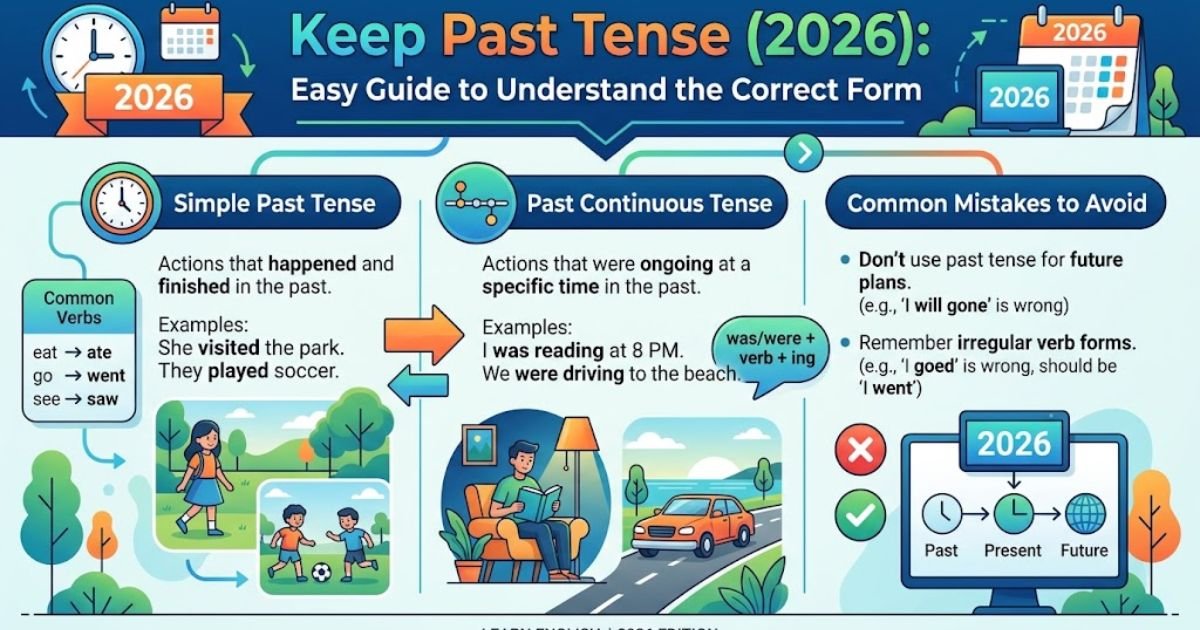
If you have ever paused mid sentence wondering whether to write “keeped” or “kept,” you are not alone. English learners and even native speakers sometimes hesitate here because the verb does not follow the usual “add ed” pattern. The short answer: the past tense of “keep” is “kept.” There is no situation in standard English where “keeped” is correct.
What Is the Past Tense of Keep? (Quick Answer)
“Kept” is the only correct past tense and past participle form of “keep.” It works the same way whether you are talking about something that happened yesterday or describing an action completed before another point in time. For example: “She kept her promise” and “He had kept the letter for years.” There is no regional variation here. American English and British English both use “kept” without exception.
Why Do People Get Confused About “Keep” in the Past Tense?
Most English verbs form their past tense by adding “ed,” like “walk” becomes “walked” or “jump” becomes “jumped.” Because this pattern is so common, learners naturally expect “keep” to become “keeped.” But “keep” belongs to a smaller group of irregular verbs that change their internal spelling instead of taking a regular ending. This mismatch between expectation and actual usage is where the confusion starts.
What Does “Kept” Mean?
“Kept” carries the same core meaning as “keep,” just shifted into the past. It can describe:
- Holding onto something (She kept the receipt.)
- Maintaining a state or condition (He kept quiet during the meeting.)
- Continuing an action over time (They kept working through the storm.)
- Following through on an obligation (We kept our word.)
The meaning depends heavily on context, but the grammatical form stays the same in every case.
Kept vs Keeped: Which One Is Correct?
Only “kept” is correct. “Keeped” is a common learner error, not an accepted variant, informal option, or regional form. Unlike some irregular verbs that have two accepted forms depending on dialect, “keep” has just one accepted past tense across all standard varieties of English.
| Term | Correct? | Meaning | Use |
| Kept | Yes | Past tense and past participle of keep | All contexts, formal and informal |
| Keeped | No | Not a recognized English word | Never used in standard writing or speech |
If you catch yourself typing “keeped,” simply swap it for “kept” and the sentence will read correctly.
Read Related Post: Shinning vs Shining: The Correct Spelling?
Is “Keep” a Regular or Irregular Verb?
“Keep” is an irregular verb. Regular verbs form their past tense by adding “ed” or “d” to the base form. Irregular verbs, including “keep,” change their spelling instead. Other irregular verbs that follow a similar vowel shift pattern include “sleep” becoming “slept” and “sweep” becoming “swept.” Recognizing this small family of verbs can make it easier to remember “kept” instead of defaulting to the regular pattern.
Grammar Breakdown: Verb Forms of Keep
Here are the core forms of “keep” so you can see how it behaves across tenses:
- Base form: keep (I keep my notes organized.)
- Present tense (third person singular): keeps (She keeps her desk tidy.)
- Past tense: kept (They kept the windows closed.)
- Past participle: kept (We have kept this tradition alive.)
- Present participle / gerund: keeping (He is keeping track of expenses.)
Notice that the past tense and past participle share the identical form, “kept.” This is common among irregular verbs and simplifies things once you memorize it, since you do not need separate forms for simple past and perfect tenses.
Where Does “Kept” Come From? (Word Origin)
The verb “keep” traces back to the Old English word “cēpan,” which meant to seize, observe, or pay attention to something. Over centuries, its meaning broadened to include holding, guarding, and maintaining, which is how we use it today. The irregular past tense “kept” developed through natural sound changes in the language rather than following the later “ed” pattern that became standard for most new and borrowed verbs.
How to Pronounce “Kept”
“Kept” is pronounced with one syllable: /kɛpt/, rhyming with “wept” and “slept.” The “k” sound is hard, and the word ends with a crisp “t” sound. There is no added syllable, so it should never sound like “keep-ed.”
How to Use “Kept” Correctly in a Sentence
Use “kept” any time you are describing a completed action in the past involving the verb “keep.” It fits naturally into simple past sentences and also pairs with helping verbs like “had” or “have” for perfect tenses.
- Simple past: “I kept the receipt in my wallet.”
- Present perfect: “She has kept every letter he sent.”
- Past perfect: “By the time I arrived, they had already kept the seat for me.”
In each case, “kept” does not change form regardless of subject or sentence structure.
Real Life Examples of “Kept” in Context
Everyday conversation: “I kept forgetting to call her back.”
Workplace communication: “The manager kept the team updated throughout the project.”
Academic writing: “The researchers kept detailed records of every trial.” This works well in formal writing because “kept” is neutral in tone and fits both casual and professional contexts.
Email: “Thank you for your patience. We have kept your order on file.”
Casual texting: “lol I kept losing my keys today.”
Each example uses “kept” the same way grammatically, which shows how flexible and consistent this single form really is.
Common Mistakes With Keep and Kept
Incorrect: “She keeped the documents safe.” Correct: “She kept the documents safe.” This happens when writers apply the regular “ed” rule to an irregular verb.
Incorrect: “He has keep the promise since 2020.” Correct: “He has kept the promise since 2020.” Here, the base form was mistakenly used instead of the past participle after “has.”
Incorrect: “They keept it a secret.” Correct: “They kept it a secret.” This is a simple spelling slip, adding an extra “e” that does not belong in the word.
None of these mistakes are unusual. They are a normal part of learning an irregular verb, and recognizing the pattern is the fastest way to stop making them.
Related Words and Phrases
A few related terms and expressions often come up alongside “keep” and “kept”:
- Keeping (present participle, as in “keeping busy”)
- Upkeep (a noun referring to maintenance)
- Keeper (someone or something that keeps or maintains)
- Kept up (a phrasal verb meaning maintained or sustained, as in “kept up the pace”)
- Kept back (held in place or delayed)
These variations show how the core verb extends into everyday vocabulary without changing its irregular past tense form.
Quick Tips to Remember the Right Form
If you tend to slip into “keeped,” try linking “keep” with similar irregular verbs like “sleep, slept” and “sweep, swept.” Practicing these together can help the pattern stick. It also helps to say the sentence out loud. “Keeped” sounds awkward once you are used to hearing “kept” in its place.
FAQ’s
Is “keeped” ever correct?
No. “Keeped” is not an accepted word in standard English. The correct past tense is always “kept.”
What is the past participle of “keep”?
The past participle is also “kept,” the same as the simple past tense form.
How do you use “kept” in a sentence?
Use it to describe a completed action involving keeping something, such as “I kept my notes organized” or “She has kept in touch with her old classmates.”
Is “keep” regular or irregular?
“Keep” is irregular. It does not follow the standard “add ed” rule that most English verbs use.
Does British English use a different past tense for “keep”?
No. Both American and British English use “kept” as the past tense and past participle of “keep.”
Conclusion
The past tense of “keep” is always “kept,” whether you are writing a casual text or a formal report. There is no accepted alternative, so once you commit “kept” to memory, you can use it confidently in any sentence, tense, or context.

Smith Jason is an SEO expert with 2–3 years of experience, sharing grammar tips, confusing words, vocabulary and writing advice.










1 thought on “Keep Past Tense (2026): Easy Guide to Understand the Correct Form”