If you have seen both spellings floating around online and felt unsure which one to trust, you are not alone. The correct spelling is “maxed.” “Maxxed” is an informal internet variation that shows up constantly in gaming chats, fitness forums, and meme culture, but it has not earned a place in standard dictionaries or professional writing. The confusion makes sense: English usually doubles a final consonant before adding “-ed” in short verbs, so “maxxed” looks like it should follow the same pattern as “planned” or “stopped.” It just does not.
The Short Answer: Maxed Is Correct
“Maxed” is the standard, dictionary-recognized past tense and past participle of the verb “max,” which itself is a shortened form of “maximize” or “reach the maximum.” You will see it in phrases like “maxed out my credit card” or “I maxed my score on the test.” “Maxxed” is a stylized slang spelling that internet communities use for emphasis, humor, or identity signaling, especially in gaming and self-improvement spaces. It is understood everywhere online, but it is not something you would use in a resume, a school paper, or a business email.
What “Maxed” Actually Means
“Maxed” describes reaching the highest possible point of something: a limit, a score, a capacity, or a level. It works the same way whether you are talking about money, video games, or physical effort.
A few common uses:
- Maxed out: completely full, exhausted, or pushed to the absolute limit (“My schedule is maxed out this week”).
- Maxed a stat or skill: reached the highest level available, often in a game (“I maxed my strength stat”).
- Maxed a credit card: spent up to the card’s limit.
- Maxed the volume: turned something all the way up.
In every one of these examples, “maxed” is doing the same grammatical job: it is a regular past-tense verb built from “max” plus “-ed.”
Why “Maxxed” Exists at All
If “maxed” is correct, why does “maxxed” show up so often? The extra “x” did not come from a grammar rule. It came from internet culture.
The spelling gained traction through “-maxxing” slang terms like “looksmaxxing” and “gymmaxxing,” which describe intense, often exaggerated efforts at self-improvement. These terms started in niche online communities and eventually spread into mainstream social media, where people now use them, often humorously, to describe almost any kind of self-improvement effort. Once “-maxxing” became a recognizable suffix, “maxxed” followed naturally as its past-tense partner, even though it breaks from standard spelling conventions.
Writers also lean toward the double “x” because it looks more intense or dramatic on the page. A doubled letter can visually suggest extra force, similar to how “sooo good” reads as more emphatic than “so good.”
The Grammar Behind the Spelling
English does double a final consonant before adding “-ed” in many one-syllable verbs, but only under specific conditions. The rule generally applies when a short verb ends in a single vowel followed by a single consonant, such as “stop” becoming “stopped” or “plan” becoming “planned.”
“Max” does not follow this pattern. It already ends in the letter “x,” and English spelling conventions do not double “x” before adding a suffix. Compare it to similar short verbs:
- fix → fixed (not fixxed)
- box → boxed (not boxxed)
- mix → mixed (not mixxed)
“Max” behaves exactly like these verbs. There is nothing unusual about it grammatically. The doubled “x” in “maxxed” is a stylistic invention, not a spelling rule applied incorrectly by accident in most cases, though many casual writers do genuinely believe it follows the doubling pattern.
Where “Max” Comes From
“Max” is short for “maximum,” which entered English from Latin, where it meant “the greatest” or “the largest.” Over the twentieth century, “max” evolved from an informal abbreviation into a fully functioning verb in its own right, used the same way as any other regular English verb. That verb form is where “maxed” comes from, following the same “-ed” pattern used across thousands of English verbs.
Read Related Post: First Cousin Once Removed vs Second Cousin: What’s the Difference?
How to Pronounce “Maxed” and “Maxxed”
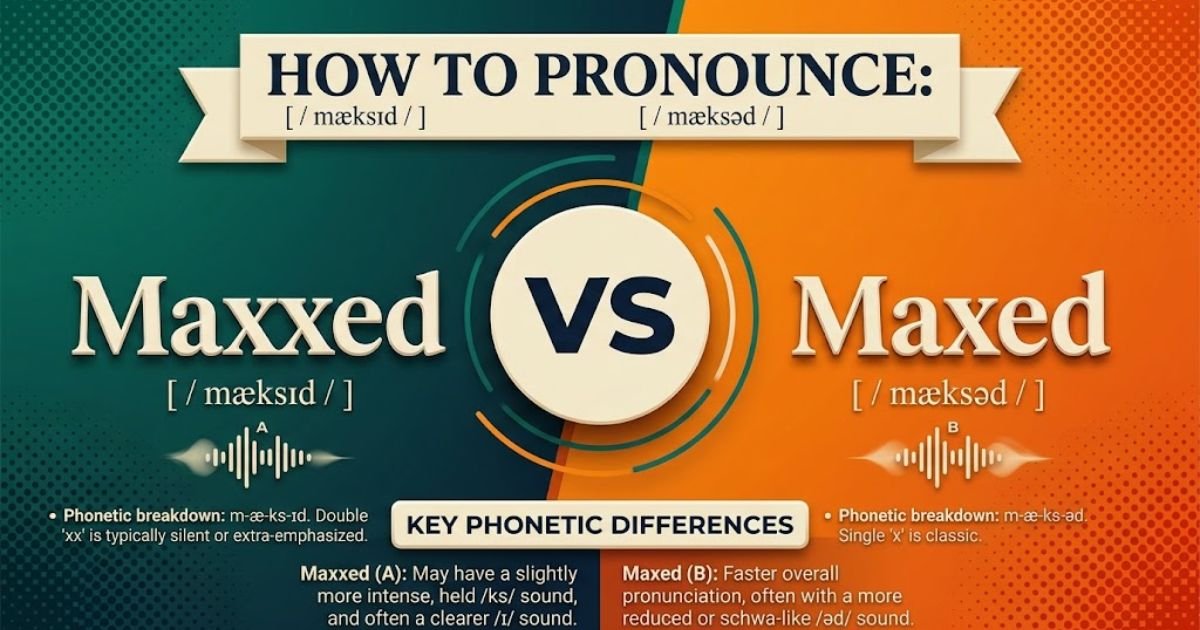
Both spellings are pronounced identically: “makst,” rhyming with “taxed.” The extra “x” in “maxxed” changes nothing about how the word sounds. It is purely a visual and stylistic choice, which is one more reason dictionaries have not adopted it as an alternate spelling.
Maxed vs. Maxxed at a Glance
| Term | Correct? | Meaning | Best Used For |
| Maxed | Yes, standard English | Reached the highest possible level or limit | Formal writing, professional communication, everyday use |
| Maxxed | No, internet slang | Same meaning, stylized spelling | Casual chats, gaming communities, memes, social media |
Real Life Examples of “Maxed” in Use
Everyday conversation: “I maxed out the AC because it is so hot today.”
Workplace communication: “We have maxed our storage capacity on the shared drive, so we need to clear some space.” This works in a professional email because “maxed” reads as clear, standard English rather than casual slang.
Academic writing: “The experiment showed that participant heart rates maxed at 180 beats per minute during peak exertion.”
Gaming (informal): “I finally maxed my character’s level after grinding all weekend.”
Formal business writing: “The department has maxed its allocated budget for this quarter and will require additional funding to proceed.”
Casual texting: “lol my phone battery is maxed, gotta charge it.”
Where You Will Actually See “Maxxed”
“Maxxed” is not wrong in the sense of being unintelligible. It simply belongs to a different register of English: casual, online, and community-driven. You will run into it in places like:
- Gaming forums and Discord servers (“I maxxed my build last night”)
- Fitness and self-improvement communities (“he’s fully gymmaxxed”)
- TikTok and X (formerly Twitter) captions
- Meme pages and comment sections
In these spaces, readers understand the word instantly and will not think twice about the spelling. The problem only shows up when “maxxed” migrates into contexts where readers expect standard English.
Common Mistakes to Avoid
Incorrect: I maxxed my score on the exam. Correct: I maxed my score on the exam. This mistake usually happens because writers overapply the consonant-doubling rule from words like “stopped” or “planned,” forgetting that “max” already ends in “x.”
Incorrect: Please note that our servers have maxxed capacity. Correct: Please note that our servers have maxed capacity. Slang spellings like “maxxed” can slip into professional writing simply because they feel familiar from everyday speech, but formal documents call for the standard spelling.
Incorrect: My car’s speed maxxxed out at 120 mph. (triple x) Correct: My car’s speed maxed out at 120 mph. Adding extra letters for emphasis is common in casual texting, but it has no place in any formal or semi-formal writing.
These are easy mix-ups, not signs of poor grammar overall. English spelling has plenty of inconsistent patterns, and “max” happens to sit right at the intersection of two of them.
Related Words and Slang Forms
Understanding “maxed” gets easier once you see it alongside related terms:
- Max out: the full phrasal verb form, meaning to reach the absolute limit.
- Maxing: the present participle, as in “maxing out my potential.”
- Looksmaxxing: slang describing efforts to improve one’s physical appearance.
- Gymmaxxing: slang describing intense gym or fitness routines.
- Maximize: the more formal verb, often preferred in professional or academic writing over “max out.”
Notice that the “-maxxing” slang family keeps the doubled “x” consistently, since it functions as its own internet-born suffix rather than a standard grammatical form.
Practical Guidance: Which One Should You Use?
The choice comes down to audience and context.
- Choose “maxed” for emails, reports, resumes, essays, articles, and any writing a stranger, teacher, or employer might read.
- “Maxxed” is acceptable informally if you are chatting with friends, posting on social media, or writing within a gaming or fitness community where the slang is already familiar to your audience.
When in doubt, default to “maxed.” It communicates the same meaning without any risk of looking like a typo or an unintentional error.
FAQ’s
Is “maxxed” a real word?
“Maxxed” is not found in standard dictionaries as an accepted spelling. It functions as internet slang, primarily within gaming, fitness, and meme communities, rather than as recognized standard English.
What does “maxed out” mean?
“Maxed out” means something has reached its highest possible limit or capacity, whether that is a credit card, a video game stat, physical effort, or storage space.
Is “maxed” the same in British and American English?
Yes. Both British and American English use “maxed” as the standard spelling. “Maxxed” appears as internet slang in both regions but is not treated as a formal variant in either.
Can I use “maxxed” in a text message?
Yes, informally. In casual conversation, texting, or social media, “maxxed” is widely understood and commonly used. It simply is not appropriate for formal or professional writing.
Why do people double the “x” in “maxxed”?
The extra letter comes from internet slang trends, particularly the “-maxxing” family of terms, where the doubled consonant adds visual emphasis and stylistic flair rather than following any grammar rule.
Conclusion
When you need to choose between maxxed or maxed, remember this simple rule: “maxed” is the correct, standard English spelling, and “maxxed” is a slang variation that belongs in casual, online spaces. Stick with “maxed” whenever you want your writing to read as clear, professional, and grammatically accurate.

Smith Jason is an SEO expert with 2–3 years of experience, sharing grammar tips, confusing words, vocabulary and writing advice.










1 thought on “Maxxed or Maxed: Which Spelling Is Correct? (2026)”