You typed a sentence, paused, and asked yourself: is it “to” or “too”? That split second of doubt happens to almost everyone, even confident writers, because the two words sound identical but do completely different jobs.
Here is the short version: “to” points toward something (a place, a person, an action), while “too” means “also” or “excessively.”
Quick Answer: Which One Do You Need?
If you can replace the word with “also” or “excessively” and the sentence still makes sense, use too. If you cannot, use to.
- “I want to go” (direction toward an action, not “also”)
- “I want to go too” (I also want to go)
Both words are correct English. Neither one is a mistake to avoid entirely. The real skill is knowing which job each word does in a given sentence.
What Does “To” Mean?
To is a preposition or part of an infinitive verb. As a preposition, it shows direction, destination, or a relationship between two things. As part of an infinitive, it pairs with a base verb to show purpose or intention.
- Preposition: “She walked to the store.”
- Infinitive: “He wants to learn Spanish.”
There is no plural or alternate spelling for this use. It stays “to” in every context where you are showing direction, connection, or attaching it to a verb.
What Does “Too” Mean?
Too is an adverb with two distinct meanings.
- Also, as well: “I’m coming too.”
- Excessively, more than needed: “The coffee is too hot.”
Notice the double “o.” That extra letter is the entire visual clue that separates this word from “to,” and it is worth memorizing because spell checkers often miss the difference since both are real words.
To vs Too: The Core Difference
| Word | Part of Speech | Meaning | Example |
| To | Preposition / infinitive marker | Direction, destination, connection to a verb | “Drive to the airport.” |
| Too | Adverb | Also, or excessively | “That bag is too heavy, and mine is too.” |
The confusion happens because both words are pronounced the same way: /tuː/. Your ear cannot tell them apart, so your eyes and your understanding of the sentence’s meaning have to do the work instead.
Read Related Post: Inact or Enact: Which Spelling Is Correct?
Where the Confusion Comes From
English has several homophones, words that sound alike but differ in spelling and meaning, and “to,” “too,” and “two” form one of the most common sets. Because pronunciation gives you no clue, the only reliable method is checking what role the word plays in the sentence. This is a spelling and function issue, not a pronunciation issue.
A Quick Grammar Breakdown
“To” as a preposition connects a verb, noun, or adjective to its object, usually showing movement or direction.
- “Send the email to your manager.”
- “This gift is to my sister.”
“To” as an infinitive marker sits directly before a base verb.
- “I need to finish this report.”
- “They plan to travel next month.”
“Too” as an intensifier modifies an adjective or adverb, showing excess.
- “You’re driving too fast.”
- “It’s too late to call.”
“Too” as an addition marker usually appears at the end of a sentence or clause, though it can appear elsewhere for emphasis.
- “My brother is coming too.”
- “I, too, believe this is the right choice.”
Where Does “Too” Come From?
Too developed from the Old English word “tō,” which originally functioned the same way “to” does today. Over time, English speakers began using a variant spelling to distinguish the “also” and “excessively” senses from the directional preposition, and the doubled vowel became the standard way to mark that difference. To comes from the same Old English root and kept the original single vowel spelling for its directional and infinitive uses.
How to Pronounce “To” and “Too”
Both words are pronounced identically: /tuː/, rhyming with “blue,” “true,” and “two.” There is no tone, stress pattern, or regional pronunciation that separates them in standard American English. This is precisely why relying on sound will never solve the confusion. Spelling and sentence context are the only dependable tools.
Real Life Examples in Context
Everyday conversation: “Can you come to my place after work? My roommate wants to come too.”
Workplace communication: “Please forward this to accounting. It’s too late to submit it this week, so we’ll aim for Monday.”
Academic writing: “The researchers presented their findings to the committee. The results were too limited to draw a firm conclusion.”
Email: “I’m looping in Sarah too, since she needs to review this before it goes to the client.”
Casual texting: “omw to your place, bring snacks too lol”
In each example, “to” attaches to a destination or a verb, while “too” adds emphasis or signals “as well.” Reading each sentence aloud and asking “does this mean also or excessively?” confirms the correct choice every time.
Common Mistakes with To and Too
Incorrect: I want to go to. Correct: I want to go too. The sentence needs “also,” so the second word requires the extra “o.”
Incorrect: This is too the museum. Correct: This is close to the museum. Here the sentence needs a preposition showing direction, not “excessively” or “also.”
Incorrect: It’s to hot outside. Correct: It’s too hot outside. The sentence describes an excessive amount of heat, which calls for “too.”
Incorrect: She’s coming too, the party is at my house. Correct: She’s coming to the party at my house. Here “to” introduces the destination, so the single-vowel spelling is correct.
These slips are common because the words sound the same and autocorrect does not always catch the error. Reading a sentence back slowly, and checking whether “also” or “excessively” fits, catches almost every mistake.
“To,” “Too,” and “Two”: Keeping All Three Straight
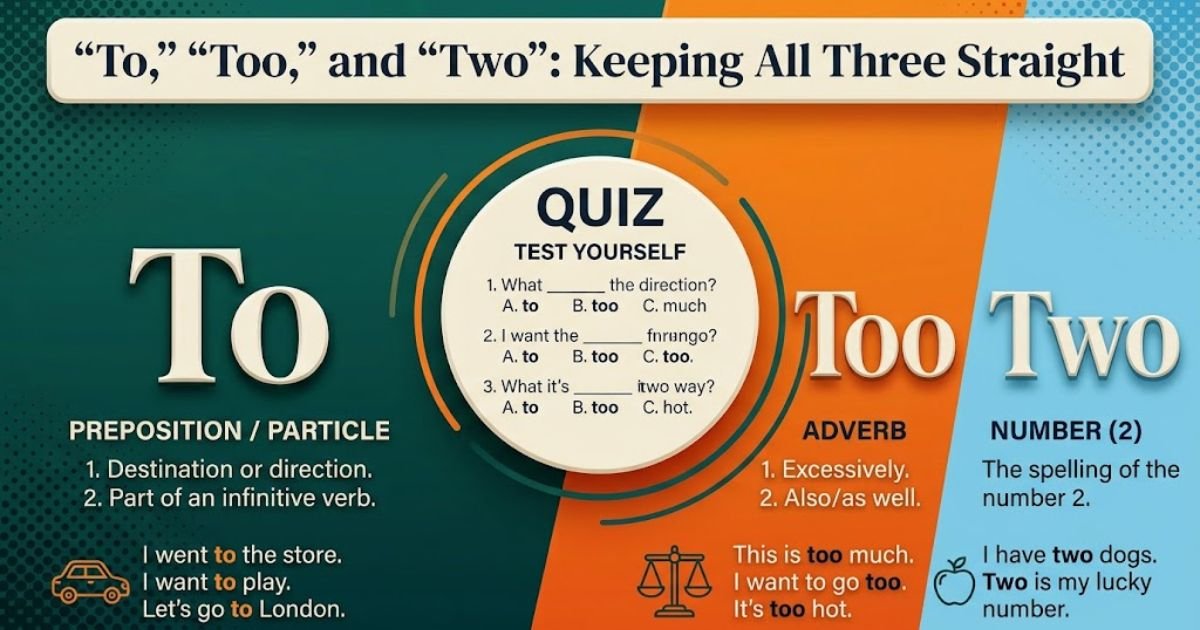
Since these three words share one pronunciation, it helps to separate all of them clearly.
- To: direction or infinitive marker (“go to school,” “want to try”)
- Too: also or excessively (“me too,” “too much”)
- Two: the number 2 (“two apples,” “two hours”)
A simple memory trick: too has an extra “o” for an extra amount (excessive) or an extra person/thing (also). Two is spelled like the number it represents, starting with the same letters as “twelve” and “twenty.”
Formal vs Informal Usage
Both words appear in formal and informal writing without restriction. There is no rule limiting “too” to casual speech or “to” to formal writing. What changes in formal writing is sentence placement: writers often prefer “as well” or “in addition” over “too” simply for variety and tone, not because “too” is grammatically wrong in formal contexts.
Practical Guidance: A Simple Test You Can Use
Before you commit to a spelling, try this two-step check.
- Can you swap the word for “also” and keep the meaning? If yes, use too.
- Does the word connect an action or object to a destination, person, or purpose? If yes, use to.
If neither test fits cleanly, read the sentence aloud and listen for whether you are describing direction or emphasis. That usually resolves any remaining doubt.
FAQ’s
Is “to” or “too” correct?
Both are correct English words with different meanings. “To” shows direction or introduces a verb, while “too” means “also” or “excessively.” The correct choice depends entirely on what the sentence is trying to say.
What does “too” mean in a sentence?
“Too” means either “also” (“I’m hungry too”) or “excessively” (“that’s too much”). Context tells you which meaning applies.
How do I remember the difference between to and too?
Think of the extra “o” in “too” as standing for an extra amount or an extra person joining in. “To” has no extra letter because it simply points toward something.
Can “too” start a sentence?
Yes, though it is less common. “Too many people showed up” is a correct and natural sentence structure.
Is it “me too” or “me to”?
It’s always “me too”, meaning “me also.” “Me to” is not a grammatically complete or correct phrase on its own.
Conclusion
“To” points toward a destination, person, or action, while “too” means “also” or “excessively.” When in doubt, try substituting “also” for the word in question. If it fits, you need “too.” If it doesn’t, “to” is your answer.

Smith Jason is an SEO expert with 2–3 years of experience, sharing grammar tips, confusing words, vocabulary and writing advice.










1 thought on “To or Too: Clear Difference, Meaning, and Usage”