You typed “inact” into a sentence, paused, and something felt off. That hesitation is your instinct working correctly. The correct word is “enact.” “Inact” is not a standard English word and should not be used in writing. Whenever you mean to describe passing a law, putting a plan into effect, or performing a role, “enact” is the spelling you want.
This confusion is common because English has a whole family of “in-” and “en-” words that sound similar but behave differently, and “inactive” (a real, correct word) sits right next to “inact” in most people’s memory. That overlap is exactly why the mistake happens.
What Does “Enact” Mean?
“Enact” is a verb. It means to make something official, usually by passing it into law, or to perform or act out a scene, role, or plan.
You will most often see it in two contexts:
- Legal and legislative use: A government body enacts a bill, turning it into law.
- Performance use: An actor or group enacts a scene, ceremony, or story.
Both meanings share a common thread: enact describes the moment something moves from idea to reality, whether that is a law or a performance.
Is “Inact” Ever Correct?
No. “Inact” is a misspelling, not an alternate form. It does not appear in Merriam-Webster, the Oxford English Dictionary, or any other major dictionary as a standalone verb. If you search for it, you will typically find spelling correction tools redirecting you straight to “enact.”
The confusion likely comes from three related words that do exist:
- Inactive (adjective): not active, not in operation
- Inaction (noun): the state of doing nothing
- Enact (verb): to put into effect or perform
Because “inactive” and “inaction” both start with “in-” and relate loosely to action, it is easy to assume a verb form called “inact” should exist too. It does not.
Enact vs Inact: Quick Comparison
| Term | Correct? | Meaning | Use |
| Enact | Yes | To make into law, or to perform a role or scene | “Congress enacted the new bill.” |
| Inact | No | Not a recognized English word | Always replace with “enact” |
| Inactive | Yes | Not active or operating | “The account has been inactive for months.” |
| Inaction | Yes | The state of not acting | “Their inaction cost the company a major client.” |
Read Related Post: Halves or Halfs: Which Spelling Is Correct?
Grammar Breakdown of “Enact”
“Enact” is a transitive verb, which means it needs a direct object to complete its meaning. You cannot simply say “they enacted.” You need to say what they enacted, such as a law, policy, or scene.
Here are its standard verb forms:
- Base form: enact
- Present tense (third person singular): enacts
- Past tense: enacted
- Past participle: enacted
- Present participle: enacting
Example across tenses:
- “Lawmakers enact new tax rules every fiscal year.” (present)
- “The state enacted a curfew last night.” (past)
- “The council has enacted three ordinances this quarter.” (present perfect)
- “They are enacting the emergency plan right now.” (present continuous)
Pronunciation
“Enact” is pronounced ih-NAKT, with stress on the second syllable. The “en-” prefix sounds like the letter “n” with a short “ih” sound before it, not like “in” with a long “eye” sound.
Where Does “Enact” Come From?
“Enact” comes from Middle English, formed by adding the prefix “en-” (meaning “to make” or “to put into”) to the word “act,” which traces back to the Latin “actus,” meaning a doing or a driving.
The prefix “en-” is a productive one in English, showing up in words like “enable,” “enforce,” and “endanger,” all of which describe causing something to happen or putting something into a particular state. “Enact” follows that same pattern: it means to cause an act, plan, or law to take effect.
There is no historical record of “inact” ever being a legitimate variant spelling. It appears to be a modern spelling error rather than an older or regional form.
How to Use “Enact” Correctly in a Sentence
“Enact” works best when paired with a clear object, such as a law, policy, rule, plan, or scene. Below are examples across different settings.
Everyday conversation: “Our neighborhood finally enacted a rule about quiet hours after 10 p.m.”
Workplace communication: “We need to enact the new safety protocol before the inspection next week.”
Academic writing: “The paper examines how quickly the reform was enacted following the vote.”
Business writing: “The board voted to enact the revised expense policy starting next quarter.”
Formal or legal writing: “Congress enacted the legislation after months of debate.”
Casual writing: “Once the new schedule is enacted, mornings should be a lot less chaotic.”
In each case, “enact” signals that something moved from proposal to reality. That is the core meaning to remember.
Common Mistakes With Inact and Enact
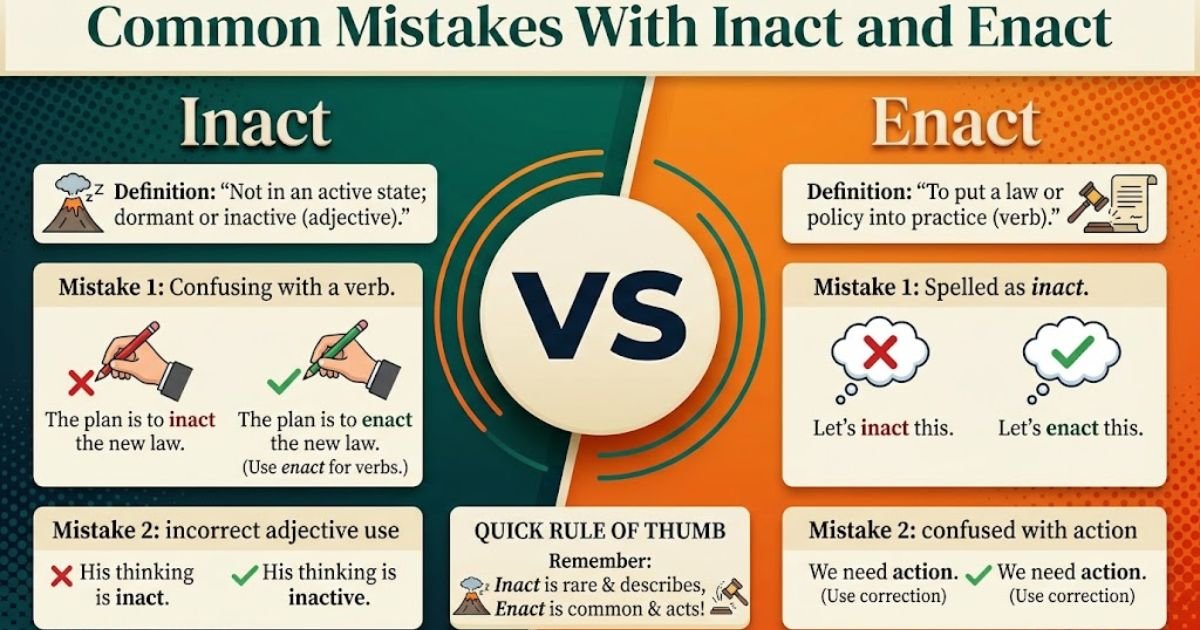
Incorrect: The city council will inact the new parking rules next month. Correct: The city council will enact the new parking rules next month.
The word “inact” does not exist, so any sentence using it needs the “en-” spelling instead.
Incorrect: The play inacts a famous historical battle. Correct: The play enacts a famous historical battle.
Even in the performance sense, “enact” is still the only correct spelling.
Incorrect: Their inactment of the ceremony was beautiful. Correct: Their enactment of the ceremony was beautiful.
This mistake extends to the noun form. “Enactment,” not “inactment,” is the correct spelling for the noun describing the act of enacting something.
Related Words to Know
Understanding a few related terms helps you avoid mixing them up in the future.
- Enactment (noun): the act of enacting something, such as a law
- Reenact (verb): to act out or perform again, often used for historical events
- Reenactment (noun): a performance that recreates a past event
- Inactive (adjective): not currently active or in use
- Inaction (noun): failure to act
- Inactivate (verb): to make something inactive, common in medical or technical writing
Notice that “inactivate” is a real word, but it means the opposite of “enact.” It describes shutting something down, not putting it into effect. Mixing up “inact,” “enact,” and “inactivate” is easy, but keeping their meanings separate will keep your writing accurate.
Practical Tips to Remember the Correct Spelling
- Think of “enact” as “en” plus “act,” meaning to put an act into motion.
- Remember that “in-” words in this family, like “inactive” and “inaction,” describe a lack of action, which is the opposite of what “enact” means.
- If your spellchecker underlines “inact,” trust it. There is no context where the underline is a false alarm.
- When in doubt, replace “inact” with “enact” and read the sentence again. It should sound correct immediately.
FAQ’s
Is “inact” a real word?
No. “Inact” is not recognized in standard English dictionaries. The correct word is always “enact.”
What does “enact” mean?
“Enact” means to make something official, typically by passing it into law, or to perform a role, scene, or plan.
How do I use “enact” in a sentence?
Pair “enact” with a direct object, such as a law or plan. Example: “The senate enacted the bill after a close vote.”
Is “enactment” the correct noun form?
Yes. “Enactment” is the standard noun form, describing the act of enacting something, such as a law’s enactment.
Is “inactive” related to “inact”?
Not directly. “Inactive” is a legitimate adjective meaning not active, but it is not the adjective form of “enact.” There is no verb “inact” for it to relate to.
Conclusion
When you need a word for passing a law, putting a plan into motion, or performing a scene, reach for enact, never “inact.” One simple way to remember it: “en-” means to make something happen, and that is exactly what enacting does.

Smith Jason is an SEO expert with 2–3 years of experience, sharing grammar tips, confusing words, vocabulary and writing advice.










1 thought on “Inact or Enact: Which Spelling Is Correct?”