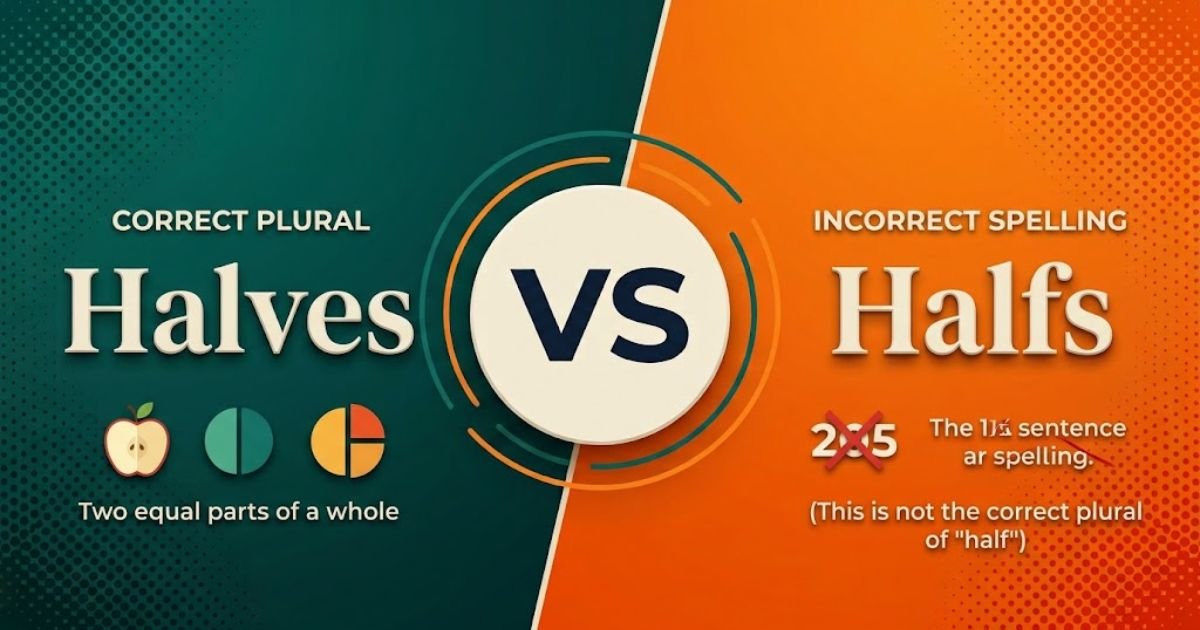
You split something in two, and now you need to write the plural. Your fingers want to type “halfs,” but something feels off. That instinct is worth trusting. The correct plural of “half” is “halves,” not “halfs.” “Halfs” is a common misspelling, not an accepted alternative.
The Quick Answer: Halves Is Correct
“Halves” is the only correct plural form of “half.” It follows an old English spelling pattern where certain nouns ending in “f” change to “ves” in the plural. “Halfs” appears often online and in casual writing, but no major dictionary lists it as a standard spelling. If you remember one rule from this article, remember this: one half, two halves.
This holds true across every context: formal writing, casual conversation, business documents, and academic papers all use “halves.” There is no informal exception where “halfs” becomes acceptable, and there is no regional variation between American and British English on this point. Both dialects treat “halves” as the standard plural.
What “Halves” Means
“Halves” is the plural of the noun half, meaning one of two equal parts of something. If you cut a sandwich into two equal pieces, you have two halves. The word also shows up in phrases like “in halves” (divided into two parts) and “meet someone halfway.”
“Halves” is also a verb form. When you say “she halves the recipe,” you mean she divides it into two equal portions. Same spelling, different job in the sentence, and both uses are grammatically correct.
Why “Halfs” Feels Right (But Isn’t)
Most English plurals are formed by adding an “s,” so “halfs” looks like a reasonable guess. Words like “cats,” “chairs,” and “books” all follow that pattern. The confusion makes sense because English has many exceptions, and “half” happens to be one of them.
The mistake usually comes from applying the regular plural rule to an irregular noun. It is one of the more understandable spelling errors in English, and plenty of fluent speakers slip on it occasionally.
The Grammar Rule: How Half Becomes Halves
English has a small group of nouns that end in “f” or “fe” and change that ending to “ves” in the plural. “Half” belongs to this group.
Here is the pattern in action:
| Singular | Plural | Correct? |
| half | halves | Yes |
| half | halfs | No |
| leaf | leaves | Yes |
| knife | knives | Yes |
| wolf | wolves | Yes |
| roof | roofs | Yes (exception) |
| chief | chiefs | Yes (exception) |
Notice that this rule is not universal. Words like “roof” and “chief” keep the regular “s” ending, which is exactly why the “f to ves” pattern trips people up. There is no shortcut here beyond learning which words follow which rule, but “half” is firmly in the “ves” category.
Linguists sometimes group these words by how they entered the language or how they were pronounced centuries ago, but for everyday writers, the practical approach is simpler: memorize the common exceptions as a set rather than trying to derive a universal rule. “Half” is one of the most frequent words in this set, so it is worth learning first.
Read Related Post: Lieing or Lying? Which One Is Correct (And Why It Matters)
Where the Word Half Comes From
“Half” traces back to Old English “healf,” which meant “side” or “part,” and further back to a common Germanic root. The plural “healfa” evolved over centuries into the modern “halves,” following the same sound shift that turned “leaf” into “leaves” and “wife” into “wives.”
This history explains why the irregular plural exists at all. It is not an exception invented to confuse learners. It is a leftover of older English pronunciation patterns that eventually settled into the spelling we use today.
In Old English, many words ending in a voiceless “f” sound shifted to a voiced “v” sound when a vowel ending was added, such as the plural marker. Over time, spelling caught up with pronunciation, which is how “healf” became “halves” while keeping the singular form closer to its original sound. This same shift shaped several of the other irregular plurals covered later in this article.
How to Pronounce Halves Correctly
“Halves” is pronounced /hævz/ in American English, rhyming with “calves.” The “l” is silent, just as it is in “half” (/hæf/). Many learners try to pronounce the “l,” but native speakers skip it entirely in both the singular and plural forms.
A quick way to check yourself: say “half” out loud. If you hear the “l,” you are overcorrecting. The word should sound like “haf.”
Halves as a Noun and as a Verb
“Halves” does double duty in English grammar.
As a plural noun, it refers to two equal parts:
- “Cut the orange into halves.”
- “Both halves of the cake were gone by noon.”
As a verb (third person singular of “to halve”), it means to divide something into two equal parts:
- “The manager halves the budget every quarter.”
- “This trick halves your cooking time.”
The spelling stays the same in both cases, which is part of why the word can feel tricky. Context tells you which job it is doing in a given sentence.
Halves in Real Sentences
Here are natural examples across different settings.
Everyday conversation: “Can you split the pizza into halves? I’m not that hungry.”
Workplace communication: “We divided the presentation into two halves so both teams could contribute.”
Academic writing: “The study population was split into two halves, one receiving treatment and one serving as a control group.”
Email: “I’ve attached both halves of the report. Let me know if the formatting needs adjusting.”
Casual writing: “He ate one half of the sandwich and saved the other half for later.”
Business writing: “The fiscal year is typically reported in two halves, H1 and H2.”
Each of these sentences uses “halves” as a plural noun describing equal parts, which is the most common use you will encounter.
Common Mistakes With Halves and Halfs
Incorrect: She split the cookie into two halfs. Correct: She split the cookie into two halves. This is the most frequent version of the mistake. “Halfs” simply is not a recognized English plural.
Incorrect: Both halfs of the team agreed on the plan. Correct: Both halves of the team agreed on the plan. Even in informal writing, “halfs” is not standard, so it is worth correcting in professional or academic contexts.
Incorrect: He half’s the difference every time. Correct: He halves the difference every time. Adding an apostrophe before the “s” turns the word into an incorrect possessive form. “Halves” needs no apostrophe when used as a verb or plural noun.
Mistakes like these are common because “half” behaves differently from most English nouns. There is nothing wrong with getting it wrong once. The goal is just to catch it going forward.
Words That Follow the Same Pattern
If “halves” feels unusual, it helps to see it as part of a small family of words rather than a one-off exception. Other nouns that shift from “f” to “ves” in the plural include:
- leaf → leaves
- knife → knives
- life → lives
- wife → wives
- loaf → loaves
- shelf → shelves
- calf → calves
Learning “halves” alongside these words can make the pattern easier to remember, since they all follow the same shift in sound and spelling.
Quick Tips to Remember the Correct Spelling
- Picture two calves standing next to two halves. Both end in “ves,” and both come from words ending in “f.”
- Say the word out loud. “Halfs” sounds awkward and clipped, while “halves” flows naturally in a sentence.
- Remember the phrase “meet me halfway,” which uses the same base spelling pattern as “halves.”
- When in doubt, check a dictionary rather than relying on autocorrect, since some tools do not flag “halfs” as an error.
FAQ’s
Is “halfs” ever correct?
No. “Halfs” is not accepted in standard American or British English. The only correct plural of “half” is “halves.”
What is the plural of half?
The plural of “half” is halves. For example: “one half” becomes “two halves.”
How do you use “halves” in a sentence?
Use “halves” to describe two equal parts of something, such as “Cut the apple into halves,” or as a verb meaning to divide something in two, such as “This method halves your prep time.”
Why does “half” change to “halves” instead of just adding an “s”?
“Half” belongs to a small group of English nouns ending in “f” that shift to “ves” in the plural, a pattern inherited from Old English. Other examples include “leaf/leaves” and “knife/knives.”
Is “halves” pronounced with an “l” sound?
No. The “l” is silent. “Halves” is pronounced like “havz,” matching the silent “l” in “half.”
Conclusion
“Halves” is the correct plural of “half,” and “halfs” is a spelling to avoid in any formal or casual writing. The rule traces back to an old English pattern shared with words like “leaves” and “knives,” so once you learn it for one word, it applies to several others. The next time you split something in two, you will know exactly how to spell it: two halves, no exceptions.

Smith Jason is an SEO expert with 2–3 years of experience, sharing grammar tips, confusing words, vocabulary and writing advice.










1 thought on “Halves or Halfs: Which Spelling Is Correct?”