You just typed a quick reply to a friend, or maybe you’re finishing an email, and you paused. Is it “you too” or “you to”? The two look almost identical and sound exactly the same out loud, which is exactly why so many people freeze up over them. Here’s the short version: “you too” is the correct phrase when you mean “also” or “as well.” “You to” is not a standalone phrase at all. It only shows up correctly as part of a longer sentence, like “I need you to call me back.”
You Too or You To: The Quick Answer
“You too” is correct whenever you’re adding agreement, returning a wish, or saying something applies to another person as well. Example: “Have a great weekend!” “You too!”
“You to” is not a complete phrase. The word “to” here is a preposition or part of an infinitive verb, and it only makes sense attached to a verb that follows it, such as “I want you to know” or “she asked you to leave.” On its own, “you to” is a grammar mistake.
If you remember nothing else from this article, remember this: “too” means “also,” and “to” points toward an action or a destination.
What Does “You Too” Mean?
“Too” is an adverb meaning “also,” “as well,” or “in addition.” When you attach it to “you,” you’re saying that something applies to the other person just as it applies to you.
It shows up constantly in everyday speech:
- “Good luck on your exam.” “You too!”
- “I missed you.” “I missed you too.”
- “Nice job today.” “You too, thanks!”
In every one of these, “too” is doing the work of “also,” and the sentence would still make sense (though sound a little more formal) if you swapped in that word instead.
Is “You To” Ever Correct on Its Own?
No. “You to” by itself is never grammatically complete. There’s no context where a native English speaker would correctly end a sentence with “you to” and stop there.
That said, “to” absolutely belongs right after “you” in longer sentences. In those cases, “to” is functioning as part of an infinitive (to go, to see, to help) or as a preposition connecting “you” to something else.
Examples where “to” correctly follows “you”:
- “I need you to finish this by Friday.”
- “She gave the keys to you.”
- “This letter is addressed to you.”
Notice that in all three, “to” is attached to a verb or is part of a phrase, never standing alone as a reply or a complete thought.
You Too vs You To: The Real Difference
The confusion isn’t really about meaning. It’s about spelling and function. Here’s the plain breakdown:
| Term | Correct on Its Own? | Function | Example |
| You too | Yes | “Too” is an adverb meaning “also” | “Have a safe trip.” “You too.” |
| You to | No | “To” is a preposition or infinitive marker, needs a verb after it | “I want you to call me.” |
“You too” answers the question “does this apply to me as well?” “To” after “you” answers a completely different grammatical need: it connects “you” to an action or object.
Read Related Post: Infront or In Front: Which One Is Correct? Complete Grammar Guide
Why These Two Get Mixed Up So Often
The mix-up comes down to three things happening at once.
First, “to” and “too” are homophones, meaning they sound identical when spoken. Your ear can’t tell them apart, so your fingers sometimes follow your ear instead of the rule.
Second, autocorrect and quick typing habits train people to drop the second “o” without noticing, especially on phones.
Third, many people never learned the distinct jobs these words do in a sentence, so the spelling feels arbitrary rather than logical.
Once you see “too” as its own word meaning “also” or “excessively,” the confusion tends to clear up fast.
Grammar Basics Behind Too, To, and You
A quick breakdown of each word’s job:
You is a second person pronoun. It can refer to one person or many, and it stays the same whether it’s the subject or object of a sentence (“you are here” and “I called you” both use the same word).
Too is an adverb. It has two main meanings: “also” (“I’m coming too”) and “excessively” (“it’s too loud”). It always adds emphasis or extra information to the words around it.
To is most often a preposition (“go to the store”) or the marker that begins an infinitive verb (“to run,” “to think,” “to decide”). It signals direction, purpose, or connection.
In American English, all three of these words are spelled and used the same way as in British English. There’s no regional variation here, so this isn’t a US versus UK issue: it’s a straightforward spelling and function distinction.
Pronunciation: Why They Sound Identical
Both “to” and “too” are pronounced the same way in nearly all standard American accents, roughly like “too” in “food.” This is precisely why the error is so common in writing but never happens in speech: nobody mishears “you too” as “you to” in conversation. The mistake is entirely visual, which means the fix is visual too. Train your eye to check the spelling, not your ear.
You Too or You To at a Glance
Here’s a fast reference you can bookmark:
| Situation | Correct Form | Why |
| Replying “same here” | You too | “Too” means “also” |
| Wishing someone well back | You too | Adds agreement |
| Asking someone to do something | You to (within a sentence) | “To” starts an infinitive |
| Ending a sentence with just these two words | You too | “You to” alone is incomplete |
How to Use “You Too” Correctly
Use “you too” whenever you’re confirming that a statement applies to the other person as well.
Everyday conversation: “Enjoy the party!” “You too, have fun!”
Workplace communication: “Great presentation today.” “Thanks, you too, the team really pulled together.”
Text or casual writing: “Miss you already.” “Miss you too!”
Formal writing (less common, but valid): “We wish you continued success, and we hope the same for you too in the coming year.”
In each case, “too” is reinforcing that something (a wish, a feeling, a compliment) goes both directions.
How to Use “You” Plus “To” Correctly
Use “to” right after “you” when it’s part of a larger instruction, request, or description involving an action.
Email: “I’m writing to ask you to review the attached draft.”
Business writing: “Management has asked you to submit the report by Monday.”
Academic writing: “The professor instructed you to cite three sources.”
Casual speech: “I told you to bring an umbrella.”
In every example, “to” connects “you” to a verb (review, submit, cite, bring), which is exactly the job “to” is built for.
Common Mistakes With “You Too” and “You To”
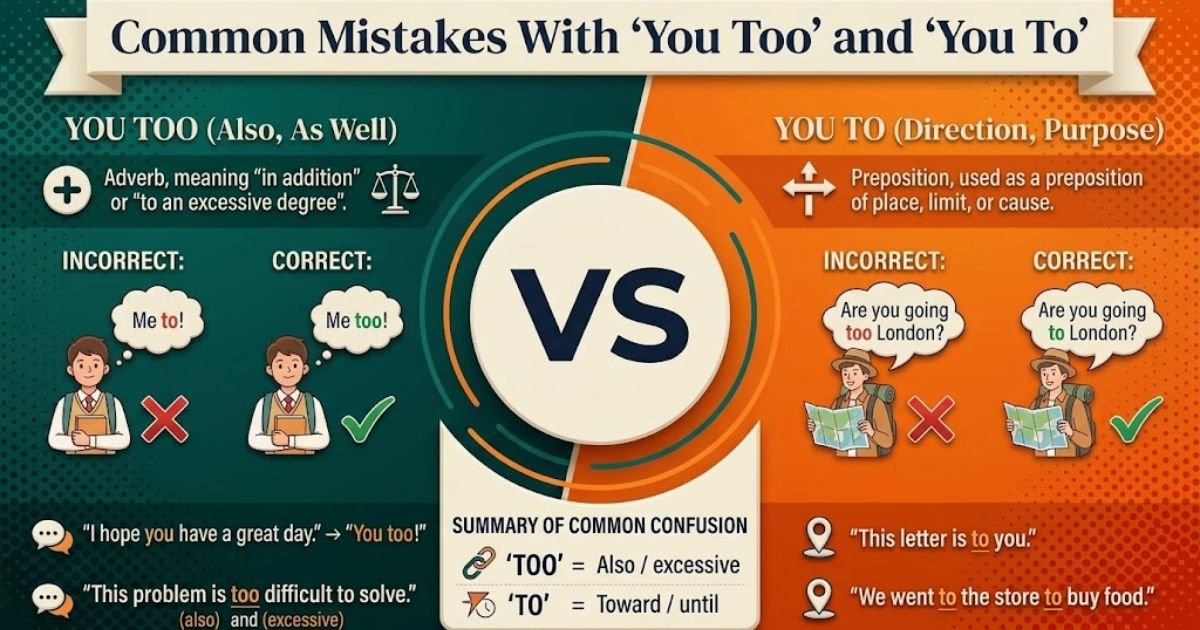
Incorrect: “Nice seeing you today, you to!” Correct: “Nice seeing you today, you too!” Reason: this is a reply meaning “also,” so it needs “too,” not “to.”
Incorrect: “I need you too finish this report.” Correct: “I need you to finish this report.” Reason: “to” here starts an infinitive (“to finish”), so the extra “o” doesn’t belong.
Incorrect: “Have a good one, you to.” Correct: “Have a good one, you too.” Reason: standalone replies wishing something back almost always need “too.”
A simple test: if you can replace the word with “also” and the sentence still makes sense, you need “too.” If you can’t, you almost certainly need “to.”
FAQ’s
Is “you too” correct?
Yes. “You too” is the correct spelling whenever you mean “also” or “as well,” such as in replies like “Have a nice day.” “You too.”
Is “you to” ever correct?
Only as part of a longer sentence where “to” connects “you” to a verb, such as “I want you to stay.” It is never correct as a standalone phrase.
What does “you too” mean?
It means the statement being made also applies to the person you’re speaking to. It’s short for something like “the same goes for you” or “that applies to you as well.”
How do I remember the difference?
Try the “also” test. If swapping in “also” keeps the sentence sensible, use “too.” If it doesn’t, you probably need “to,” and there’s likely a verb coming right after it.
Why do “to” and “too” sound the same?
They’re homophones in standard American English, both pronounced like the word “too” in “food.” The identical sound is exactly why the spelling mistake is so common in writing.
Conclusion
“You too” is the correct standalone phrase for agreeing, wishing something back, or saying something also applies to someone else. “You to” only works when it’s tucked inside a longer sentence, connecting “you” to an action that follows.
The next time you’re unsure, run the quick “also” test: if “also” fits, you want “too.” If it doesn’t, check for a verb right after “to,” and you’ll have your answer every time.

Smith Jason is an SEO expert with 2–3 years of experience, sharing grammar tips, confusing words, vocabulary and writing advice.










1 thought on “You Too or You To: What’s the Correct Grammar in 2026?”