You typed “aswell” and something felt off, so now you are here checking. That instinct was right. “As well” is the only correct form. “Aswell” is a common misspelling that has never been accepted as standard English, no matter how often it shows up in texts and casual writing.
Here is the short version: “as well” is two separate words that mean “also” or “in addition.” Writing them as one word changes nothing about the meaning, it just makes the sentence look like a typo. Below, you will find exactly why this happens, how to use “as well” correctly, and how to stop making the mistake for good.
The Quick Answer: “As Well” Is Correct, “Aswell” Is Not
“As well” is always two words. It functions as an adverbial phrase meaning “also,” “too,” or “in addition to something already mentioned.”
“Aswell” is not a recognized word in any major English dictionary, including Merriam-Webster, Oxford, or Cambridge. It is a spelling error, not an informal variant or a regional spelling. There is no context, formal or casual, where “aswell” is the accepted choice.
If you remember one rule from this article, remember this: whenever you mean “also” or “too,” write “as well” with a space between the two words.
Why People Confuse “As Well” With “Aswell”
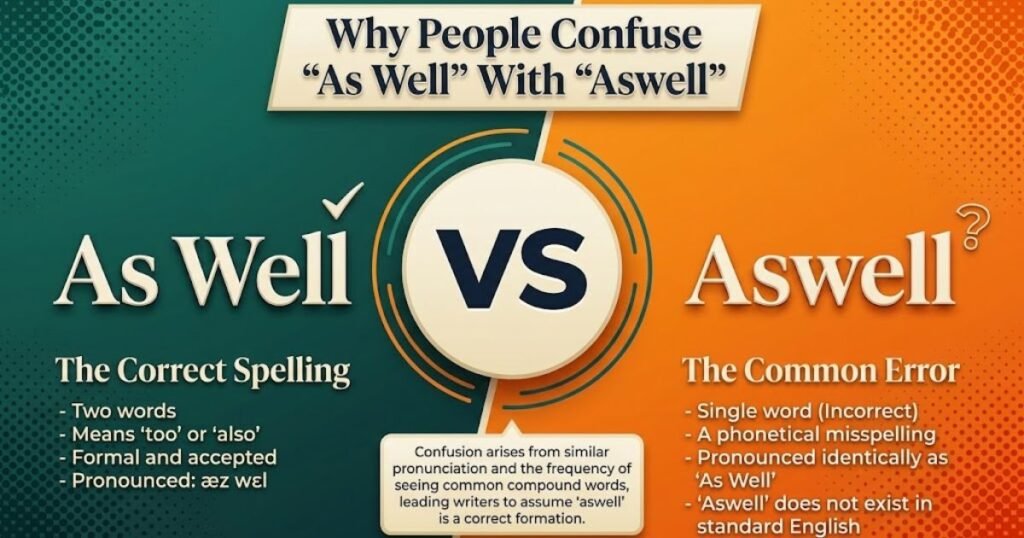
The mix-up happens because English has several compound words that started as two words and eventually merged into one, like “already,” “altogether,” and “always.” Readers subconsciously apply that same pattern to “as well,” assuming it followed the same path.
It didn’t. “As well” never went through that merging process. The two words kept their independent identity because “as” and “well” still function as separate grammatical pieces, not as one fused concept. Fast typing and autocorrect habits also play a role, since it’s easy to let your fingers run the words together without noticing.
What “As Well” Actually Means
“As well” is an adverbial phrase. It typically appears at the end of a clause or sentence and adds information, signaling that something applies in addition to what was already stated.
It’s interchangeable with “also” and “too” in most cases, though the placement in the sentence can shift depending on which word you choose.
- I ordered a coffee. I got a muffin as well.
- I also got a muffin.
- I got a muffin too.
All three sentences carry the same basic meaning. “As well” simply offers a slightly more formal or measured tone than “too,” while sounding a bit more natural in speech than “also” in some contexts.
Grammar Breakdown: How “As Well” Works in a Sentence
Understanding the grammar helps the correct spelling stick.
Part of speech: “As well” functions as an adverbial phrase, not a single word category like a noun or verb.
Position in a sentence: It usually appears at the end of a clause.
- She speaks French and Spanish as well.
It can also appear after the subject in more formal writing, though this is less common.
- She, as well as her brother, attended the ceremony.
Formality: “As well” fits both formal and informal writing. It works in emails, reports, academic papers, and everyday conversation without sounding out of place in any of them.
American vs. British English: There is no meaningful difference in how American and British English use “as well.” Both treat it identically in spelling, meaning, and placement.
Read Related Post: Carrer vs Career: The Correct Spelling Explained
Where “Aswell” Came From (and Why It Never Became Valid)
“Aswell” has no legitimate etymology of its own. It’s not an older spelling that fell out of favor, and it’s not a regional variant used in any English speaking country. It is simply a typo that spread because it looks plausible.
Compare this to words like “altogether,” which genuinely evolved from “all together” through centuries of use and eventually earned its own distinct meaning (altogether means “completely,” while all together means “as a group”). “As well” never developed that kind of split meaning, so there was never a reason for it to become one word.
Pronunciation: Does It Sound Different?
No. “As well” is pronounced exactly as it looks, with a brief pause or stress shift between the two words: “az-WEL.” There is no pronunciation clue that would suggest it should be written as a single word. The confusion is purely visual and typing related, not auditory.
As Well vs. Aswell: Quick Comparison
| Term | Correct? | Meaning | Use |
| As well | Yes | Also, too, in addition | Standard in all writing, formal and informal |
| Aswell | No | Not a recognized word | Never appropriate; always a spelling error |
Real Life Examples of “As Well” Used Correctly
Everyday conversation: “I’m grabbing tacos for dinner. Want some chips as well?”
Workplace communication: “Please send the invoice as well as the signed contract by Friday.” This example uses “as well as,” a related phrase covered further below, to connect two required items.
Academic writing: “The study accounted for age and income levels as well as education background.”
Email: “Thanks for the update. Could you loop in the design team as well?”
Formal writing: “The proposal addresses budget concerns as well as long term staffing needs.”
Casual writing: “Loved the movie, the soundtrack was great as well.”
Each of these works because “as well” is doing the same job every time: adding something extra to a statement that already exists.
Common Mistakes with “As Well” and “Aswell”
Incorrect: I want to come aswell. Correct: I want to come as well. The two words got merged into one, which is the core error this article addresses.
Incorrect: She finished her homework, aswell as her chores. Correct: She finished her homework, as well as her chores. Even when paired with “as,” the phrase still needs a space between “as” and “well.”
Incorrect: He is aswell. Correct: He is doing well as well. (Or simply: He is well too.) This one is worth flagging separately, since some readers confuse “aswell” with “as well” used to describe health, similar to “he is well.” These are different phrases with different jobs, and neither one merges into a single word.
These mistakes are extremely common, so don’t feel bad if you’ve made them. Typing quickly and autocorrect settings are usually the real culprits.
Related Phrases Worth Knowing
A few related terms often show up alongside “as well” and are worth understanding on their own:
- As well as: means “in addition to” and often introduces a second item or subject. “The manager, as well as her team, reviewed the report.”
- Too: a shorter, more casual synonym for “as well,” usually placed at the end of a sentence.
- Also: a more formal synonym, often placed earlier in the sentence, right before the verb.
- In addition: a formal alternative, commonly used to start a new sentence or clause.
- Likewise: used to indicate agreement or a similar action, though it carries a slightly different nuance than “as well.”
None of these require special spelling rules beyond standard English, so once you’re comfortable with “as well,” the rest tend to fall into place naturally.
How to Avoid Writing “Aswell” Again
A few habits make this mistake easy to eliminate:
- Slow down slightly when typing “as well.” Most errors happen during fast typing, not from genuine confusion about the rule.
- Turn off aggressive autocorrect suggestions if your keyboard keeps merging the words for you.
- Read your sentence back before sending it. A quick scan usually catches the merged spelling.
- Remember the two word rule by comparing it to “as much” or “as often.” No one writes those as one word, and “as well” follows the same pattern.
Practical Guidance for Different Writing Contexts
In professional emails and reports, always use “as well” in its two word form since incorrect spelling can undercut credibility, especially in formal documents. In casual texting, the stakes are lower, but using the correct spelling still builds a stronger writing habit over time. In academic writing, “as well as” is frequently used to introduce additional supporting points, so getting the spacing right matters for clarity and grammatical correctness.
FAQs About As Well and Aswell
Is “aswell” ever correct?
No. “Aswell” is not a recognized word in any standard English dictionary. It should always be written as two words: “as well.”
What does “as well” mean?
“As well” means “also,” “too,” or “in addition to something already mentioned.”
Can I use “as well” at the beginning of a sentence?
It’s uncommon and can sound awkward. “As well” typically works best at the end of a clause or sentence. For sentence openers, “also” or “in addition” tend to read more naturally.
Is “as well as” the same as “as well”?
Not exactly. “As well” means “also,” while “as well as” means “in addition to” and typically connects two items or subjects within the same sentence.
Why does spell check sometimes miss “aswell”?
Some spell checkers flag it correctly, but not all catch it, especially in messaging apps with more relaxed grammar checking. This is part of why the error spreads so easily.
The Bottom Line
“As well” is always correct, and “aswell” is always a spelling mistake. Keep the two words separated, and you will never run into confusion over this phrase again. When in doubt, picture it next to “as much” or “as often,” two words you would never think to merge, and you’ll spell it correctly every time.

Smith Jason is an SEO expert with 2–3 years of experience, sharing grammar tips, confusing words, vocabulary and writing advice.