If you have ever paused mid sentence wondering whether to write “cocoon” or “cacoon,” you are not alone. The two words look and sound almost identical, which makes it easy to type the wrong one without noticing. The correct spelling for the silky protective casing spun by insects like moths and butterflies is “cocoon.” “Cacoon” is a real word too, but it means something completely different: a tropical seed pod. If you are talking about caterpillars, comfort, or shelter, cocoon is the word you want.
What Does “Cocoon” Mean?
A cocoon is the silk case that certain insect larvae, most famously moths, spin around themselves before entering the pupal stage. It protects the developing insect while its body transforms into its adult form.
Beyond biology, English speakers use cocoon figuratively to describe any state of protection, comfort, or isolation. A person might “cocoon” at home on a rainy weekend, or a new employee might be “cocooned” from difficult clients while they learn the job.
What Does “Cacoon” Mean?
“Cacoon” is not simply a misspelling. It is a legitimate word with its own meaning, just an uncommon one outside certain regions and fields.
A cacoon refers to the large, hard seed pod produced by tropical vines in the genus Entada, particularly Entada rheedii and Entada gigas. These pods, sometimes called sea hearts or sea beans, are tough enough to survive months adrift in the ocean, which is how their seeds spread between continents. In Jamaica, the plant itself is known as the cacoon vine, and dried cacoon seeds are brewed into a traditional tea.
So the confusion is understandable: both words describe a protective outer casing. One belongs to an insect. The other belongs to a plant.
Cocoon vs Cacoon: Quick Comparison
| Term | Correct For | Meaning | Common Use |
| Cocoon | Insects, general English | Silk casing spun by larvae; figuratively, a state of protection or comfort | Everyday writing, science, idioms |
| Cacoon | Botany, regional English | Large woody seed pod of a tropical Entada vine | Caribbean and African botanical or herbal contexts |
Is “Cacoon” Ever an Acceptable Spelling of “Cocoon”?
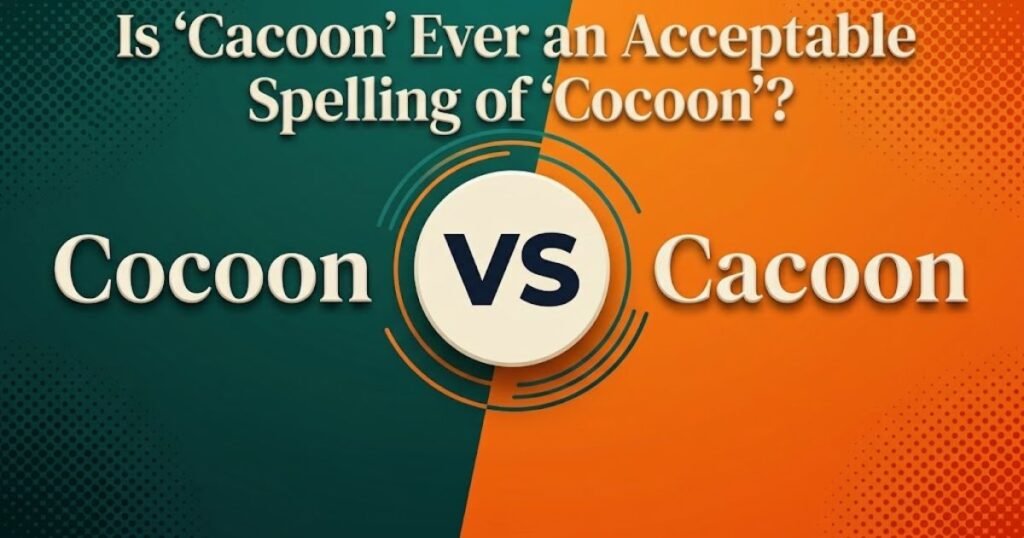
No. Even though “cacoon” appears in dictionaries, it is never listed as an alternate spelling of “cocoon.” The two are unrelated words that happen to be near homophones. If you meant the insect’s silk shelter and typed “cacoon,” it is a spelling mistake, not a valid stylistic choice.
Why Do People Confuse These Two Words?
The mix-up happens for a few simple reasons:
- The words sound almost the same when spoken quickly.
- Both describe some kind of protective wrapping, so the meanings feel related even when they are not.
- “Cacoon” is rare enough that most people have never encountered it, so autocorrect or muscle memory nudges writers toward a familiar-looking but incorrect vowel pattern.
A simple memory trick: cocoon has two O’s, just like the round, coiled shape of the silk it describes. If you picture a caterpillar curling up, the double O fits the image.
Read Related Post: As Well or Aswell: Which One Is Correct?
Where Does the Word “Cocoon” Come From?
Cocoon entered English in the late 1600s from the French word cocon, which traces back to the Old Provençal coucoun, related to coca, meaning shell or eggshell. Over time, English speakers standardized the spelling with the double O it has today, and the word kept its core meaning: a shell-like covering that protects something vulnerable inside.
The word cacoon, by contrast, comes from Caribbean and West African usage describing the Entada vine and its seed pods. It is a much more narrow, regional term with no shared root with “cocoon.”
How Do You Pronounce “Cocoon”?
Cocoon is pronounced kuh-KOON, with the stress on the second syllable. The first syllable is a quick, soft “kuh” sound, similar to the “co” in “collect.”
“Cacoon” is pronounced similarly, kuh-KOON as well, which is exactly why the two are so easy to mix up in speech. You genuinely cannot tell them apart by ear. The only way to know which one someone means is context or spelling.
Grammar: Singular, Plural, and Verb Forms
“Cocoon” functions as both a noun and a verb in American English.
As a noun:
- Singular: cocoon
- Plural: cocoons
As a verb:
- Base form: cocoon
- Past tense: cocooned
- Present participle: cocooning
- Third person singular: cocoons
Example: “She cocooned herself in blankets and skipped her morning meetings.”
“Cacoon” is almost always used as a noun in its botanical sense and does not have an established verb form in standard usage.
How to Use “Cocoon” Correctly in a Sentence
Here are natural examples across different contexts:
Everyday conversation: “The caterpillar spent two weeks inside its cocoon before it emerged as a butterfly.”
Workplace communication: “We want new hires to feel supported, but we should not cocoon them from real client feedback forever.”
Academic writing: “The silk fibers that form the cocoon are produced by specialized glands in the larva’s head.”
Email: “I’m cocooning at home this weekend to finish the report, so I’ll be slow to respond.”
Formal writing: “The economic policy effectively cocooned domestic manufacturers from foreign competition for nearly a decade.”
Each of these uses cocoon correctly, whether describing the literal insect structure or the figurative sense of shelter and isolation.
Common Mistakes to Avoid
Incorrect: The moth wriggled out of its cacoon after three weeks. Correct: The moth wriggled out of its cocoon after three weeks. This is the classic error: swapping in “cacoon” when the sentence is clearly about an insect’s transformation, where cocoon is the only correct word.
Incorrect: She wanted to cacoon herself away from the noise of the city. Correct: She wanted to cocoon herself away from the noise of the city. The figurative sense of self-protection or retreat always uses cocoon, never cacoon.
Incorrect: He collected several rare coccoons from the garden. Correct: He collected several rare cocoons from the garden. This mistake adds an extra “c,” which is a different and less common typo but worth watching for. Cocoon has exactly two O’s and two C’s, no more.
Mixing these up is a completely normal slip, especially since spell checkers sometimes accept “cacoon” without flagging it because it is a real, if rare, word.
Related Words and Terms
A few related words are worth knowing:
- Pupa: the developmental stage many insects go through while inside a cocoon or chrysalis
- Chrysalis: the hardened casing specific to butterflies, distinct from the silk cocoon spun by moths
- Sea bean or sea heart: common names for the seed produced inside a cacoon pod
- Cocooning: a noun describing the broader trend or habit of staying home for comfort and safety
Understanding these neighboring terms helps clarify why cocoon and chrysalis are sometimes confused as well, even though they refer to different structures used by different insects.
Practical Guidance: Which Word Should You Use?
If you are writing about insects, comfort, protection, isolation, or nearly any everyday or professional topic, use cocoon. That covers the vast majority of writing situations.
Reserve cacoon only for specific botanical, regional, or historical contexts involving the Entada vine, its seed pods, or Caribbean and African folk traditions tied to that plant. Outside of those narrow situations, cacoon will read as a spelling error to most readers.
Frequently Asked Questions
Is “cacoon” a real word?
Yes. It refers to the large seed pod of a tropical Entada vine, a completely different meaning from cocoon. It is simply rare and easily confused with the more common word.
What is the correct spelling of the insect’s silk casing?
Cocoon is the correct spelling for the protective silk structure spun by insect larvae before they become adults.
Can I use “cacoon” as a synonym for cocoon?
No. Even though they sound alike, cacoon and cocoon describe unrelated things: one is a plant seed pod, and the other is an insect’s silk shelter. They are not interchangeable.
How do you use “cocoon” as a verb?
Use “cocoon” to describe wrapping something protectively or withdrawing from the outside world, as in “cocoon,” “cocooned,” or “cocooning.” Example: “He cocooned himself in his hoodie during the flight.”
Why do cocoon and cacoon sound the same?
Both words are pronounced kuh-KOON, so the confusion is purely about spelling and meaning, not pronunciation. Context is the only reliable way to tell them apart in speech.
Final Takeaway
When in doubt, remember this: cocoon is the word for insects, comfort, and protection, while cacoon belongs to a specific tropical seed pod that most writers will never need to mention. Stick with cocoon in nearly every situation, and you will always be correct.

Smith Jason is an SEO expert with 2–3 years of experience, sharing grammar tips, confusing words, vocabulary and writing advice.