Many writers pause before typing this phrase because affect and effect sound almost identical. The correct phrase is take effect. It means to begin working or become official, as in “The new policy takes effect Monday.” “Take affect” is a common misspelling. Below, you’ll see why the confusion happens, how the two words differ, and a simple way to choose correctly every time.
Which Is Correct: Take Effect or Take Affect?
“Take effect” is correct. “Take affect” is incorrect in standard English.
Take effect is an idiom that means to start producing results or to become active. A law, rule, medication, price change, or policy can take effect. In each case, something that was waiting begins to operate.
The phrase uses effect as a noun, meaning a result or outcome. Affect is mainly a verb, and it does not fit the grammar of this idiom.
What Does “Take Effect” Mean?
Take effect has two closely related meanings.
1. To become official or active on a certain date.
- “The new dress code takes effect on Monday.”
- “Your updated insurance plan will take effect on the first of the month.”
2. To begin producing the intended result.
- “The pain medication should take effect within thirty minutes.”
- “The new marketing strategy hasn’t taken effect yet.”
In both meanings, the subject is the thing that starts working: a law, a drug, a change, a policy. The verb take here means “to begin to have,” and effect names the result that follows.
The phrase is flexible in tense: takes effect, took effect, will take effect, has taken effect, and taking effect are all standard.
Why Do People Mix Up Effect and Affect?
There are three reasons this pair trips up so many writers.
First, the words look alike. They differ by one letter at the start.
Second, they sound alike. In normal speech, the first vowel in both words is a weak, unstressed sound, so listeners rarely hear a difference.
Third, both words connect to change and consequence. Something affects a situation, and the result is an effect. Because the meanings overlap so closely, the spelling is easy to mix up, even for professional writers. It is a normal, very common slip.
Effect vs. Affect: What Is the Difference?
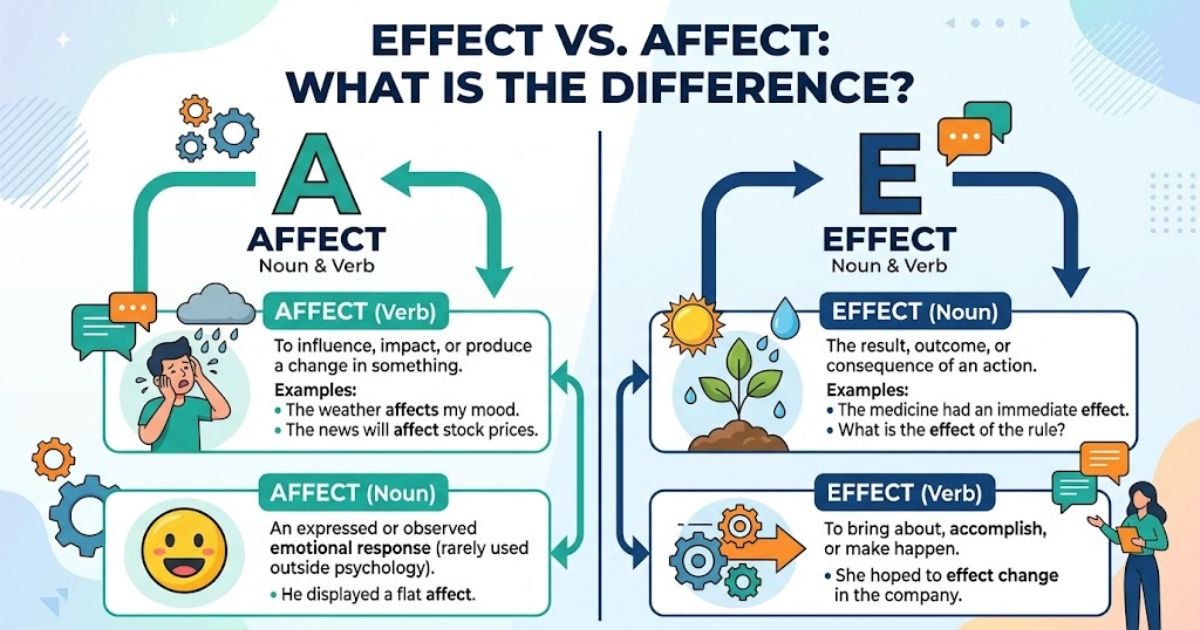
The short version is that affect is usually a verb meaning “to influence,” while effect is usually a noun meaning “a result.”
| Term | Usual Part of Speech | Meaning | Example |
| Affect | Verb | To influence or change something | “The weather will affect our travel plans.” |
| Effect | Noun | A result or outcome | “The weather had an effect on our travel plans.” |
| Take effect | Verb phrase (idiom) | To become active or start working | “The new schedule takes effect tomorrow.” |
| Take affect | Not standard | No accepted idiomatic meaning | Avoid in writing |
There are two less common uses worth knowing:
- Effect as a verb means “to bring about,” as in “The new manager hopes to effect real change.” This is formal and fairly rare.
- Affect as a noun is a psychology term for a person’s outward display of emotion, as in “The patient showed a flat affect.” Here the stress falls on the first syllable.
Neither of these rare uses makes “take affect” correct.
Read Related Post: Puting vs Putting: Which Spelling Is Correct?
Is “Take Affect” Ever Correct?
Not as an idiom. There is no accepted phrase “take affect” that means “begin to work” or “become official.”
You could technically place the words next to each other in a sentence where take is a separate verb and affect is the noun from psychology. For example, a clinical note might read, “Clinicians take affect into account when assessing mood.” But there, take and affect are not a phrase. They just happen to sit side by side, and the meaning is entirely different.
For everyday writing, treat “take affect” as an error. If you mean that something is beginning to work or become official, use take effect.
How Do You Pronounce Effect and Affect?
Both words are typically pronounced with an unstressed first syllable and stress on the second:
- Effect: ih-FEKT
- Affect (verb): uh-FEKT
In fast speech, most American speakers say them almost identically. That is why the confusion appears mostly in writing, not speech.
The noun affect used in psychology is the exception. It is stressed on the first syllable: AF-ekt.
Where Do Effect and Affect Come From?
Both words trace back to Latin, and both connect to the Latin verb facere, meaning “to do” or “to make.”
- Effect comes from the Latin effectus, related to efficere, “to accomplish” or “to bring about.” That origin fits its modern meaning of a result.
- Affect comes from the Latin affectus and the verb afficere, “to act on” or “to influence.” That origin fits its modern meaning of acting on something.
The shared root helps explain why the words feel so close. One describes acting on something, and the other describes what comes out of it.
How Do You Use “Take Effect” in a Sentence?
Here are natural examples from different settings.
Everyday conversation
- “The cold medicine finally took effect, and I slept through the night.”
- “Do the new parking rules take effect this week?”
Workplace and email
- “The revised remote work policy takes effect on January 1.”
- “Please note that the price increase will take effect for all orders placed after March 15.”
Academic and formal writing
- “The amendment took effect after ratification by the required number of states.”
- “The regulation will take effect ninety days after publication.”
Casual writing
- “The caffeine has not taken effect yet, so please be patient with me.”
In each sentence, the subject is the thing that begins to work or become official. If you can replace the phrase with “begin to work” or “become active,” you have the right idiom.
What Are Common Mistakes With Take Effect?
These are the errors that show up most often. None of them signals poor English. They are ordinary slips.
Mistake 1: Writing “affect” in the idiom
- Incorrect: The new law takes affect next month.
- Correct: The new law takes effect next month.
Take effect always uses the noun effect.
Mistake 2: Using “effect” when you mean “influence” as a verb
- Incorrect: The delay will effect our schedule.
- Correct: The delay will affect our schedule.
Here you need a verb meaning “to influence,” which is affect.
Mistake 3: Writing “in affect” instead of “in effect”
- Incorrect: The ban is still in affect.
- Correct: The ban is still in effect.
In effect means “in operation” or “in practice,” and it uses the noun.
Mistake 4: Splitting the idiom into “take an effect”
- Incorrect: The update will take an effect soon.
- Correct: The update will take effect soon.
The idiom has no article between take and effect.
What Are Related Phrases Like “Go Into Effect” and “In Effect”?
Several phrases use effect in the same result-focused way. All of them use the noun spelling.
- Go into effect and come into effect: both mean the same as take effect. “The new tax rate goes into effect in July.”
- Be in effect: to be currently active. “The speed limit is in effect until the construction ends.”
- Put into effect: to make something active. “The company put the new schedule into effect last week.”
- Come into force: a common British form, especially for laws.
- Effective: an adjective meaning “in operation” or “successful.” “The policy is effective January 1.”
Related word forms are also worth knowing:
- Effective and effectively come from effect.
- Affected means “influenced” (as a verb) or “artificial” (as an adjective, as in “an affected accent”).
- Effected means “brought about,” the past tense of the formal verb.
- Affection is a related word with a different meaning, meaning fondness, and shares the aff- prefix.
American and British usage: The rule is the same in both varieties. American English usually prefers take effect and go into effect. British English often uses come into force for laws and regulations, though come into effect and take effect also appear. Neither variety accepts “take affect.”
How Can You Remember the Right Word?
Here are three quick checks you can use while writing.
1. The RAVEN trick. Remember: Affect is a Verb, Effect is a Noun. Since take effect needs the noun, effect wins.
2. The “the” test. If you can put the, an, or any in front of the word, you need the noun effect. “The effect,” “an effect,” “any effect.” You would not say “the affect” in ordinary writing.
3. The swap test. Replace the phrase with “begin to work.” If the sentence still makes sense (“The medicine began to work”), use take effect.
If you still hesitate, remember that the phrase “take effect” is fixed. Treat it like a single unit, and you won’t have to decide between the two words each time.
FAQ’s
Is “take affect” correct?
No. The correct phrase is “take effect.” “Take affect” is a misspelling in standard English.
What does “take effect” mean?
It means to become active, official, or start working. A law can take effect on a date, and a medication can take effect after you swallow it.
How do I use “take effect” in a sentence?
Use it with something that starts working or becomes official. For example: “The new office hours take effect on Monday.”
Is “go into effect” the same as “take effect”?
Yes. Both mean to become active or official. “Go into effect” is common in American English, especially for laws and policies.
Can “affect” ever be a noun?
Yes, but mainly in psychology, where it means a visible display of emotion (stress on the first syllable). It is not used in the phrase “take effect.”
What Should You Remember About Take Effect?
The correct phrase is take effect, and it means to become active or start working. Affect is usually a verb meaning “to influence,” so it does not belong in this idiom.
If you remember one thing, make it this: when something begins to work, it takes effect, because the result (the noun) is what arrives.

Smith Jason is an SEO expert with 2–3 years of experience, sharing grammar tips, confusing words, vocabulary and writing advice.










1 thought on “Take Effect or Take Affect? Which Is Correct?”