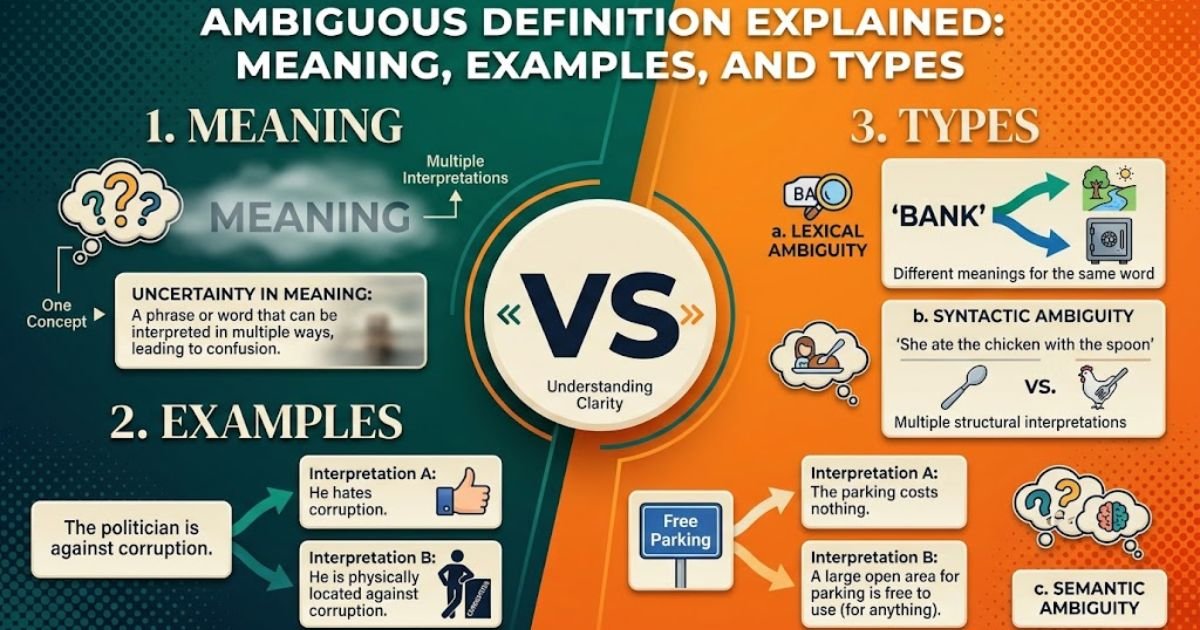
You read a sentence twice and still cannot tell what it means. That is usually a sign the sentence is ambiguous. The word describes language, ideas, or statements that can reasonably be understood in more than one way, and the confusion it causes is exactly why so many writers search for a clear explanation of what “ambiguous” actually means.
What Does Ambiguous Mean?
Ambiguous is an adjective that describes something open to more than one interpretation. A word, phrase, sentence, or situation is ambiguous when a reasonable reader could understand it in two or more different ways, and there is not enough context to tell which meaning was intended.
For example, the sentence “I saw her duck” is ambiguous because “duck” could be a bird or an action (lowering the head quickly). Both readings make sense, so the sentence needs more context to be clear.
Ambiguous vs Vague: What Is the Real Difference?
People often confuse “ambiguous” with “vague,” but they describe different problems.
| Term | Meaning | Example |
| Ambiguous | Has two or more clear, distinct meanings | “Visiting relatives can be annoying” (are the relatives visiting, or are you visiting them?) |
| Vague | Lacks enough detail to have any clear meaning | “The event is sometime soon” (no specific meaning at all) |
Something ambiguous offers multiple specific interpretations. Something vague offers no specific interpretation. Both cause confusion, but for different reasons.
Read Related Post: Bougie or Boujee: Which One Should You Use?
Grammar and Part of Speech
Ambiguous is an adjective. It describes a noun, such as a statement, sentence, phrase, image, or situation. It does not change form for singular or plural nouns: you can say “an ambiguous sentence” or “several ambiguous sentences,” and the word stays the same.
Related word forms include:
- Ambiguity (noun): the state of being ambiguous, as in “The contract was full of ambiguity.”
- Ambiguously (adverb): describes how something is done, as in “She answered ambiguously.”
- Unambiguous (adjective): the opposite, meaning having only one clear meaning.
There is no separate comparative or superlative form in common use. Native speakers say “more ambiguous” or “less ambiguous,” not “ambiguouser.”
Spelling and Pronunciation
The word is spelled a-m-b-i-g-u-o-u-s, with no hyphen and no variant spelling in American or British English. A common misspelling is “ambigious,” which drops the “u” before “ous.” Remembering that the root is “ambiguity” (which clearly has the “u”) can help you spell ambiguous correctly.
Pronunciation: am-BIG-yoo-uhs, with the stress on the second syllable.
Where Does the Word Ambiguous Come From?
Ambiguous comes from the Latin word ambiguus, meaning “doubtful” or “shifting,” which itself comes from ambigere, meaning “to wander” or “to go around” (from ambi-, meaning “both” or “around,” and agere, meaning “to drive or do”). The word entered English in the 1500s and has kept its core meaning of something that can go more than one way.
How to Use Ambiguous Correctly in a Sentence
Use ambiguous when you want to describe something that genuinely has more than one reasonable meaning, not simply something confusing or poorly worded. A sentence can be poorly written without being ambiguous, and it can be perfectly grammatical while still being ambiguous.
Correct usage pattern: [Subject] + [form of “to be”] + ambiguous + [optional: about/regarding + topic].
- “The instructions were ambiguous.”
- “His answer was ambiguous about whether he was coming.”
- “The law contains several ambiguous clauses.”
Real Life Examples of Ambiguous Language
Everyday conversation
“Can you call me later?” is ambiguous if you don’t specify whether “later” means in an hour or tomorrow.
Workplace communication
“Let’s touch base next week” is ambiguous without a specific day, which can lead to missed meetings.
Academic writing
“The study showed mixed results” is ambiguous if the reader cannot tell which specific outcomes were mixed.
Emails
“Send it over when you get a chance” is ambiguous about urgency, and busy coworkers may interpret “when you get a chance” very differently.
Business writing
“Employees may take leave as needed” is ambiguous in a policy document because it does not state limits, approval steps, or notice requirements.
Formal writing
“The committee will review the matter shortly” is ambiguous because “shortly” has no defined timeframe.
After each of these, notice that the fix is usually the same: add a specific detail (a time, a name, a number) that removes the second possible meaning.
Types of Ambiguity in English
Not all ambiguous language works the same way. Linguists generally group it into a few categories:
- Lexical ambiguity: one word has multiple meanings, such as “bank” (riverbank or financial institution).
- Syntactic (structural) ambiguity: sentence structure allows more than one reading, such as “I saw the man with the telescope” (who has the telescope?).
- Semantic ambiguity: the meaning of a phrase is unclear even though grammar is fine, such as “Every child loves some toy” (one shared toy, or a different toy per child?).
- Referential ambiguity: a pronoun could refer to more than one noun, such as “Sarah told Jane she was late” (who was late?).
Knowing the type of ambiguity helps you fix it faster, since lexical problems need a clearer word, while structural problems usually need reordered sentence parts.
Common Mistakes With Ambiguous Sentences
Incorrect: After the meeting, John told Mike he made a mistake.
Correct: After the meeting, John admitted to Mike that John had made a mistake.
The pronoun “he” is ambiguous because it could refer to either John or Mike.
Incorrect: The teacher said the student was wrong in her report.
Correct: In her report, the teacher said the student was wrong.
Moving “in her report” removes the ambiguous suggestion that the mistake belongs to the student’s report.
Incorrect: Flying planes can be dangerous.
Correct: Piloting planes can be dangerous. (or) Planes that are flying can be dangerous.
The original is ambiguous because “flying planes” could describe the act of piloting or describe planes that are currently airborne.
These are not signs of bad writing. Ambiguous phrasing happens to native speakers all the time, and the fix is almost always to add one clarifying detail.
How to Avoid Being Ambiguous in Writing
- Read your sentence as if you knew nothing about the context, and check whether a stranger could take it two ways.
- Replace vague pronouns (it, he, she, they) with the specific noun when more than one noun could match.
- Add concrete numbers, dates, or names instead of relative terms like “soon” or “later.”
- Read sentences aloud. Spoken ambiguous phrasing is often easier to catch by ear than by eye.
- When structure causes the problem, try reordering the sentence rather than adding more words.
Related Words and Terms
- Ambiguity: the noun form, referring to the quality of having multiple meanings.
- Unambiguous: the antonym, meaning clear and having only one possible meaning.
- Equivocal: a close synonym, often used specifically for language meant to mislead.
- Vague: related but distinct, referring to a lack of specific detail rather than multiple specific meanings.
- Double entendre: a specific, often intentional, type of ambiguous phrasing with two meanings, one usually suggestive.
When Is Ambiguous Language Used on Purpose?
Not all ambiguous wording is a mistake. Writers, comedians, and politicians sometimes use it deliberately. Wordplay, jokes, poetry, and diplomatic statements often rely on ambiguous phrasing to create humor, layered meaning, or room for flexible interpretation. Legal and technical writing, by contrast, almost always benefits from removing ambiguity, since a misread clause can cause real disputes.
FAQ’s
What does ambiguous mean in simple terms?
It means something can be understood in more than one way, and there isn’t enough context to know which meaning is correct.
Is ambiguous a negative word?
Not inherently. It is descriptive rather than negative, though in contracts, instructions, or legal writing, being ambiguous is usually a problem because it creates confusion.
What is the difference between ambiguous and confusing?
Something confusing may simply be hard to follow. Something ambiguous is specifically understandable in two or more distinct ways.
How do you use ambiguous in a sentence?
“The wording of the email was ambiguous, so I asked for clarification before scheduling the call.”
What is the noun form of ambiguous?
The noun form is “ambiguity,” as in “The report was full of ambiguity.”
Conclusion
Ambiguous describes anything, a word, sentence, or situation, that reasonably supports more than one meaning. Spotting ambiguous phrasing gets easier once you know the patterns: unclear pronouns, missing details, and sentence structures that can be read two ways. Fix those, and your writing becomes clear enough that a reader never has to guess what you meant.

Smith Jason is an SEO expert with 2–3 years of experience, sharing grammar tips, confusing words, vocabulary and writing advice.










1 thought on “Ambiguous Definition Explained: Meaning, Examples, and Types”