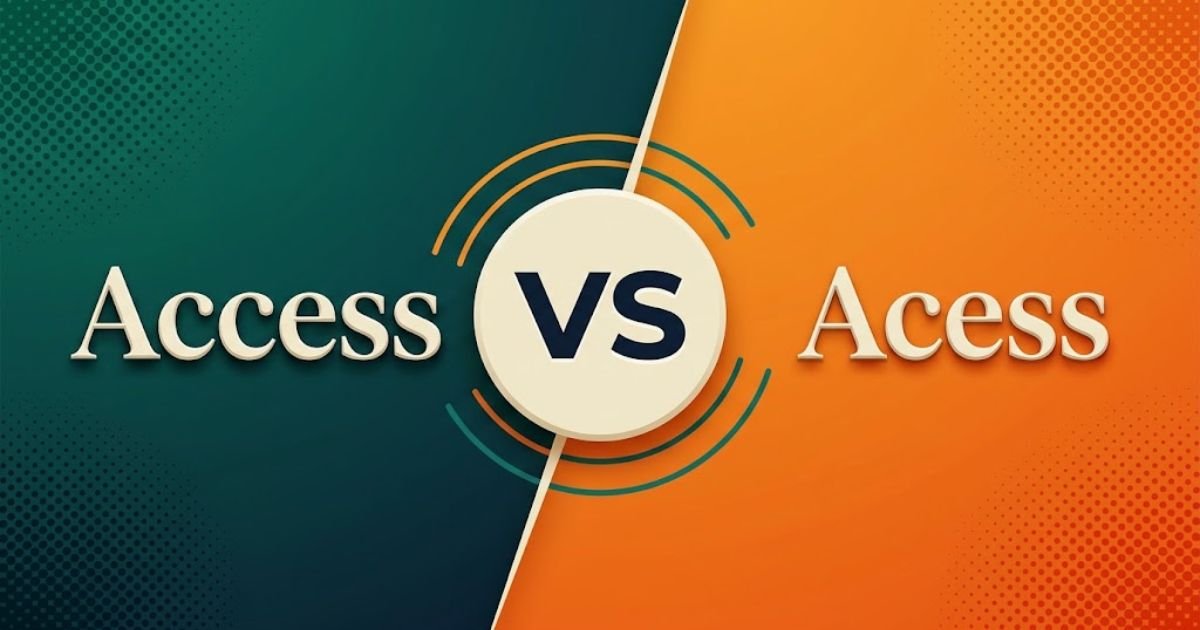
If you have ever typed “acess” and paused, wondering if you dropped a letter, you are not alone. The confusion usually comes from how quickly the word is typed or spoken, since the double “c” sound can get lost. Here is the short version: “access” is the only correct spelling. “Acess” is a misspelling and has no accepted use in English.
Quick Answer: Access Is Correct, Acess Is Not
Access is the correct spelling in American English and every other recognized form of English. Acess is simply a typo, most likely caused by skipping the second “c” while typing quickly or sounding the word out. It does not appear in any dictionary, and it carries no separate meaning of its own. If you see “acess” in a sentence, it should be corrected to “access” every time.
What Does “Access” Mean?
Access refers to the ability, right, or means to enter, use, obtain, or approach something. It can describe a physical action, like entering a building, or an abstract one, like reaching information or resources.
For example:
- She used her keycard to gain access to the office.
- Students need access to reliable internet for online classes.
- The new bridge gives residents easier access to the city center.
The word covers both the idea of permission (being allowed to use something) and the idea of ability (having a practical way to reach it).
Why Do People Misspell Access as Acess?
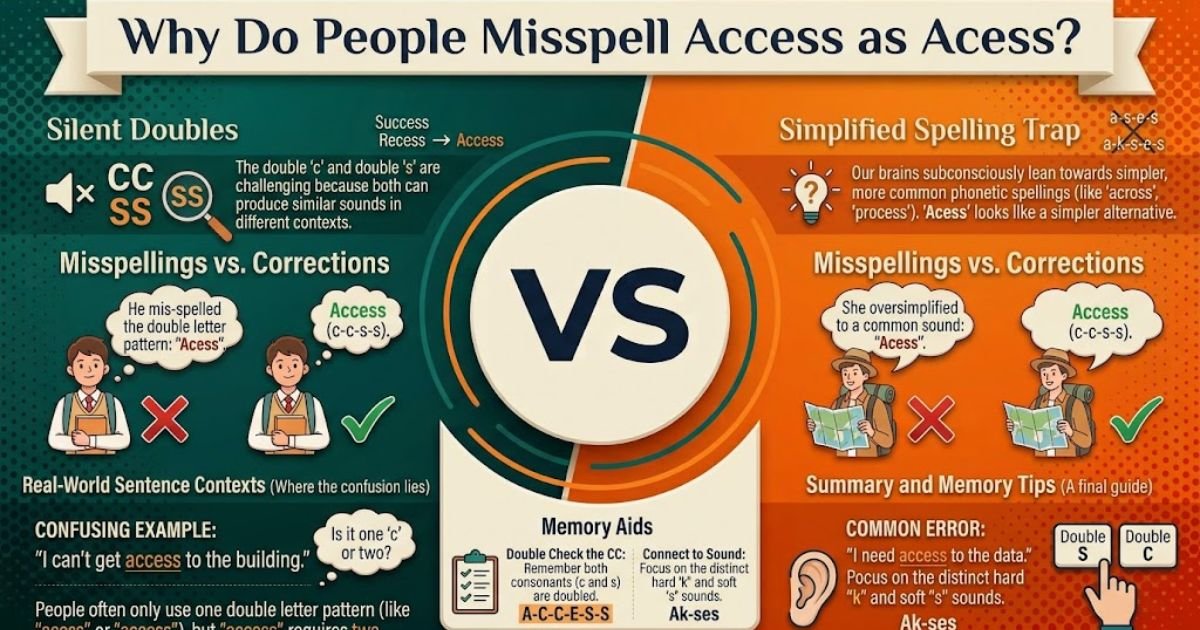
Most spelling mix-ups happen for predictable reasons, and this one is no exception. A few common causes explain why “acess” shows up so often:
- Fast typing. Double letters are easy to drop when typing quickly, especially on a phone keyboard.
- Pronunciation shortcuts. When spoken casually, the double “c” sound can blend together, making it sound like a single consonant.
- Autocorrect gaps. Not every device or platform catches this specific error, so it can slip through unnoticed.
- Non-native spelling patterns. In some languages, similar-sounding words use a single consonant, which can carry over into English spelling.
None of these reasons make “acess” acceptable. They just explain why the mistake is common.
Access: Grammar Breakdown
Understanding how “access” functions grammatically makes it easier to use correctly in different sentences.
Part of Speech
Access most commonly functions as a noun, referring to the means or opportunity to use or reach something.
It also works as a verb, meaning to obtain, enter, or make use of something.
- Noun: “You need special access to enter that database.”
- Verb: “Please access the file from the shared folder.”
Pronunciation
“Access” is pronounced AK-sess (/ˈæk.sɛs/), with the stress on the first syllable. Both C’s are pronounced clearly, one as a hard “k” sound and one blending into the “s” sound that follows, which is exactly why the second “c” sometimes gets dropped in writing.
Verb Forms
As a verb, “access” follows regular conjugation rules:
- Base form: access
- Third person singular: accesses
- Past tense: accessed
- Past participle: accessed
- Present participle: accessing
Example: “The team accessed the server remotely last night.”
Plural Form
As a noun, “access” is typically used as an uncountable noun, meaning it does not usually take a plural form. You would not say “accesses” to mean multiple instances of access in everyday writing. Instead, you would rephrase the sentence, such as “multiple points of access” or “different ways to access the system.”
Read Related Post: Maxxed or Maxed: Which Spelling Is Correct? (2026)
Where Does the Word “Access” Come From?
Access comes from the Latin word accessus, meaning “a coming to” or “an approach,” which itself comes from accedere (“to approach” or “to go near”). The word entered English through Old French in the 14th century, keeping its core meaning of approaching or reaching something. Over time, English speakers expanded the meaning to include not just physical approach but also rights, permissions, and digital connections, which is why the word feels just as natural in a sentence about doors as it does in one about computer systems.
Access vs Acess: Comparison Table
| Term | Correct? | Meaning | Use |
| Access | Yes | The means, right, or ability to enter, use, or reach something | Standard spelling in all forms of English |
| Acess | No | No accepted meaning | Common misspelling; always correct to “access” |
How to Use “Access” Correctly in a Sentence
Since “access” works as both a noun and a verb, the correct usage depends on the role it plays in your sentence.
As a noun:
- “Employees have access to the building around the clock.”
- “The library offers free access to thousands of digital resources.”
As a verb:
- “You can access your account settings from the main menu.”
- “Researchers were finally able to access the archived records.”
In workplace writing:
- “Please confirm that you have access to the shared drive before the meeting.”
In academic writing:
- “Limited access to educational materials remains a barrier for many students in rural areas.”
In casual conversation:
- “I can’t access my email right now, my password isn’t working.”
Each of these examples shows the word doing real work in a natural sentence rather than being forced in for the sake of using it.
Common Mistakes with “Access” and “Acess”
Here are the most frequent errors people make with this word, along with simple corrections.
Incorrect: I don’t have acess to that folder. Correct: I don’t have access to that folder. Explanation: “Acess” is missing a letter. The correct spelling always includes both C’s.
Incorrect: She accessed to the report yesterday. Correct: She accessed the report yesterday. Explanation: “Access” as a verb does not need “to” after it. It directly takes an object.
Incorrect: They gave us accesses to the new system. Correct: They gave us access to the new system. Explanation: “Access” is typically uncountable as a noun, so it does not usually take an “-es” plural ending.
Incorrect: He asked for acess before entering the lab. Correct: He asked for access before entering the lab. Explanation: Same missing letter issue. Reading the word aloud slowly, “ac-cess,” can help you remember both C’s.
Related Words and Terms
Understanding a few related words can round out your grasp of “access” and prevent future confusion.
- Accessible (adjective): able to be reached, entered, or used
- Accessibility (noun): the quality of being easy to access, often used in design and technology
- Inaccessible (adjective): not able to be reached or used
- Accession (noun): the act of formally taking a position or acquiring something, a different word entirely despite the similar spelling
- Gain access: a common phrase meaning to obtain the ability or right to enter or use something
These words share the same Latin root but serve different grammatical purposes, so it helps to keep their meanings separate.
Is “Acess” Ever Acceptable in Informal Writing?
No. Unlike some casual spelling variations that are tolerated in texting or social media, “acess” is not a recognized informal spelling. It is simply an error, not a stylistic choice. Even in the most relaxed writing contexts, using “access” is the safer and clearer option.
A Simple Way to Remember the Correct Spelling
One easy trick is to break the word into two parts: AC and CESS. Picture the word as “AC” (like air conditioning) plus “CESS.” Saying it in these two chunks reinforces that there are two C’s, not one. Another option is to remember that “access” rhymes with “excess,” another word that keeps its double consonant.
FAQ’s
Is “acess” a real word?
No. “Acess” is not a real word in any recognized dictionary. It is a common misspelling of “access.”
What does “access” mean?
Access means the ability, right, or means to enter, use, obtain, or approach something, whether that is a building, a system, or information.
How do you spell “access” correctly?
The correct spelling is a-c-c-e-s-s, with two C’s and two S’s. Remembering “AC” plus “CESS” can help you keep the spelling straight.
Can “access” be used as a verb?
Yes. As a verb, “access” means to obtain or make use of something, as in “You can access your files anytime.”
Is there a British English difference for “access”?
No. Both American and British English spell and use “access” the same way. The word does not change between the two.
Conclusion
Access is the correct spelling, and acess is simply a common typo with no legitimate use. Whether you are writing an email, a school paper, or a quick text message, sticking with “access” will always be the accurate and professional choice.

Smith Jason is an SEO expert with 2–3 years of experience, sharing grammar tips, confusing words, vocabulary and writing advice.










1 thought on “Access or Acess: Which Spelling Is Correct?”