If you have ever paused mid sentence wondering whether to write “long term,” “long-term,” or “longterm,” you are not alone. The confusion makes sense because English lets compound phrases shift form depending on how they function in a sentence. Here is the short answer: “long-term” (hyphenated) and “long term” (two words) are both correct, depending on usage. “Longterm” (one word) is not standard English.
What Is the Correct Spelling: Long Term, Long-Term, or Longterm?
The correct spelling depends on the job the phrase is doing in your sentence.
- Use long-term (with a hyphen) when it works as an adjective before a noun, such as “long-term plan” or “long-term relationship.”
- Use long term (two separate words, no hyphen) when it works as a noun phrase, usually after “the,” such as “in the long term.”
- Avoid longterm (one word). It shows up occasionally in casual writing, but no major dictionary recognizes it as standard, and most style guides treat it as a spelling error.
Once you know which role the phrase plays, the correct form becomes automatic.
Why Do People Confuse Long Term and Longterm?
The confusion happens because many English compound adjectives eventually merge into single words over time. Think of “online” or “nowadays,” which used to be written as two words. Writers sometimes assume “long term” is following the same path and shorten it to “longterm.” It has not made that shift, at least not in accepted usage, so the single word form still reads as a mistake to editors, teachers, and careful readers.
What Does Long Term Mean?
“Long term” describes something that extends over an extended period of time, rather than something quick or temporary. It is the opposite of “short term.”
As a noun phrase, it usually appears with “the”: “in the long term,” “over the long term,” or “for the long term.” As an adjective, it describes nouns like goals, care, effects, memory, or investments: “long-term goals,” “long-term care,” “long-term memory.”
The meaning stays consistent across both forms. What changes is only the punctuation, based on grammatical function.
Long Term vs Long-Term: What Is the Actual Difference?
This is the part that trips up even experienced writers, so here is the rule in plain terms.
Long-term (hyphenated) is a compound adjective. Compound adjectives that appear directly before a noun are typically hyphenated in American English. That is why you write “a long-term lease” but not “a long term lease.”
Long term (no hyphen) is a noun phrase. When the phrase comes after a verb, especially after “the,” it does not modify a noun directly, so no hyphen is needed. You would write “she is thinking about the long term,” not “the long-term.”
A simple test: if the phrase sits right before a noun and describes it, hyphenate it. If it stands on its own as a noun, leave it as two words.
| Term | Correct? | Meaning | Use |
| Long-term | Yes | Compound adjective describing something extended over time | Before a noun: “long-term goals” |
| Long term | Yes | Noun phrase referring to an extended period | After a verb, often with “the”: “in the long term” |
| Longterm | No | Nonstandard spelling | Not recognized by major dictionaries |
Read Related Post: “Within the Week” vs “Within a Week”: Meaning, Grammar, and When to Use Each
Is Long Term One Word or Two?
“Long term” is two words when used as a noun. It only gains a hyphen when it functions as an adjective directly before a noun. It is never correctly written as a single word in standard American English, regardless of its grammatical role.
Grammar Breakdown: Part of Speech and Sentence Structure
Understanding the part of speech makes the spelling choice much easier.
As an adjective (hyphenated): “Long-term” comes before a noun and describes a quality of that noun. Example: “The company announced a long-term strategy.”
As a noun phrase (no hyphen): “Long term” stands alone, usually as the object of a preposition. Example: “The plan makes more sense in the long term.”
Predicate position exception: When the phrase comes after the noun it modifies, rather than before it, many style guides drop the hyphen even though it is still functioning adjectivally. Example: “This investment is long term” (not “long-term”) because it follows the verb “is” rather than sitting directly in front of a noun. This mirrors the pattern seen in phrases like “well known,” which is hyphenated before a noun (“a well-known author”) but open after a verb (“the author is well known”).
There is no separate plural form. You would not pluralize “long-term” itself, though the noun it modifies can be plural: “long-term effects,” “long-term plans.”
Where Did the Phrase Long Term Come From?
“Long term” combines two ordinary English words, “long” (extended in duration) and “term” (a defined period of time), both of which trace back through Middle English to earlier Germanic and Latin roots. The phrase itself became common in economic, legal, and medical writing during the 19th and 20th centuries, describing time frames that extend beyond an immediate or short period. There is no unusual origin story here. It developed the way most descriptive English compounds do, through repeated pairing of two existing words until the combination became a fixed phrase.
How Do You Pronounce Long Term?
“Long term” is pronounced exactly the same whether it is hyphenated or not: long turm (rhymes with “song” and “firm”). The hyphen is a written convention and has no effect on pronunciation or stress. Native speakers place slightly more emphasis on “long” in casual speech, but this is not a hard rule.
Correct Usage in Real Sentences
Seeing the phrase in context makes the rule stick faster than memorizing it in the abstract.
Everyday conversation: “I’m not worried about tonight. I’m thinking about the long term.”
Workplace communication: “We need a long-term fix, not another temporary patch.”
Academic writing: “The study examined the long-term effects of sleep deprivation on memory.”
Email: “Let’s schedule a call to discuss our long-term roadmap for the product.”
Business writing: “Over the long term, the merger is expected to reduce operating costs.”
Formal writing: “Long-term unemployment remains a significant concern for policymakers.”
Casual writing: “Honestly, I don’t do well with long-term commitments.”
Notice that every hyphenated example places the phrase directly before a noun, while the open form always follows a verb or preposition.
Common Mistakes With Long Term and Longterm
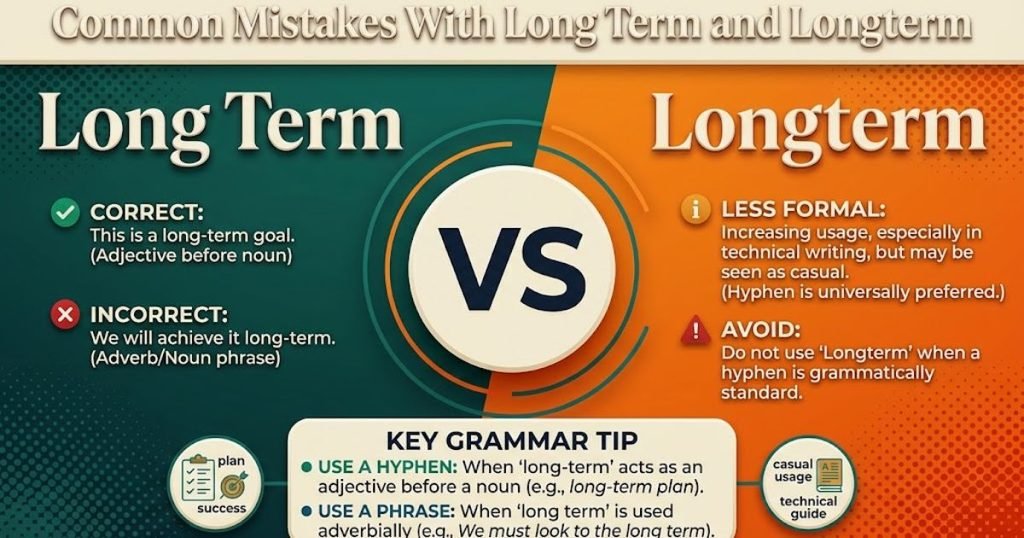
Here are the mistakes people make most often, along with quick corrections.
Incorrect: We are focused on longterm growth. Correct: We are focused on long-term growth. Longterm is not a recognized word, so it should always be split into “long” and “term.”
Incorrect: This is a long-term. Correct: This is the long term. When the phrase functions as a noun on its own, it does not take a hyphen.
Incorrect: She has long term goals for her career. Correct: She has long-term goals for her career. Since “long term” sits directly before the noun “goals” and describes it, it needs a hyphen.
Incorrect: The lease is long-term. Correct: The lease is long term. Because the phrase follows the verb “is” rather than sitting before a noun, most American style guides prefer no hyphen here.
These slips are easy to make because the meaning stays the same in every version. Only the grammar signals which form to use.
Related Terms and Similar Constructions
Several related phrases follow the same hyphenation pattern, so learning “long-term” also helps with these:
- Short-term (the direct opposite, following identical rules)
- Long-lasting
- Long-standing
- Mid-term
- Full-time and part-time
If you can correctly hyphenate “long-term,” you already understand the pattern for most compound time-related adjectives in English.
Practical Guidance: How to Choose the Right Form
When you are unsure which version to use, ask yourself one question: does this phrase come right before a noun it is describing? If yes, hyphenate it. If it stands alone after a verb, or functions as a noun itself, leave it open. And no matter the context, never write it as a single word. That form simply is not part of standard English spelling.
FAQ’s
Is “longterm” a real word?
No. “Longterm” is not recognized by major dictionaries or style guides. The correct forms are “long-term” (hyphenated, as an adjective) and “long term” (two words, as a noun).
Is “long-term” or “long term” correct in a resume?
Both can appear, depending on placement. Use “long-term” before a noun, such as “long-term project management experience.” Use “long term” if it stands alone, such as “committed to growth over the long term.”
Do British and American English treat this differently?
No significant difference exists. Both British and American English hyphenate “long-term” before a noun and leave “long term” open as a noun phrase.
How do I use “long-term” in a sentence?
Place it directly before the noun it describes: “The company is planning long-term investments in renewable energy.”
Why is there no hyphen in “in the long term”?
Because “long term” functions as a noun phrase there, not as an adjective modifying another word, so no hyphen is needed.
Conclusion
The safest rule to remember is this: hyphenate “long-term” only when it sits directly before a noun, leave “long term” open everywhere else, and skip “longterm” entirely since it is not standard English. Keep that one distinction in mind, and you will get it right every time.

Smith Jason is an SEO expert with 2–3 years of experience, sharing grammar tips, confusing words, vocabulary and writing advice.










1 thought on “Long Term or Longterm: Which Spelling Is Correct in 2026?”