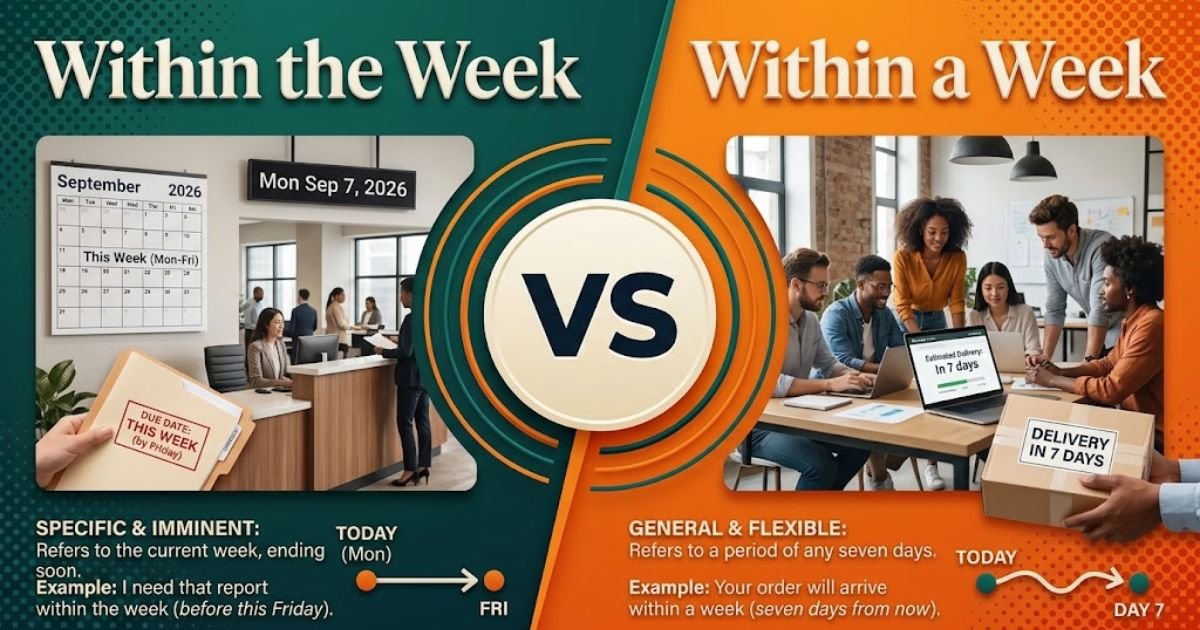
If you have ever paused mid-sentence wondering whether to write “I will finish this within the week” or “I will finish this within a week,” you are not alone. Both phrases look almost identical, yet they point to slightly different timeframes. The short version: both phrases are grammatically correct, but they are not always interchangeable. “Within a week” means sometime before seven days pass, starting from now. “Within the week” means sometime before the current calendar week ends.
The Quick Answer: What’s the Real Difference?
“Within a week” refers to a rolling seven-day period that starts the moment you say it. If you say it on a Wednesday, it means before next Wednesday.
“Within the week” refers to the remainder of the current week, as defined by a calendar (usually ending Friday, Saturday, or Sunday, depending on convention). If you say it on a Wednesday, it means before that week officially ends, which could be in two, three, or four days.
Both are correct English. Neither one is a mistake. The confusion comes from the fact that they overlap most of the time, so people use them interchangeably without noticing the subtle difference.
Why This Phrase Confuses So Many People
English uses the articles “a” and “the” to signal very different things, but the difference is subtle when talking about time. “A week” treats the week as a generic unit of duration, like a stopwatch you start counting from today. “The week” treats the week as a specific, defined block on the calendar, one that already has a beginning and an end regardless of when you happen to be speaking.
Because most conversations happen in the middle of a workweek, the two timeframes often land on nearly the same day, which makes the distinction feel unnecessary. It only becomes obvious when you say either phrase on a Monday versus a Friday.
“Within a Week”: Meaning and Grammar
“Within a week” is a prepositional phrase built from the preposition within, the indefinite article a, and the noun week. The indefinite article signals that “week” is being used as a general unit of time, not tied to any specific calendar week.
This phrase means “before seven days from now have passed.” It creates a moving deadline based on the moment of speaking or writing.
- Said on Tuesday, it means by the following Tuesday.
- Said on Saturday, it means by the following Saturday.
Because the countdown always starts fresh, “within a week” is the phrase most people reach for when giving a general estimate, a shipping timeframe, or a personal promise.
“Within the Week”: Meaning and Grammar
“Within the week” uses the definite article the, which points to a specific, already-established week: the one currently in progress. This phrase means “before this particular calendar week ends.”
The tricky part is that “the week” does not have one universal end date. In everyday American usage, most people treat the week as ending on Friday (for work purposes) or Sunday (for the full calendar week). Because that boundary shifts depending on context, “within the week” can mean anywhere from a few hours to almost seven days, depending on which day you say it.
- Said on a Monday, “within the week” leaves several days of room.
- Said on a Thursday or Friday, it leaves very little room at all.
Side-by-Side Comparison
| Phrase | Article Type | Reference Point | Typical Length | Common Use |
| Within a week | Indefinite (a) | Starts today, counts 7 days forward | Always about 7 days | Estimates, promises, deadlines given at any time |
| Within the week | Definite (the) | Ends when the current calendar week ends | Variable, depends on the day | Office and scheduling language, urgent short-term tasks |
Read Related Post: You To or You Too: Which Is Correct?
Where This Distinction Comes From
The pattern is not unique to “week.” English regularly uses the with time nouns to point to a specific, contextually understood unit (“within the hour,” “within the month,” “within the year”), and a/an to describe a general span measured from now (“within an hour,” “within a month,” “within a year”). This is simply how English articles work: definite articles point to something specific and already known, while indefinite articles introduce something general or new. There is no unusual etymology or historical rule behind “within the week” specifically; it follows the same logic that governs “the” and “a” throughout the language.
Pronunciation Note
Neither phrase presents a pronunciation challenge. “Within” is pronounced wih-THIN, with a soft “th” sound as in “this,” not a hard “th” as in “think.” Both phrases are spoken with natural stress on “week,” since it carries the key meaning.
How to Use Each Phrase Correctly
Use “within a week” when:
- You want a clear seven-day countdown regardless of what day it is.
- You are giving a shipping estimate, project deadline, or general promise.
- You want the phrase to work the same way no matter when someone reads it.
Use “within the week” when:
- You are referring to the specific week already in progress.
- The context makes clear which days remain (a work week, a school week, a billing week).
- You want to emphasize urgency because the current week is closing soon.
Real-Life Examples
Everyday conversation “I promise I’ll call you back within a week.” (A rolling seven-day window starting now.)
Workplace email “Please submit your timesheet within the week.” (Meaning before this specific work week ends, likely Friday.)
Academic writing “Students must submit revisions within a week of receiving feedback.” (A consistent seven-day rule that applies no matter when feedback is given.)
Business writing “Our team will review the proposal within the week and follow up on Friday.” (Referring to the remainder of this current week.)
Formal writing “The committee expects a written response within a week of this notice.” (A fixed countdown, useful for legal or contractual language.)
Casual writing “I’ll probably finish the book within the week, it’s a short one.” (Referring loosely to the days left in this week.)
After reading these, notice that “within a week” always sounds like a countdown, while “within the week” always sounds tied to a specific calendar week already underway.
Common Mistakes to Avoid
Incorrect: “The report is due within the week, three weeks from now.” Correct: “The report is due within three weeks.” The phrase “within the week” only makes sense for the current week, not for a future one.
Incorrect: “I said it on Monday, so ‘within the week’ obviously means I have until next Monday.” Correct: “I said it on Monday, so ‘within the week’ means before this current week ends, likely by Friday or Sunday.” People often mistakenly stretch “within the week” into a full seven-day period, but it is tied to the current calendar week, not a fresh seven-day count.
Incorrect: Using “within the week” in a formal contract without specifying which day the week ends. Correct: In contracts, use “within a week” or a specific date to avoid ambiguity. Legal and business writing benefits from precision, and “within the week” can be interpreted differently depending on the reader.
Related Phrases Worth Knowing
- Within an hour / within the hour: same pattern, applied to a 60-minute window versus the remainder of the current hour.
- Within a month / within the month: same logic applied to monthly timeframes.
- By the end of the week: a clearer alternative to “within the week” when precision matters.
- In a week’s time: a close synonym for “within a week.”
- Inside of a week: an informal variant meaning the same as “within a week.”
Practical Guidance for Choosing the Right Phrase
If clarity matters, especially in professional or legal writing, lean toward “within a week” or a specific day or date. It removes any guesswork about when the countdown starts and ends. Save “within the week” for casual or office contexts where everyone already shares an understanding of when the current week wraps up.
FAQ’s
Is “within the week” grammatically correct?
Yes. It is a correct and commonly used phrase in American English, referring to the remainder of the current calendar week.
Is “within a week” the same as “in a week”?
They are very close in meaning. “Within a week” emphasizes “no later than,” while “in a week” can sometimes suggest “exactly at the one-week mark.” In casual speech, most people use them interchangeably.
Which phrase should I use in a business email?
“Within a week” is generally safer in business writing because it gives a fixed, unambiguous deadline that does not depend on which day of the week you send the message.
Does “within the week” always mean by Friday?
Not always. It depends on context. In a work setting, it often implies Friday. In a broader calendar sense, it can mean by Sunday. When precision matters, state the exact day instead.
Can these phrases be used in formal writing?
Yes, both are acceptable in formal writing. However, “within a week” is usually clearer, since “within the week” relies on shared assumptions about when the week ends.
Conclusion
Both “within a week” and “within the week” are correct, but they measure time differently. “Within a week” counts seven days forward from right now. “Within the week” points to whatever is left of the current calendar week.
When you want a guaranteed, unambiguous deadline, choose “within a week.” When you are talking about the days remaining in this specific week, “within the week” gets the job done.

Smith Jason is an SEO expert with 2–3 years of experience, sharing grammar tips, confusing words, vocabulary and writing advice.










1 thought on ““Within the Week” vs “Within a Week”: Meaning, Grammar, and When to Use Each”