If you have ever paused mid sentence wondering whether someone signed a contract “under distress” or “under duress,” you are not alone. These two words look alike, sound somewhat alike, and both relate to stress or pressure. The key difference is this: distress refers to emotional or physical suffering, while duress refers to illegal pressure, coercion, or threats used to force someone into an action. They are not interchangeable, and using the wrong one can actually change the legal meaning of a sentence.
What Is the Quick Answer?
Distress is a noun describing pain, suffering, anxiety, or hardship. It can be emotional (“she was in distress after the news”) or physical (“the ship sent a distress signal”).
Duress is a noun describing coercion, specifically the use of threats, force, or unlawful pressure to make someone do something against their will. It shows up most often in legal contexts, such as contracts signed “under duress.”
They both involve pressure, but distress describes a state of suffering, while duress describes the act of forcing someone through threats.
Why Do People Confuse Distress and Duress?
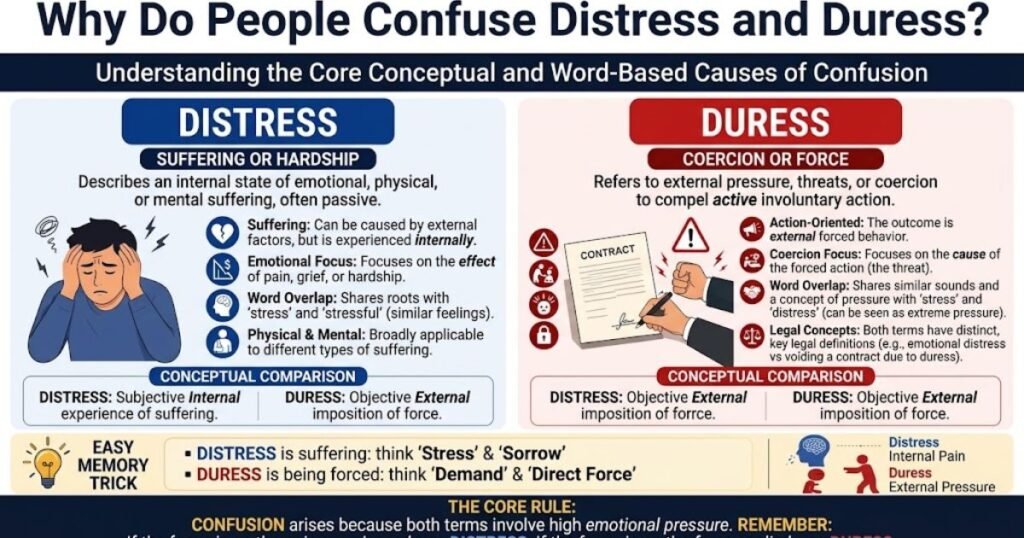
The confusion makes sense. Both words share the Latin root stringere, meaning “to draw tight” or “to bind.” Both relate to pressure. Both are two syllable nouns that end similarly. And both frequently appear near legal, emotional, or crisis related language.
But their meanings diverge in an important way. Distress is about how someone feels. Duress is about what someone does to another person, usually through threats or force, to control their behavior.
Distress vs Duress: Meaning and Core Difference
Here is a simple way to remember it:
- Distress = suffering. A state of pain, worry, or hardship.
- Duress = coercion. An action involving threats or force that pressures someone into doing something.
If you are describing how a person feels, use distress. If you are describing someone being threatened or forced into an action, use duress.
Comparison Table
| Term | Part of Speech | Meaning | Common Use |
| Distress | Noun (also verb) | Suffering, pain, or anxiety | Emotional states, physical emergencies, medical contexts |
| Duress | Noun | Coercion through threats or force | Legal contracts, criminal defenses, forced consent |
Grammar Breakdown: Distress
Distress functions primarily as a noun, though it can also be used as a verb.
- Noun: “The passengers were in distress after the turbulence.”
- Verb: “The delay continued to distress the waiting family.”
The adjective form is distressed (“a distressed homeowner”) and distressing (“a distressing update”). Distress is countable in specific technical uses (such as multiple “distress signals”) but usually functions as an uncountable noun describing a state (“she was in distress,” not “she was in a distress”).
Read Related Post: Lovey or Lovie: Which Spelling Is Correct? Meaning, Usage, and Examples
Grammar Breakdown: Duress
Duress is almost exclusively a noun. It does not have a common verb form, and it is rarely used as an adjective. You will most often see it in the fixed phrase “under duress.”
- Correct: “He signed the agreement under duress.”
- Incorrect: “The situation was very duress.” (Duress cannot describe a situation directly; it describes the pressure applied to a person.)
There is no widely accepted adjective form like “duressed.” If you need an adjective, use coerced or forced instead.
Where Do These Words Come From?
Both words trace back to the Latin verb stringere, meaning to draw tight or constrict.
- Distress entered English through Old French destresse, ultimately from Latin districtus, related to being pulled apart or constrained.
- Duress came through Old French duresse, from Latin duritia, meaning hardness or harshness. It originally referred to harsh treatment or imprisonment before narrowing to its modern legal sense of coercion.
This shared root explains the visual and phonetic overlap, even though the modern meanings have moved in different directions.
Pronunciation Guide
- Distress is pronounced dih-STRESS, with stress on the second syllable.
- Duress is pronounced doo-RESS or dyoo-RESS, also stressed on the second syllable.
The similar rhythm is part of why these words get mixed up in speech, especially when spoken quickly.
When to Use Distress
Use distress when describing:
- Emotional pain: “The email left her in distress for hours.”
- Physical suffering: “The hiker showed signs of physical distress after the climb.”
- Emergency signals: “The boat sent out a distress call.”
- Financial hardship: “The company is showing signs of financial distress.”
Distress works in everyday conversation, medical writing, journalism, and casual speech. It does not require a legal context.
When to Use Duress
Use duress almost exclusively in legal, formal, or serious coercion related contexts:
- Contract law: “The court ruled the contract void because it was signed under duress.”
- Criminal defense: “The defendant argued he acted under duress.”
- Formal statements: “She admitted the confession was made under duress.”
Duress typically appears with the preposition under, forming the standard phrase “under duress.” You will rarely see duress used casually to describe everyday stress, because it specifically implies coercion, threats, or the risk of serious harm.
Real Life Examples
Everyday conversation “I could tell she was in distress the moment she walked in.”
Workplace communication “Please flag any vendor showing signs of financial distress before we renew the contract.”
Academic writing “The study measured psychological distress levels among first year students.”
Legal or business writing “The signature was later ruled invalid because it was obtained under duress.”
Casual writing “That final exam put me in total distress.”
Notice that duress rarely appears outside formal or legal writing. If you are chatting with a friend about a stressful day, distress is almost always the natural word. Duress would sound oddly formal, almost like accusing someone of a crime.
Common Mistakes
Incorrect: She signed the form under distress. Correct: She signed the form under duress. Reason: “Under duress” is the fixed legal phrase implying coercion. “Under distress” is not standard usage; distress describes a feeling, not a forced action.
Incorrect: He was in duress after hearing the news. Correct: He was in distress after hearing the news. Reason: Emotional suffering after news is distress, not duress, since no one is coercing him.
Incorrect: The economy is under duress. Correct: The economy is in distress. Reason: An economy can suffer or struggle (distress), but it cannot be threatened or coerced the way a person can (duress).
Related Words and Legal Terms
Understanding a few related terms can help clarify the distinction further:
- Coercion: forcing someone to act through threats, closely related to duress.
- Distressed: adjective describing something or someone experiencing hardship.
- Undue influence: a legal term for improper persuasion, related to but distinct from duress.
- Stress: the general, more common term for pressure or strain, often confused with both words.
- Anguish: a stronger synonym for emotional distress.
Practical Tip to Remember the Difference
Here is a simple test. Ask yourself: is someone being threatened, or is someone simply suffering?
If the answer involves threats, coercion, or force, use duress. If the answer involves emotional or physical suffering with no coercion involved, use distress. If you are ever unsure, picture a courtroom. Duress almost always belongs there. Distress belongs almost everywhere else.
Frequently Asked Questions
Is “duress” the same as “distress”?
No. Duress means coercion through threats or force, while distress means suffering, pain, or anxiety. They are related in origin but different in meaning.
What does “under duress” mean?
“Under duress” means an action was taken because of threats, force, or unlawful pressure, often making the action legally invalid, such as a coerced signature or confession.
Can you say “under distress” instead of “in distress”?
“In distress” is the standard phrase for describing suffering (“she was in distress”). “Under distress” is uncommon and not typically used by native speakers; “under duress” is the correct phrase for coercion.
Is duress only used in legal writing?
Duress is used almost exclusively in legal, formal, or serious coercion contexts. It is rarely used in casual conversation about everyday stress.
Which word should I use to describe feeling overwhelmed at work?
Use distress, since it describes emotional strain. Duress would only apply if someone were forcing you to act through threats, which is a much more serious situation.
Final Takeaway
The easiest way to keep these words straight is to remember that distress is a feeling, and duress is a force. If someone is suffering, they are in distress. If someone is being threatened or coerced into an action, they are acting under duress. Keep that distinction in mind, and you will never mix these two words up again.

Smith Jason is an SEO expert with 2–3 years of experience, sharing grammar tips, confusing words, vocabulary and writing advice.