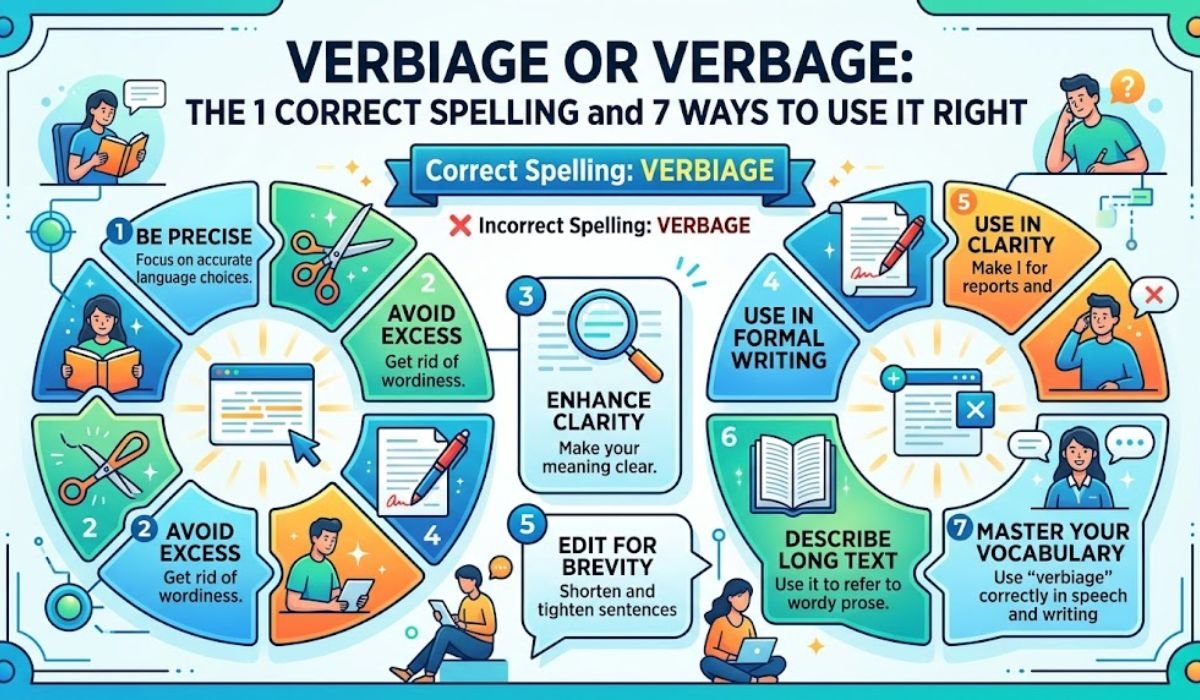
You start typing a sentence, then stop. Is it verbiage or verbage? The confusion makes sense, because the word is spoken quickly and the middle syllable often gets swallowed.
The correct spelling is verbiage, with an “i” after the “b.” Verbage is a common misspelling. This guide covers the meaning, pronunciation, and seven practical ways to use the word.
Which Spelling Is Correct: Verbiage or Verbage?
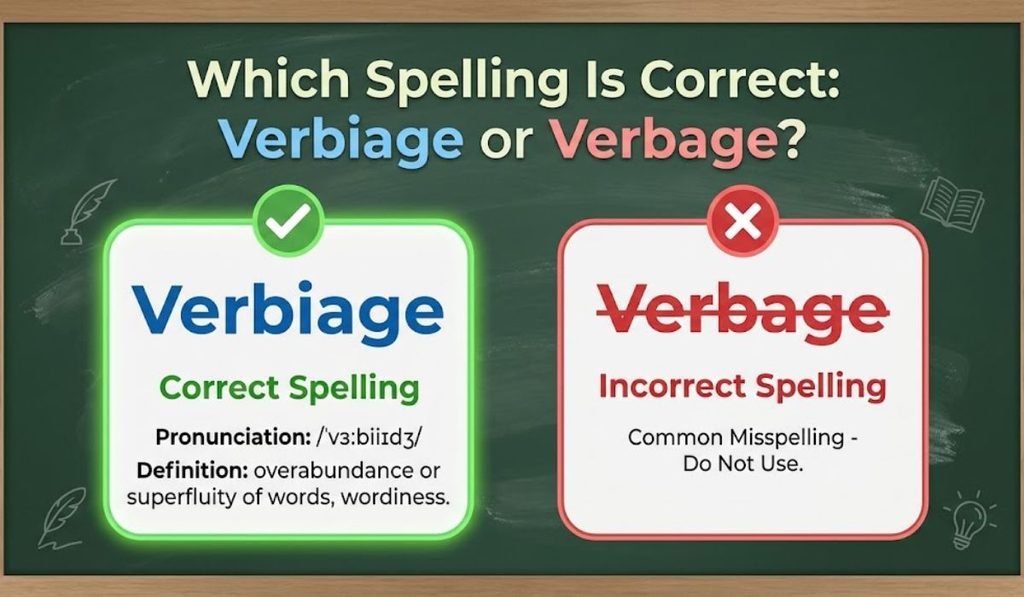
Verbiage is the correct spelling. Verbage is a misspelling.
Verbiage has four syllables in writing: ver-bi-age. Verbage drops the “i,” which leaves out a syllable the word actually has. Standard dictionaries list verbiage as the headword, and editors treat verbage as an error in formal, professional, and academic writing.
If you write verbage in a casual text, nobody will be confused. In an email to a client or a college essay, though, the misspelling can distract readers from your point.
What Does Verbiage Mean?
Verbiage is a noun with two related meanings.
- Excessive or unnecessary words. This is the older and more critical sense. Verbiage in this meaning is clutter that hides the point.
- The way something is worded. This is the neutral, everyday sense. People use it for the exact wording of a contract, a sign, a policy, or a form.
Context tells you which meaning is intended. “Cut the verbiage” is a request to trim. “Check the verbiage on the form” is a request to review the wording.
Verbiage vs. Verbage at a Glance
| Term | Correct? | Meaning | Use |
| Verbiage | Yes | Wording, or an excess of words | Any writing or speech |
| Verbage | No | Not a standard word | Avoid; replace with verbiage |
Verbage has no separate meaning and no legitimate use as an alternative word. It is only a misspelling of verbiage.
Why Do So Many People Write Verbage?
Three things cause the mistake.
Pronunciation. Many speakers say “VUR-bij,” which has only three sounds instead of four. When you spell what you hear, the “i” disappears.
Pattern confusion. English has many words ending in “-age” that follow a consonant directly, such as message, package, and baggage. The brain assumes verbiage works the same way.
Autocorrect habits. Misspellings that appear often in casual writing start to look normal. Seeing “verbage” in emails and chat messages can make the wrong form feel familiar.
None of this means you are bad at spelling. This is just a tricky word.
Is Verbiage a Noun, Verb, or Adjective?
Verbiage is a noun, and it works as an uncountable (mass) noun, like information or advice.
- It usually takes a singular verb: “The verbiage is confusing.”
- It does not normally take a plural form. You would not say “verbiages” in standard English.
- To count it, use a phrase such as “a piece of verbiage” or “two sections of verbiage,” though most writers simply rephrase.
Verbiage has no verb form. The related adjective is verbose, and the related noun for the quality of being wordy is verbosity. In American English, the word is used the same way as in British English, and the spelling does not change between the two.
Read Related Post: Unphased or Unfazed? 6 Facts That Settle the Spelling Debate
How Do You Pronounce Verbiage?
In American English, verbiage is pronounced VUR-bee-ij (/ˈvɜːrbiɪdʒ/).
- VUR (rhymes with her)
- bee
- ij (like the end of village)
Some speakers compress the middle and say “VUR-bij.” That is common in fast speech, but saying all three sounds in the spoken form helps you remember the “i” when you write.
Where Does the Word Verbiage Come From?
Verbiage came into English from French. The French word is related to an older verb meaning “to chatter” or “to babble,” and it traces back to the Latin word verbum, meaning “word.”
That Latin root explains a whole family of English words. Verb, verbal, verbose, and verbatim all come from verbum. Seeing verbiage as part of the “word” family also supports the spelling, since verbal and verbose both keep the sounds that lead into the “i.”
7 Ways to Use Verbiage Correctly
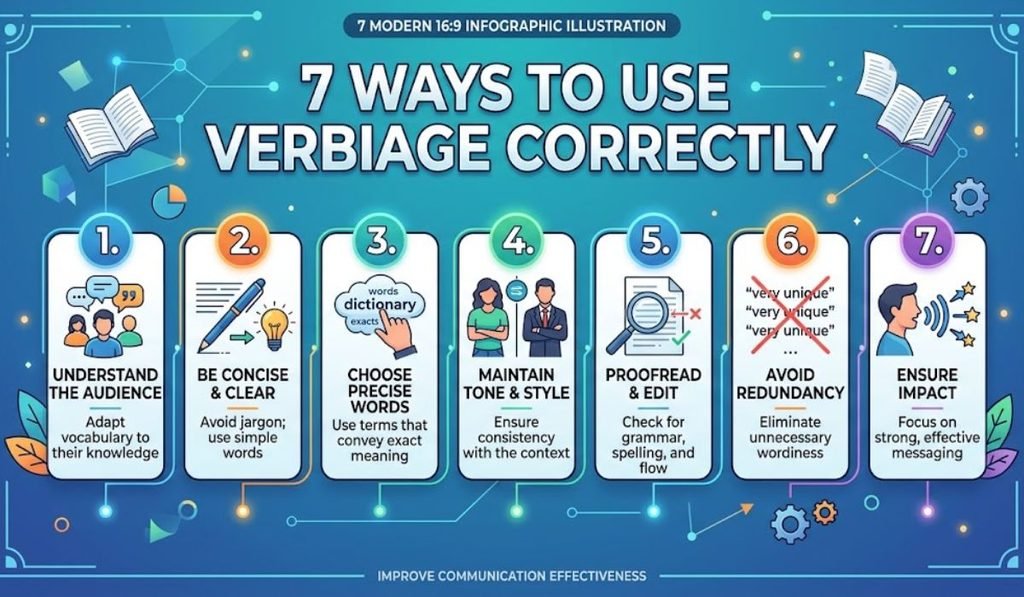
Here are seven realistic situations, each with a sentence you might actually write.
1. Talking about contract or policy wording.
“Our attorney reviewed the verbiage in the lease before we signed.”
Here, verbiage means the exact wording, with no negative tone.
2. Describing wordiness.
“The report was full of verbiage, and the main finding was buried on page nine.”
This is the critical sense: too many words, too little substance.
3. Giving editing feedback.
“Let’s cut some of the verbiage in the second paragraph.”
Editors use this phrasing to ask for tighter writing.
4. Writing a workplace email.
“Could you take a look at the verbiage on the new return policy page?”
The sentence is polite, direct, and understood by everyone in a business setting.
5. Academic writing.
“The author’s argument is sound, but the dense verbiage makes it hard to follow.”
The word works well for evaluating style in a review or critique.
6. Marketing and web copy.
“We replaced the confusing verbiage on the sign-up button with two clear words.”
Teams that write interface text talk about verbiage all the time.
7. Casual conversation.
“I skipped the verbiage and just read the bullet points.”
Even in everyday speech, the word signals that you ignored the filler.
Does Verbiage Sound Negative?
It can. Historically, verbiage meant too many words, so some careful writers and editors still prefer it only in that critical sense. They would write “the wording of the contract” instead of “the verbiage of the contract.”
In modern American usage, though, the neutral meaning of “wording” is very common, especially in business, law, and technology. Both meanings are accepted. If your audience is formal or strict about style, choose wording for the neutral sense and keep verbiage for the critical one. That choice avoids any possible confusion.
Common Verbiage Mistakes to Avoid
Mistake 1: Misspelling the word
Incorrect: The verbage in this agreement is unclear.
Correct: The verbiage in this agreement is unclear.
The word needs the “i” after the “b.”
Mistake 2: Making it plural
Incorrect: The two verbiages are very different.
Correct: The two versions of the wording are very different.
Verbiage is uncountable, so rephrase when you need to compare more than one set of words.
Mistake 3: Using it as a verb or adjective
Incorrect: She verbiaged the report.
Correct: She padded the report with extra words.
Verbiage is only a noun. Use another word for actions or descriptions.
Mistake 4: Confusing it with verbosity
Incorrect: His verbiage made him hard to listen to.
Better: His verbosity made him hard to listen to.
Verbiage is the words themselves. Verbosity is the habit of using too many of them. Both versions are understandable, but the second is more precise.
Words Related to Verbiage
Knowing nearby words helps you choose the best one for your sentence.
- Synonyms (wording sense): wording, phrasing, language, terminology
- Synonyms (excess sense): wordiness, padding, filler, circumlocution
- Related adjectives: verbose, wordy, long-winded
- Related noun: verbosity
- Antonyms: concision, brevity, succinctness
- Common phrases: legal verbiage, excess verbiage, technical verbiage, cut the verbiage
Frequently Asked Questions About Verbiage
Is verbage a real word?
No. Verbage is not a standard English word. It is a frequent misspelling of verbiage, and you should use the longer form in all writing.
What does verbiage mean in a sentence?
It means either the specific wording of something or an excess of words. “The verbiage in the warranty is hard to understand” uses the wording sense. “Cut the verbiage and get to the point” uses the excess sense.
Is it rude to say someone uses too much verbiage?
It can feel blunt, because the critical sense implies the person is wordy. A softer option is “Could we tighten the wording here?” That keeps the feedback friendly.
How do I remember how to spell verbiage?
Think of the word as verb + i + age. The “i” is easy to find if you connect it to verbal and verbose, which come from the same Latin root meaning “word.”
Conclusion
Use verbiage, never verbage. The word has four letters between “verb” and the end that spell out “iage,” and the “i” is the one that people skip.
Remember that it comes from the same family as verb and verbal, and the extra letter will stay in your spelling for good. Whether you mean the wording of a document or a pile of unnecessary words, the spelling stays the same.

Smith Jason is an SEO expert with 2–3 years of experience, sharing grammar tips, confusing words, vocabulary and writing advice.









1 thought on “Verbiage or Verbage: The 1 Correct Spelling and 7 Ways to Use It Right”