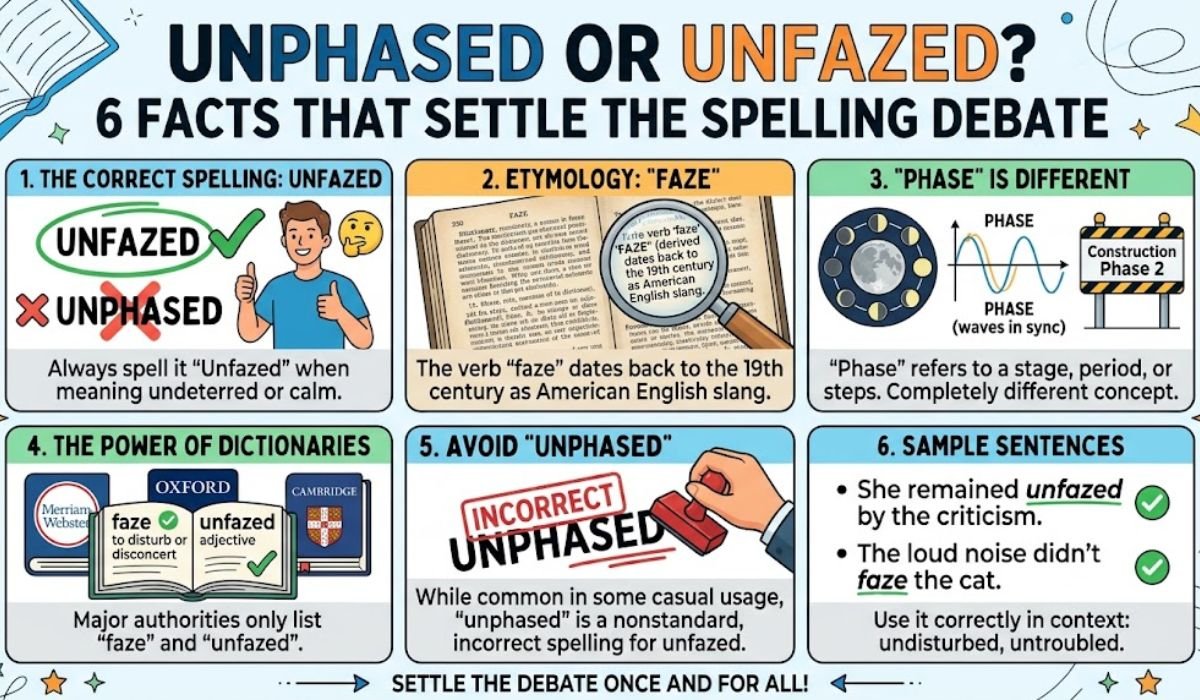
You want to say someone stayed calm under pressure, but now you’re stuck: unphased or unfazed? The confusion is understandable, because the two spellings sound identical and “phase” is a far more familiar word than “faze.” The answer is simple. Unfazed is the standard spelling for “not disturbed or worried.” In that sense, unphased is a common misspelling.
Which Is Correct: Unphased or Unfazed?
Use “unfazed” when you mean someone is not bothered, rattled, or disturbed by something.
That is the entire short answer. The word comes from the verb “faze,” which means to disturb or disconcert someone. “Unfazed” simply adds the prefix “un-” to the past participle “fazed.”
She walked into the meeting unfazed by the last-minute changes.
Dictionaries list “unfazed” as the standard form for this meaning. “Unphased” does show up often in casual writing, but editors and teachers will mark it as an error.
What Does Unfazed Mean?
Unfazed describes a person who is not disturbed, shaken, or discouraged by something that might upset others. It suggests calm confidence, sometimes even a shrug.
You can use it for big moments and small ones:
- A pilot who stays steady through turbulence is unfazed.
- A toddler who keeps eating after dropping a spoon is unfazed.
- A manager who hears bad news and moves straight to solutions is unfazed.
The word usually points to an emotional reaction that never happened. Something could have rattled the person, but it didn’t.
Why Do People Write Unphased, and Is It Ever Right?
People write “unphased” for one reason: sound-alike spelling. “Faze” and “phase” are homophones. Most of us see “phase” constantly, in phrases like “the next phase” or “the moon’s phases,” so the “ph” spelling feels familiar and natural. The rare word loses to the common one.
There is one narrow case where “unphased” can be a real word. If you take the verb “phase,” meaning to carry out something in stages, “unphased” can describe something that is not done in stages. A construction plan that happens all at once, for example, could be called an unphased project.
Even so, that use is uncommon. If your sentence is about someone’s emotional reaction, “unphased” is wrong. If it’s about stages of a plan, you can still use it, but “not phased” or “all at once” is usually clearer.
Faze vs. Phase: What Is the Difference?
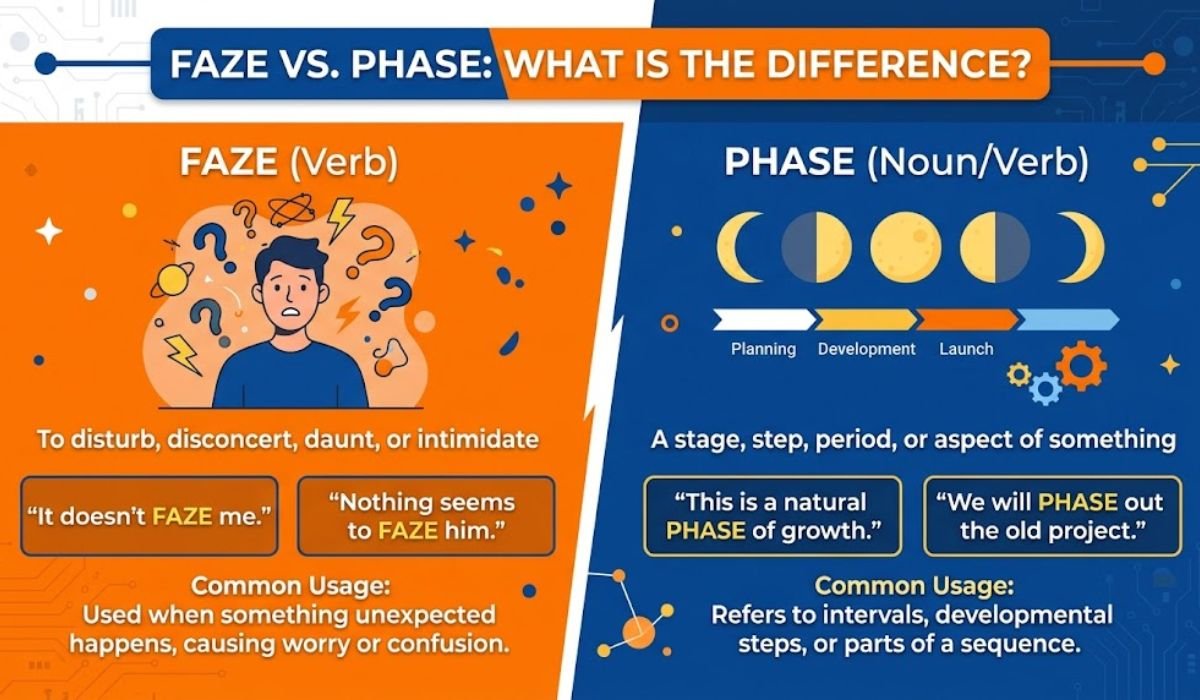
The whole debate comes down to two different verbs that sound the same. This table keeps them straight.
| Term | Correct? | Meaning | Use it when |
| Unfazed | Yes (standard) | Not disturbed or rattled | Describing someone’s calm reaction |
| Unphased | Rare, mostly a misspelling | Not carried out in stages | Describing a plan with no stages (uncommon) |
| Faze | Yes | To disturb or disconcert | Usually in negative sentences (“It didn’t faze her”) |
| Phase | Yes | A stage, or to arrange in stages | Describing steps, cycles, or timelines |
A quick memory trick: faze relates to feelings, and phase relates to plans or stages. Both pairs begin with the same sound.
Read Related Post: Is Good Morning One Word? The Definitive Answer
How Is Unfazed Pronounced?
“Unfazed” is pronounced un-FAYZD (/ʌnˈfeɪzd/). The stress falls on the second syllable. The “-ed” ending sounds like a “d,” not a separate syllable.
Since “unphased” is pronounced exactly the same way, speech gives you no clue about spelling. This is why the mistake appears mostly in writing and rarely in conversation.
Where Does the Word Faze Come From?
“Faze” is an older word than many people expect. According to Merriam-Webster, it traces back to the Old English verb fēsian, which meant “to drive away.” Over time, the meaning shifted from driving something off to disturbing or discouraging a person.
The unrelated word “phase” comes from the Greek phasis, meaning “appearance,” and entered English through Latin and French. These are two separate word families that happen to sound alike in modern English.
Because “faze” is mostly used in a few fixed patterns today, many writers rarely see its spelling. That is a big part of why “phased” sneaks in.
What Part of Speech Is Unfazed, and How Does It Work in a Sentence?
“Faze” is a transitive verb, which means it needs an object. You faze someone. Its forms are simple:
- Base form: faze
- Third person singular: fazes
- Past tense and past participle: fazed
- Present participle: fazing
“Unfazed” is an adjective formed from the past participle. You will usually see it after a linking verb (“She seemed unfazed”) or right before a noun (“an unfazed expression”).
Two usage notes help:
- “Faze” appears mostly in negative or question forms: “Nothing fazes him,” “It didn’t faze me,” “Does that faze you?”
- “Unfazed” is common in both American and British English, and the spelling does not differ between them.
You can add “by” to say what did not disturb the person: “unfazed by the criticism.”
How Do You Use Unfazed in Everyday, Work, and Academic Writing?
Here are realistic examples across different settings.
Everyday conversation
I thought the dog would panic during the thunderstorm, but he was totally unfazed.
Workplace email
The client was unfazed by the revised timeline, so we can move forward as planned.
Business writing
Investors appeared unfazed by the quarterly dip and held their positions.
Academic writing
The participants remained unfazed even after the researchers introduced the distracting noise.
Casual writing and texting
Got a flat tire on the way there and she was completely unfazed. I would’ve lost it.
In the business example, “unfazed” works because it describes an emotional response, not a timeline. If you write “unphased by the quarterly dip,” many readers will see the error right away.
What Mistakes Do People Commonly Make with Unfazed and Phase?
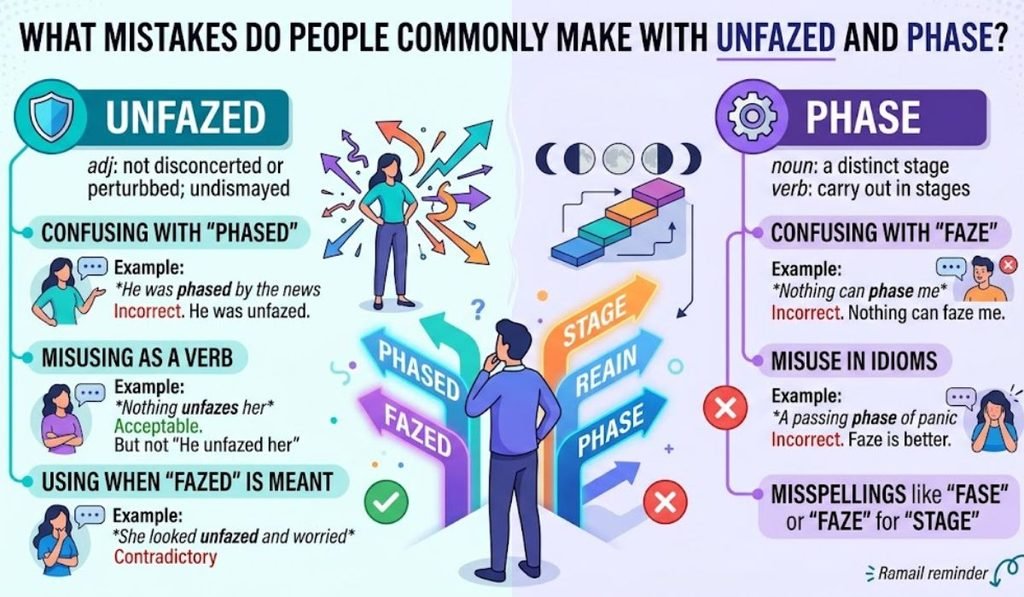
These errors are normal. Even experienced writers trip on a homophone pair.
Mistake 1: Using “unphased” for a calm reaction
Incorrect: The teacher was unphased by the noisy classroom.
Correct: The teacher was unfazed by the noisy classroom.
“Unphased” would suggest the classroom was not divided into stages, which makes no sense here.
Mistake 2: Writing “phased” when you mean “fazed”
Incorrect: The criticism never phased her.
Correct: The criticism never fazed her.
The verb that means “to disturb” is spelled with an “f.”
Mistake 3: Writing “fazed” when you mean a stage-by-stage process
Incorrect: The company fazed out the old software.
Correct: The company phased out the old software.
“Phase out” means to remove something gradually, so it needs the “ph” spelling.
Mistake 4: Spelling the negative as “unfased”
Incorrect: He looked unfased.
Correct: He looked unfazed.
Keep the “z” and the “ed” ending, because the word is built from the past participle “fazed.”
What Are Some Synonyms, Antonyms, and Related Phrases?
If you want to vary your wording, these words and phrases carry a similar sense to “unfazed.”
Synonyms: unruffled, unflappable, undaunted, unperturbed, unbothered, composed, nonchalant, cool-headed
Antonyms: rattled, flustered, shaken, thrown off, disconcerted, unnerved
Related “phase” phrases (all spelled with “ph”):
- phase in (introduce gradually)
- phase out (remove gradually)
- in phase, out of phase (synchronized or not)
- going through a phase (a temporary stage)
Related “faze” phrases:
- doesn’t faze me
- never fazed by it
- couldn’t be fazed
- fazed by (usually in the past tense)
Note that “unfazed” often sounds more natural than a longer synonym, especially in everyday writing.
What Are the 6 Facts That Settle the Debate?
If you remember only a handful of things, remember these:
- “Unfazed” is the standard spelling for “not disturbed or worried.”
- “Faze” and “phase” are different words that happen to sound the same.
- “Faze” means to disturb, and it mostly appears in negative sentences.
- “Phase” means a stage, or to carry out something in stages.
- “Unphased” is a common error in the emotional sense, though it can rarely mean “not done in stages.”
- American and British English agree: both use “unfazed.”
FAQ’s
Is unphased a real word?
Sometimes. It can mean “not done in phases,” as in an unphased construction plan, but that use is rare. When you mean “not bothered,” the correct word is unfazed.
What does unfazed mean?
Unfazed means not disturbed, rattled, or discouraged by something that might upset others. It describes someone who stays calm in the face of surprises, pressure, or criticism.
How do I use unfazed in a sentence?
Pair it with “by” to show what did not bother the person. For example: “The speaker was unfazed by the technical glitch and kept going.”
Is it “never phased me” or “never fazed me”?
It is “never fazed me.” The verb “faze” means to disturb, and “phased” would suggest stages or timing.
Is unfazed used in British English?
Yes. British and American English both use unfazed with the same spelling and meaning.
Conclusion
When you want to say someone wasn’t bothered, write unfazed. Think of “faze” as being about feelings and “phase” as being about stages. If a reader asks whether the person’s reaction or the project’s timeline is the point, you will know which spelling to choose.
One easy takeaway: if nothing rattled the person, nothing “phased” them either, so keep the “f” and write unfazed.

Smith Jason is an SEO expert with 2–3 years of experience, sharing grammar tips, confusing words, vocabulary and writing advice.










1 thought on “Unphased or Unfazed? 6 Facts That Settle the Spelling Debate”