
You hear someone say an idea “really resignated with them,” and now you’re wondering which spelling is right. The confusion makes sense: both words start with “res” and sound similar when spoken quickly. Resonate is the correct word for ideas that connect with you or sounds that echo. Resignate is not standard English. This guide shows the difference and how to avoid the mix-up.
Which Is Correct: Resignate or Resonate?
Resonate is correct. Resignate is not a standard English word.
Use “resonate” when something strikes a chord with you or produces a deep, lasting sound. Use “resign,” “resigned,” or “resignation” when you mean quitting a job or accepting something unpleasant.
Here is the quick version:
- Correct: Her speech really resonated with the audience.
- Incorrect: Her speech really resignated with the audience.
What Does Resonate Mean?
“Resonate” is a verb with two main meanings, one literal and one figurative.
The literal meaning is about sound and vibration. A cello resonates when its body amplifies the notes. A voice resonates in an empty hall when the sound seems to fill the space and linger.
The figurative meaning is far more common in everyday writing. When a message resonates with you, it feels true, relevant, or emotionally meaningful. You connect with it.
- The mission statement resonated with new employees.
- His story resonated with me because I grew up in a small town too.
- That song still resonates after twenty years.
Is Resignate a Real Word?
Not in the way most people use it. “Resignate” is not a standard verb in modern American English, and you should not use it in school, work, or published writing. If you check a trusted dictionary such as Merriam-Webster, you can confirm how “resonate” and “resign” are listed and spelled.
So when you see “resignate” in a sentence, it is almost always one of three things:
- A misspelling of resonate
- A mix-up with resign or resignation
- A made-up blend of the two words
There is no everyday situation where “resignate” is the right choice. If you are unsure, “resonate” or “resign” will almost always fix the sentence.
Why Do People Mix Up Resignate and Resonate?
Three things cause this error.
The sounds overlap. “Resonate” is pronounced REZ-uh-nayt. “Resignation” is pronounced rez-ig-NAY-shun. Both start with “rez” and contain a “nay” sound, so the ear blends them together.
The spelling looks similar. Both words begin with “res,” and a writer who remembers the shape of a word but not its letters can easily land on a hybrid.
The ending feels natural. Many English verbs end in “-ate,” such as “separate,” “motivate,” and “navigate.” So “resignate” looks like it belongs to that family, even though it doesn’t.
None of this means you are bad at English. It means your brain is looking for a pattern, which is exactly what it should do.
Resonate vs Resignate at a Glance
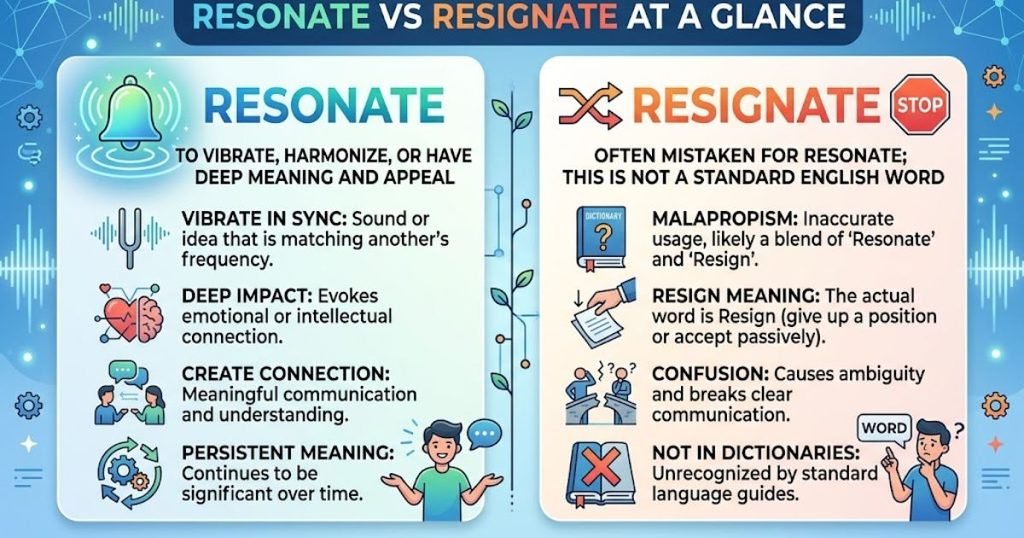
| Term | Correct? | Meaning | Use |
| Resonate | Yes | To echo, vibrate, or strongly connect with someone | Sounds, ideas, messages, stories, music |
| Resignate | No (not standard) | No accepted meaning in modern usage | Avoid; use resonate or resign |
| Resign | Yes | To quit a job or position, or accept something | Jobs, offices, accepting a situation |
| Resignation | Yes | The act of resigning, or a feeling of acceptance | Letters, announcements, emotions |
Read Related Post: Finaly or Finally: 5 Simple Facts to Fix This Common Mistake (2026)
How Do You Pronounce Resonate, and What Are Its Forms?
“Resonate” is pronounced REZ-uh-nayt, with the stress on the first syllable. The last syllable rhymes with “late.”
Here are its forms:
- Resonate: base form (They want the message to resonate.)
- Resonates: third person singular (It resonates with me.)
- Resonated: past tense (The speech resonated deeply.)
- Resonating: present participle (The bell was still resonating.)
- Resonance: noun (The film has emotional resonance.)
- Resonant: adjective (a resonant voice)
- Resonantly: adverb (rare, but valid)
“Resonate” is usually followed by the word with when it means “connect”: resonate with a person, a group, or an idea. It can also be followed by “in” or “through” when describing sound: the chant resonated through the valley.
American and British English use the same spelling and meaning for this word, so you do not need to worry about regional differences.
Where Does the Word Resonate Come From?
“Resonate” comes from the Latin verb resonare, which means “to sound again” or “to echo.” The prefix re- means “again,” and sonare means “to sound.” That is why the word first described sound and only later developed its figurative sense of an idea echoing in your mind.
Once you know this, the meaning is easy to remember. Something that resonates sounds again inside you.
“Resign” has a different origin. It comes from the Latin resignare, built from re- and signare (to sign or seal). The Latin meaning is closer to “unseal” or “cancel,” and it eventually developed into “give up.” Different roots explain why these words have no overlap in meaning, even though they look alike.
How Do You Use Resonate in a Sentence?
Examples work best when they come from real situations. Here are some across different contexts.
Everyday conversation
- That podcast really resonated with me.
- His advice didn’t resonate at the time, but it does now.
Workplace communication
- We need a slogan that resonates with first-time buyers.
- The new policy resonated with most of the team.
Academic writing
- The author’s themes continue to resonate with modern readers.
- The study found that personal stories resonate more than statistics.
- Thanks for sharing your thoughts. Your point about onboarding really resonated.
Formal writing
- The court’s opinion resonated well beyond the original case.
Sound and music
- The organ’s final note resonated through the cathedral.
In each of these, “resonate” suggests a response, either an echo in a room or a connection in the mind. If you can swap in “connect” or “echo,” the word probably fits.
What Are the Common Mistakes With Resignate and Resonate?
These errors are normal, and they are easy to fix.
Mistake 1: Using “resignate” instead of “resonate”
Incorrect: The message resignated with our customers.
Correct: The message resonated with our customers.
The writer meant “connected,” so “resonate” is the right word.
Mistake 2: Using “resignate” instead of “resign”
Incorrect: She plans to resignate next month.
Correct: She plans to resign next month.
When you mean quitting a job, the verb is “resign.”
Mistake 3: Using “resonate” when you mean “resign”
Incorrect: He resonated from his position last week.
Correct: He resigned from his position last week.
This one is rarer, but it happens when the two words get mixed up in the other direction.
Mistake 4: Writing “resonate” without “with” when connection is meant
Incorrect: The idea resonated me.
Correct: The idea resonated with me.
In the figurative sense, “resonate” needs “with” before the person or group. This is a small preposition error rather than a spelling one.
What Should You Write If You Meant Resign, Resigned, or Resignation?
Often the writer who types “resignate” actually wanted a word related to quitting or accepting. These are the correct options:
- Resign (verb): to leave a job or position. He resigned on Friday.
- Resign yourself to: to accept something you can’t change. She resigned herself to a long wait.
- Resigned (adjective): accepting, often with sadness. He gave a resigned shrug.
- Resignation (noun): the act of quitting, or a quiet acceptance. She submitted her resignation letter.
Notice that “resign” is pronounced rih-ZYN, with a long “i,” while “resignation” shifts to rez-ig-NAY-shun. That pronunciation shift is the reason “resignation” sounds close to “resonate” in a hurry.
How Can You Remember the Difference?
Try this simple trick:
- Resonate has “sound” inside it. Think of the “son” in resonate as in “sonic” or “sonar.” Resonate is about sound and echoes.
- Resign has “sign” inside it. Think of signing a letter to quit.
If your sentence is about an echo or a connection, use resonate. If it is about leaving a job or accepting something, use resign. And if you are about to type “resignate,” stop and choose one of those two.
Frequently Asked Questions
Is resignate a word?
No. “Resignate” is not a standard English word. Use “resonate” if you mean to connect or echo, and “resign” if you mean to quit or accept.
What does resonate mean?
“Resonate” means to produce a lasting sound, or to strike a chord with someone. When a message resonates with you, it feels meaningful and relevant.
How do I use resonate in a sentence?
Add “with” after the verb when you mean connection. For example: Her honesty resonated with the whole team.
Is it “resonate with” or “resonate to”?
“Resonate with” is the standard choice for connection with a person or idea. “Resonate to” is much less common and usually sounds unnatural in US English.
What is the difference between resonate and resign?
“Resonate” is about echoes and connection. “Resign” is about quitting a role or accepting a situation. They come from different Latin roots and are never interchangeable.
Conclusion
Resonate is the correct word. Resignate is not standard English. If something echoes or connects, it resonates. If someone quits or gives in, they resign. When in doubt, look for “son” (sound) in resonate and “sign” in resign, and the right choice will usually be clear.

Smith Jason is an SEO expert with 2–3 years of experience, sharing grammar tips, confusing words, vocabulary and writing advice.