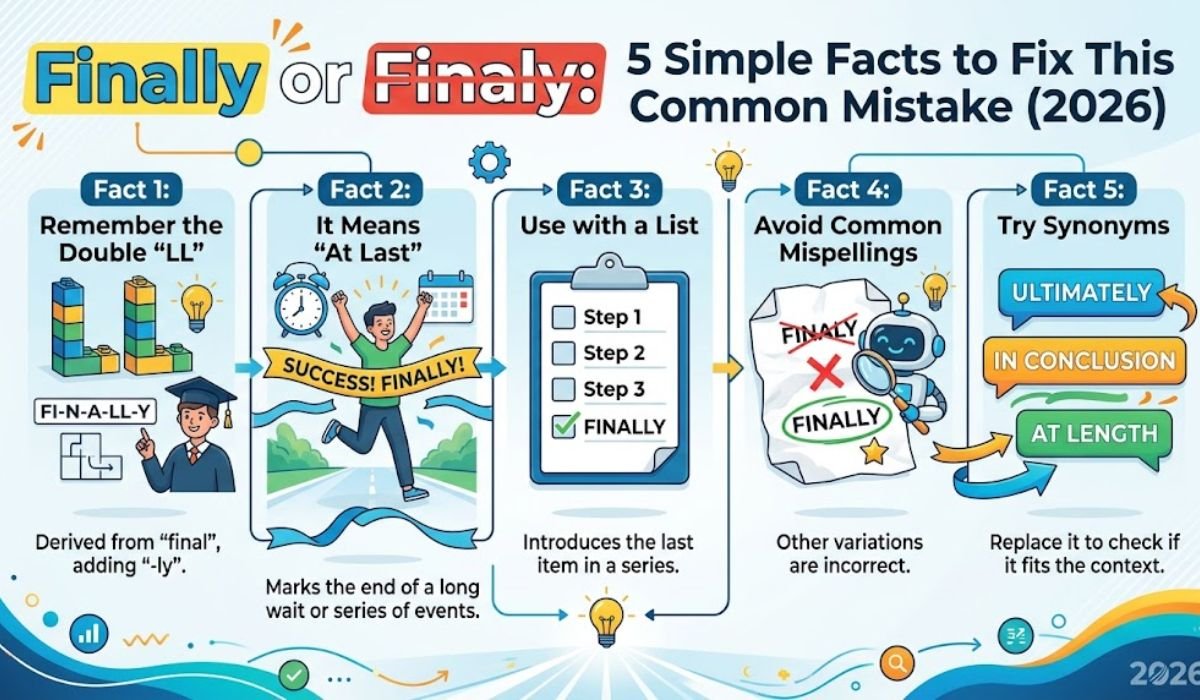
Is it “finaly” or “finally”? Many writers drop a letter because the word sounds short when spoken fast. The correct spelling is finally, with two L’s. “Finaly” is a misspelling and is not a word in standard English. Once you see why the second L is there, the spelling is easy to remember.
Which Spelling Is Correct: Finaly or Finally?
“Finally” is the correct spelling. “Finaly” is always a mistake in standard American and British English.
Here are the five facts that fix this error for good:
- Finally has two L’s: f-i-n-a-l-l-y.
- It is an adverb meaning “after a long time,” “at the end,” or “lastly.”
- It is built from the word final plus the ending -ly.
- It is pronounced the same in the US and the UK, and spelled the same too.
- “Finaly” has no standard use, so spell checkers will flag it.
What Does Finally Mean?
Finally has three main meanings, and context tells you which one is meant.
After a long wait or effort. This is the most common use. “The package finally arrived.” The word suggests the wait was longer than expected.
As the last item in a sequence. “First, preheat the oven. Next, mix the batter. Finally, add the chocolate chips.” Here it works like “lastly.”
In the end, or as a conclusion. “The committee finally agreed on a budget.” It signals that a process reached its result.
A fourth, less common meaning is “in a way that cannot be changed.” For example: “The contract was finally settled.” Most readers will understand this as “conclusively.”
Why Is Finally Spelled With Two L’s?
Because two separate pieces meet: the word final ends in l, and the suffix -ly begins with l. Nothing gets dropped. Both letters stay.
The same pattern appears in other common words:
| Base Word | Add -ly | Result |
| final | + ly | finally |
| real | + ly | really |
| usual | + ly | usually |
| actual | + ly | actually |
| total | + ly | totally |
If you can spell “really” and “usually,” you already know the rule. A quick memory trick: final + ly = finally. Say the two parts out loud while you type, and the double L appears on its own.
Many people write “finaly” because the spoken word blends the two L sounds into one. Your ear hears one L, but the spelling needs two.
Is Finally a Verb, Adjective, or Adverb?
Finally is an adverb. It describes when or how an action happens, or where something falls in a series.
Related forms belong to other parts of speech, which is a common source of confusion:
| Word | Part of Speech | Example |
| final | Adjective | “This is the final draft.” |
| final | Noun | “She studied for her chemistry final.” |
| finally | Adverb | “He finally finished the draft.” |
| finalize | Verb | “We need to finalize the schedule.” |
| finality | Noun | “The judge spoke with finality.” |
Adverbs like finally do not change form for singular or plural. They also do not have a standard comparative form, so “more finally” is not used.
Read Related Post: Verbiage or Verbage: The 1 Correct Spelling and 7 Ways to Use It Right
Where Does the Word Finally Come From?
English formed finally from the adjective final and the ending -ly. Final comes from the Latin finalis, which relates to finis, meaning “end” or “boundary.” That Latin root also gives us finish, finite, and infinite.
The meaning connection makes the spelling easier to remember. Finally is the “end word.” If you can think of final inside it, you will not leave out the second L.
How Do You Pronounce Finally?
In American English, finally has three syllables: FY-nuh-lee. The stress falls on the first syllable.
Many speakers compress the middle into something closer to FY-nl-ee, which is a big reason the spelling goes wrong. When you speak, the double L sounds like a single L. When you write, you must still type both.
British and American speakers pronounce it almost identically, so there is no regional difference to worry about.
How Do You Use Finally in a Sentence?
Finally fits many situations. Here are examples from different settings:
Everyday conversation
- “I finally got my driver’s license.”
- “The rain finally stopped, so we went for a walk.”
Workplace and email
- “Finally, please send me the signed form by Friday.”
- “The team has finally resolved the login issue.”
Academic writing
- “First, the data was collected. Then it was cleaned. Finally, it was analyzed.”
Casual writing and texting
- “Finally! Friday is here.”
When finally opens a sentence as a transition, follow it with a comma: “Finally, we reviewed the results.” This is the standard punctuation. When it sits in the middle of a sentence, no comma is needed: “We finally reviewed the results.”
In the first example, the academic sentence works because finally marks the last step in a clear sequence. In the workplace example, “Finally, please send…” signals that this is the last request in a list of instructions.
Finally vs. Final, Lastly, Eventually, and At Last
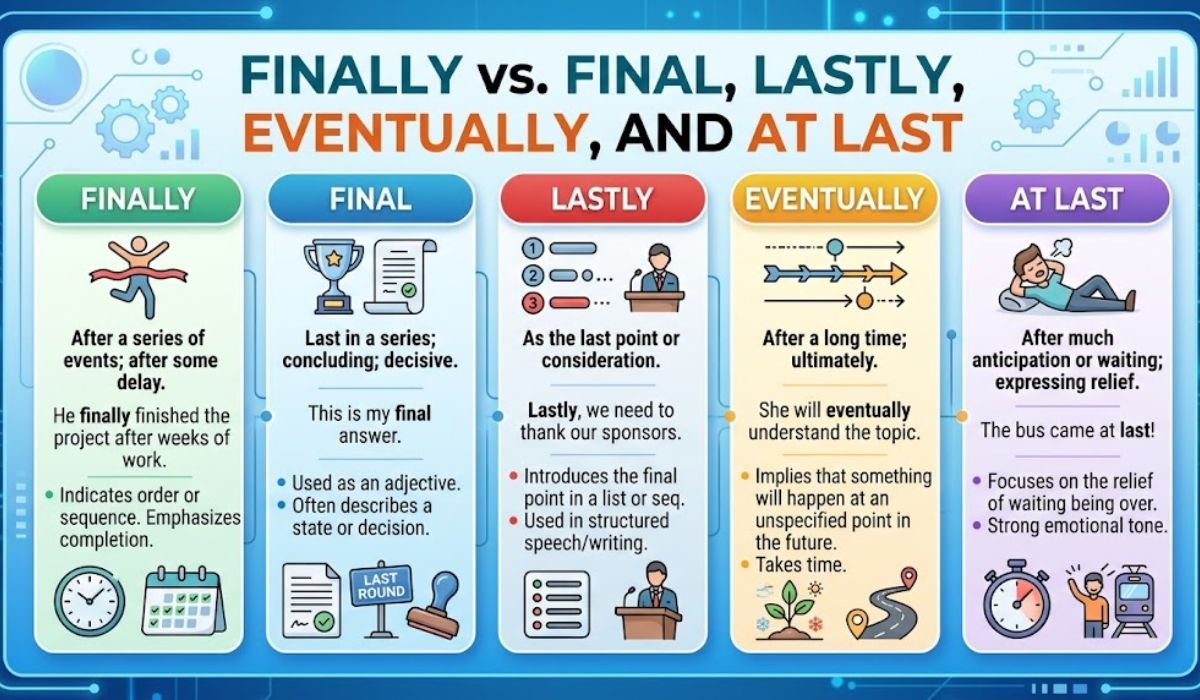
Writers often swap these words, but they are not identical.
| Term | Part of Speech | Best Use | Example |
| finally | Adverb | After a wait, or last in a sequence | “I finally understand it.” |
| final | Adjective | Describes the last thing | “The final exam is tomorrow.” |
| lastly | Adverb | Last item in a list | “Lastly, thank you all.” |
| eventually | Adverb | Something happens later, often without a clear deadline | “Eventually, he moved away.” |
| at last | Adverb phrase | Relief after a long wait | “At last, we found the keys.” |
The key difference: finally often carries a sense of waiting or effort, while lastly simply marks the end of a list. Eventually says something will happen in time, but does not say there was frustration involved.
What Are the Most Common Finally Mistakes?
These errors are normal. Even experienced writers make them when typing quickly.
Mistake 1: Dropping the second L
Incorrect: I finaly finished my homework.
Correct: I finally finished my homework.
The word needs both L’s because final and -ly each contribute one.
Mistake 2: Using final when an adverb is needed
Incorrect: She final passed the test.
Correct: She finally passed the test.
Final is an adjective, so it describes nouns. To describe an action, use the adverb.
Mistake 3: Missing the comma after a transition
Incorrect: Finally we can start the meeting.
Correct: Finally, we can start the meeting.
A comma helps separate the transition word from the rest of the sentence.
Mistake 4: Confusing finally with eventually
Incorrect: I will finally call you someday.
Correct: I will eventually call you someday.
Finally suggests the wait is over. For something vague in the future, eventually is the better choice.
Does Finaly Ever Count as Correct?
No standard English dictionary lists “finaly” as a word. In everyday English writing, it is simply a typo or spelling error.
You may see “Finaly” in other settings, such as a username, a brand name, or a surname in another language. Those are proper names and not variants of the English adverb. In school, work, or professional writing, always use finally.
If your spell checker underlines the word, trust it. This is one of the easier errors to fix.
How Can You Remember the Correct Spelling?
Try one of these quick methods:
- Split it in two. Think final + ly. Write both parts, and the double L follows.
- Compare it to “really.” If you never write “realy,” do not write “finaly.”
- Say it slowly. Pronounce it as fi-nal-ly, with each L audible, then speed up when speaking.
- Check the end. Words that end in -lly from an adjective ending in l always keep both L’s.
Another simple habit: after writing the word, look for two L’s in a row near the end. If you see them, you are correct.
Frequently Asked Questions About Finaly vs. Finally
Is “finaly” a correct word?
No. Finally is the only correct spelling. “Finaly” is a misspelling and will be marked wrong in standard writing.
What does “finally” mean?
It means “after a long time,” “at last,” or “as the last item in a series.” Example: “After three tries, I finally passed the test.”
Is “finally” spelled differently in British English?
No. American and British English both spell it finally.
Do I need a comma after “finally”?
Use a comma when finally begins a sentence as a transition: “Finally, we started.” You do not need one when it appears in the middle: “We finally started.”
Can I use “finally” in formal writing?
Yes. It works in essays, reports, emails, and presentations, especially to mark the last step in a sequence.
Conclusion
The question “finaly or finally” has a simple answer: finally is correct. Think of the word final plus the ending -ly, and the double L takes care of itself. Remember that rule, and you will not need to look it up again.

Smith Jason is an SEO expert with 2–3 years of experience, sharing grammar tips, confusing words, vocabulary and writing advice.







1 thought on “Finaly or Finally: 5 Simple Facts to Fix This Common Mistake (2026)”