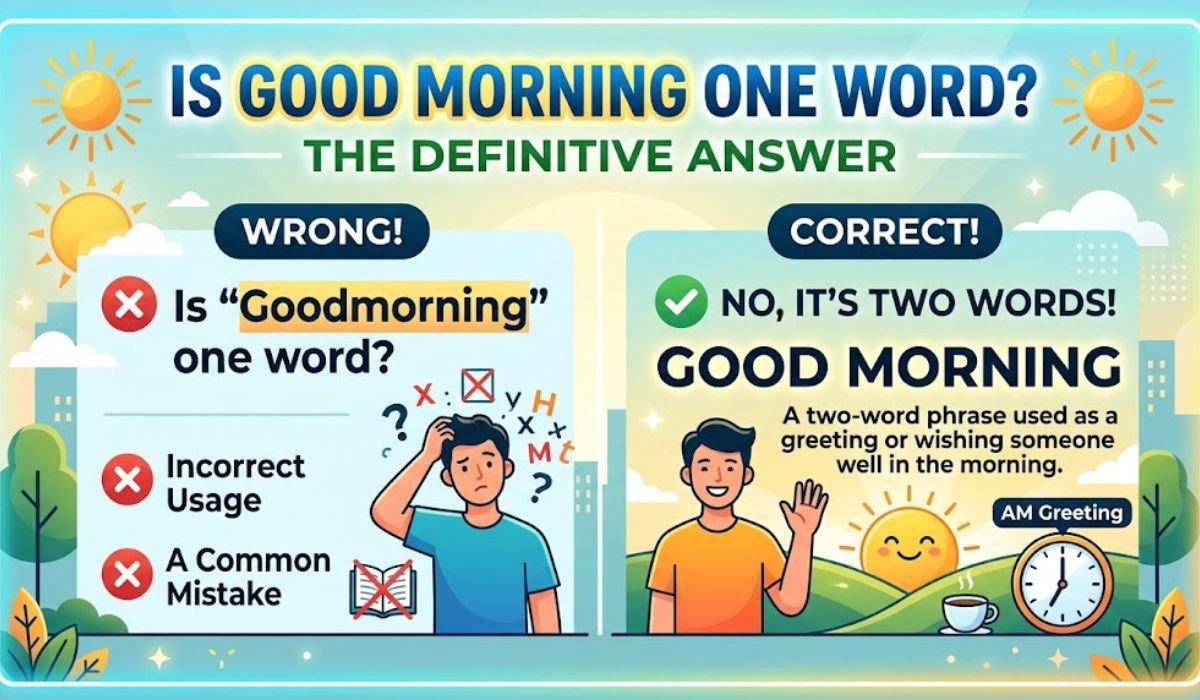
You type a quick message to a coworker and pause: is it “good morning” or “goodmorning”? The confusion makes sense. Greetings like “goodbye” are one word, and “good morning” sounds like a single unit when spoken. Here is the answer: “good morning” is two words, written with a space between them. This article covers spelling, capitalization, and usage so you can write it with confidence.
What Is the Short Answer?
“Good morning” is always written as two separate words: good morning. The one-word spelling “goodmorning” is not standard English.
Dictionaries list the greeting as an open compound, which means the words stay separate on the page even though they work together as one expression. You can use it in emails, texts, essays, and formal letters without changing the spelling.
Why Do People Think “Good Morning” Might Be One Word?
Three things cause the mix-up.
First, we say it quickly. In normal speech, the two words blend into a single rhythm, so it feels like one unit.
Second, English has several one-word greetings and farewells. “Goodbye” and “hello” are single words, so it seems logical that “good morning” would be too.
Third, autocorrect and social media habits spread odd spellings. Hashtags like #goodmorning have no spaces because hashtags cannot contain spaces. That is a platform rule, not a spelling rule.
What Part of Speech Is “Good Morning”?
In most sentences, “good morning” is an interjection (also called a greeting or set phrase). It stands alone as a polite expression and is not part of the sentence’s grammar.
It can also work in other ways:
- As a noun phrase: “She had a good morning at the gym.” Here, “good” is an adjective describing the noun “morning.”
- As a compound modifier: “He sent a good-morning text.” When two words team up to describe a noun, a hyphen links them.
The greeting has no verb forms, no plural, and no tense. You cannot say “good mornings” as a greeting, though “good mornings” can appear in a different sense: “We shared a few good mornings on that trip.”
What Does “Good Morning” Mean?
As a greeting, it means “hello, and I hope your morning goes well.” People use it from sunrise until noon, roughly. After that, “good afternoon” takes over.
The phrase carries a warm, friendly tone. It works in nearly every setting, from texting a friend to opening a business presentation. Because it is polite and neutral, it rarely sounds too casual or too stiff.
As a noun phrase, it simply describes a morning that was pleasant: “It was a good morning for a walk.”
Is “Goodmorning” Ever Correct?
No. “Goodmorning” is a misspelling in standard American English. Spell-checkers will flag it, and editors will correct it.
There is one exception worth knowing. Some usernames, brand names, hashtags, and website addresses combine the words because spaces are not allowed. In those cases, the one-word form is a technical choice. It does not change the correct spelling in regular writing.
| Form | Correct? | Where It Appears |
| good morning | Yes | Standard spelling in all writing |
| Good morning | Yes | At the start of a sentence or greeting |
| goodmorning | No | Misspelling (except in hashtags or usernames) |
| good-morning | Sometimes | Only as a compound modifier before a noun |
| Good Morning | Sometimes | Titles, headlines, or proper names |
Read Related Post: Spicey vs Spicy: Which Spelling Is Correct?
How Do You Capitalize and Punctuate “Good Morning”?
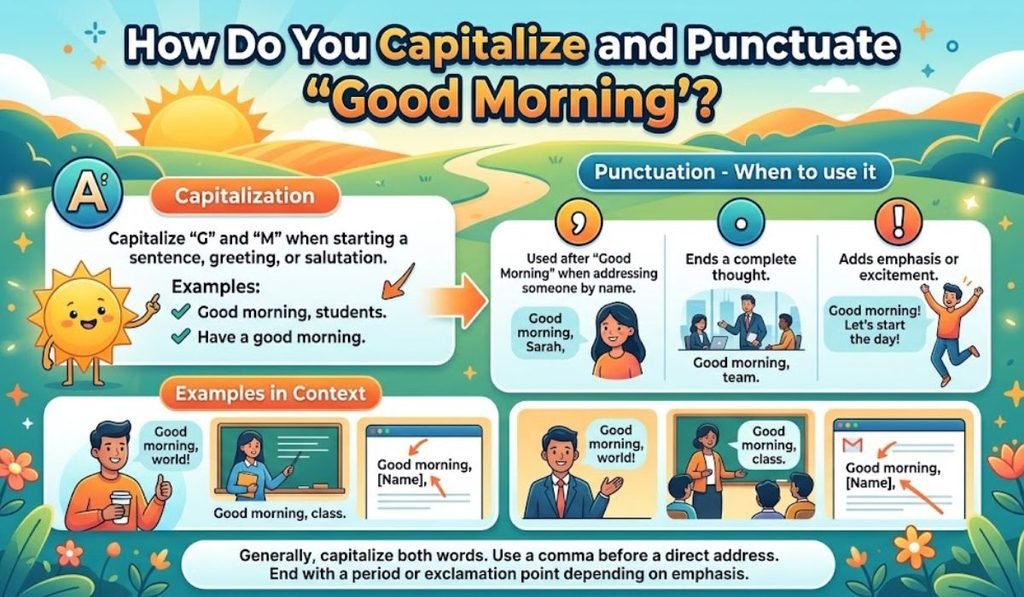
Capitalize only the first word when the greeting starts a sentence or opens an email: “Good morning, everyone.”
Do not capitalize it in the middle of a sentence: “She said good morning to the neighbors.”
When you address someone directly, add a comma before the person’s name: “Good morning, Maria.” The comma marks the name as a direct address. Without it, the sentence reads as if Maria is part of the greeting itself.
In a formal letter or email, a comma after the greeting is standard: “Good morning, Dr. Patel,”. Some writers use a colon in very formal business letters, but a comma is more common in everyday email.
Use title case only in titles, such as a song, show, or book called Good Morning America.
How Is “Good Morning” Pronounced?
In American English, it sounds like “good MOR-ning.” The stress falls on the first syllable of “morning.”
The “d” in “good” often softens or nearly disappears in fast speech, which is why the phrase can sound like “goo-morning.” In casual speech, many people also shorten it to “mornin'” or just “morning.”
That shortened form is fine in conversation. In writing, “Morning!” works for informal messages, but “Good morning” is better for professional emails.
Where Does “Good Morning” Come From?
The greeting grew out of older English wishes for a pleasant day. Earlier forms such as “good morrow” were common in older English literature and were used the same way, as a polite wish for someone’s morning. “Morrow” is an old word for morning or the next day.
Over time, “good morrow” faded, and “good morning” became the everyday form. The pattern matches “good afternoon,” “good evening,” and “good day,” which also developed as short polite wishes.
The history is a good reminder that these phrases began as full wishes, something like “I wish you a good morning.” Speakers shortened them over time. That shortening is part of why they feel like single units today, even though they are still written as separate words.
How Do You Use “Good Morning” in Sentences?
Here are natural examples from different settings.
Everyday conversation:
- “Good morning! Did you sleep okay?”
- “I told the barista good morning, but she was already focused on the line.”
Workplace and email:
- “Good morning, team. Here is the agenda for today’s meeting.”
- “Good morning, Mr. Ellis. Thank you for meeting with us.”
Casual texting:
- “Good morning! Coffee later?”
- “Morning! Running a few minutes late.”
Formal speaking:
- “Good morning, ladies and gentlemen. Welcome to today’s conference.”
Writing about the phrase itself:
- “She sent him a good-morning text every day.”
The last example uses a hyphen because “good-morning” acts as a single adjective describing “text.” Without the hyphen, the sentence is still understandable, but the hyphen makes the relationship clearer.
What Are the Most Common Mistakes?
These mistakes are normal, and they are easy to fix.
Mistake 1: Writing it as one word.
Incorrect: Goodmorning, everyone.
Correct: Good morning, everyone.
The two words stay separate in standard writing.
Mistake 2: Capitalizing both words mid-sentence.
Incorrect: She said Good Morning to the class.
Correct: She said good morning to the class.
Only capitalize the greeting when it begins a sentence or is part of a title.
Mistake 3: Forgetting the comma before a name.
Incorrect: Good morning Sarah.
Correct: Good morning, Sarah.
The comma separates the greeting from the person being addressed.
Mistake 4: Using it after noon.
Incorrect: Good morning, we will start the afternoon session now.
Correct: Good afternoon, we will start the session now.
Most speakers switch to “good afternoon” after midday.
Mistake 5: Missing the hyphen before a noun.
Incorrect: He sent a good morning text.
Correct: He sent a good-morning text.
When the phrase modifies a noun, the hyphen helps readers see it as one description.
What About Related Greetings Like Good Night and Goodbye?
This is where the confusion often starts, because similar phrases follow different spelling patterns.
| Term | Standard Spelling | Notes |
| good morning | Two words | Open compound, always separate |
| good afternoon | Two words | Same pattern as good morning |
| good evening | Two words | Same pattern |
| good night | Two words | Standard form in most dictionaries |
| goodbye | One word | Closed compound, standard |
| good day | Two words | Formal or old-fashioned |
“Goodbye” is the main exception. It is a closed compound that developed from an older phrase meaning “God be with you.” Over centuries, it shortened and fused into one word.
For “good night,” some dictionaries also list “goodnight” as an accepted variant in certain uses, but “good night” remains the safe standard choice. If you are unsure, check a current dictionary such as Merriam-Webster.
FAQ’s
Is “good morning” one word or two words?
It is two words. Write it as “good morning,” with a space between them.
Is “goodmorning” ever acceptable?
Not in standard writing. You may see it in hashtags, usernames, or website addresses, where spaces are not allowed. In regular sentences, use “good morning.”
Do I capitalize “good morning” in an email?
Capitalize only the first word when it opens the message: “Good morning, Alex.” Use lowercase when the phrase appears in the middle of a sentence.
Do I need a comma after “good morning”?
Yes, when you address someone by name. Write “Good morning, Jordan.” Without a name, the comma is optional: “Good morning everyone” is usually fine, though “Good morning, everyone” is more common in formal writing.
Is it “good morning” or “good mornin'”?
“Good morning” is standard. “Mornin'” is a casual, spoken shortening and fits informal texts or dialogue, but not formal writing.
Conclusion
Think of “good morning” the way you think of “good afternoon” and “good evening.” They are all two words, and they all follow the same spelling pattern. Capitalize the first word at the start of a sentence, add a comma before a name, and keep the space.
If you only remember one thing, remember this: “good morning” has a space, and “goodmorning” does not belong in standard writing.

Smith Jason is an SEO expert with 2–3 years of experience, sharing grammar tips, confusing words, vocabulary and writing advice.








1 thought on “Is Good Morning One Word? The Definitive Answer”