If you have ever paused mid sentence wondering whether to write “specs” or “specks,” you are not alone. The two words sound almost identical when spoken quickly, which is exactly why people mix them up in writing. Here is the short answer: “specs” is short for specifications or eyeglasses, while “specks” refers to tiny spots or particles. They are not interchangeable, and using the wrong one can confuse your reader.
What Does “Specs” Mean?
“Specs” is an informal shortened form of the word specifications. It shows up constantly in technical, business, and casual conversation when people talk about the detailed requirements or features of a product.
“Specs” also has a second common meaning: it is a casual, plural way to refer to eyeglasses. Someone might say, “I forgot my specs at home,” meaning they left their glasses behind.
Both meanings are correct. Context tells you which one the speaker intends.
Examples:
- “Can you send me the specs for the new laptop model?”
- “She left her specs on the kitchen counter.”
- “The engineering team finalized the specs last week.”
What Does “Specks” Mean?
“Specks” is the plural form of speck, a noun meaning a very small spot, mark, or particle. Specks are physically tiny and usually visible only because of contrast, like a dark speck on a white shirt or a speck of dust floating in sunlight.
Examples:
- “There are specks of paint on the floor.”
- “I noticed a few specks of dirt on the lens.”
- “From the plane, the houses looked like tiny specks below.”
Specs vs Specks: The Core Difference
The confusion between these two words comes down to one letter and one sound, but the meanings are completely unrelated.
| Term | Correct? | Meaning | Example Use |
| Specs | Yes | Short for specifications, or informal term for eyeglasses | “Check the product specs before buying.” |
| Specks | Yes | Small spots or particles | “Clean the specks off the window.” |
Both words are legitimate. Neither one is a misspelling of the other. The mistake happens when a writer chooses the wrong word for the meaning they intend, not because one form is grammatically wrong.
Read Related Post: Writing or Writting: Never Get Confused Again
Why Do People Confuse Specs and Specks?
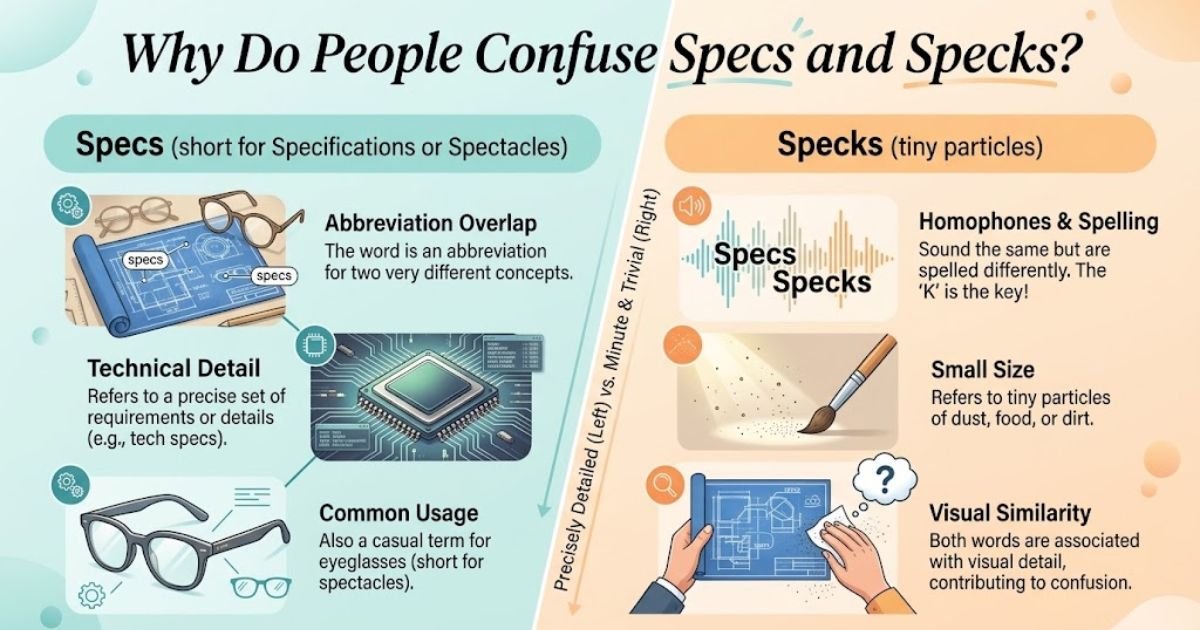
The confusion is mostly about sound. When spoken at a normal conversational pace, “specs” and “specks” can sound nearly identical, especially in accents where the short “e” sound gets slightly softened. Since English spelling does not always match pronunciation exactly, writers sometimes type the word that sounds right without checking the meaning.
Autocorrect and voice-to-text tools also contribute to the mix-up, since both words are real dictionary entries and neither one gets flagged as a spelling error.
Grammar Breakdown
Understanding the grammar behind each word makes the distinction much easier to remember.
Specs (specifications or eyeglasses)
- Part of speech: noun (informal, plural in form)
- Singular form: technically “spec,” though it is used less often
- Common in technical writing, marketing copy, and everyday speech
- Considered informal; formal writing usually spells out “specifications”
Specks (small particles)
- Part of speech: noun, plural
- Singular form: speck (“There is a speck of dust on the table.”)
- Works as a standard noun in both formal and informal writing
- No informal shortening involved; “speck” is the full, standard word
Pronunciation
Both words are pronounced with a short “e” sound, similar to the “e” in “pet.” The difference lies in the final consonant sound:
- Specs ends with a “ks” sound, like the word “sex” without the “s” at the start.
- Specks ends with the same “ks” sound, but the “ck” spelling reflects its root word “speck.”
Because the pronunciation is so close, relying on sound alone will not tell you which word to use. Meaning is the only reliable guide.
Where Do These Words Come From?
“Speck” comes from Old English “specca,” meaning a small spot or stain. It has kept a consistent meaning for centuries, referring to something visually small.
“Specs” as a shorthand for “specifications” is a much newer, informal abbreviation that became common in the 20th century alongside the rise of technical and engineering documentation. The “eyeglasses” meaning of “specs” is also an informal shortening, believed to come from clipping the word “spectacles.”
Neither word has a biblical or classical origin worth mentioning here, since both developed through practical, everyday language use.
How to Use Each Word Correctly
Use “specs” when you are talking about:
- Technical details or requirements of a product (“the specs of a phone”)
- Eyeglasses, in casual conversation (“I need new specs”)
Use “specks” when you are talking about:
- Small visible particles, spots, or marks
- Something that appears tiny due to distance (“specks in the distance”)
Real Life Examples
Everyday conversation “Have you seen my specs? I can’t read this menu without them.” (Here, “specs” clearly means eyeglasses based on context.)
Workplace communication “Attached are the full specs for the Q3 product release.” (This use of “specs” refers to specifications, common in business emails.)
Academic writing “The device specifications outline power requirements in detail.” (Formal writing tends to avoid “specs” and uses the full word “specifications” instead.)
Casual texting “There’s a speck of something on your jacket, want me to grab it?”
Descriptive writing “Tiny specks of gold shimmered in the riverbed.” (This example works because “specks” accurately describes something small and scattered.)
Common Mistakes
Incorrect: “The eagle looked like a small speck against the blue sky, so I checked its specs online later.” Correct: “The eagle looked like a small speck against the blue sky.”
The first sentence accidentally mixes both words when only “speck” was needed. Watch for sentences where one meaning creeps into a spot meant for the other.
Incorrect: “Can you send me the product specks?” Correct: “Can you send me the product specs?”
This mistake usually happens because the writer typed the word that sounded right without picturing the meaning. Since “specifications” has nothing to do with tiny particles, “specks” is never correct here.
Incorrect: “There are specs of dust on the shelf.” Correct: “There are specks of dust on the shelf.”
Dust particles are small physical marks, so “specks” is the accurate word. “Specs” would incorrectly suggest specifications or eyeglasses.
Related Words Worth Knowing
- Speck (singular): a single small spot or particle
- Spectacles: the full, formal word for eyeglasses
- Specifications: the full, formal word behind “specs”
- Speckled: an adjective describing something covered in small spots, like a speckled egg
- Fleck: a close synonym of “speck,” also meaning a small spot or particle
Quick Practical Guidance
If you are unsure which word fits, ask yourself one question: am I describing something small and physical, or something related to details, requirements, or glasses?
- Small physical spot or particle: use specks
- Product details, requirements, or glasses: use specs
This single check resolves almost every case of confusion between the two.
FAQ’s
Is “specs” a real word?
Yes. “Specs” is a widely accepted informal noun meaning specifications or eyeglasses. It appears in dictionaries as an informal or colloquial term.
Is “specks” a real word?
Yes. “Specks” is the standard plural form of “speck,” a noun meaning a small spot or particle. It is used in both formal and informal writing.
What is the singular form of “specs”?
The singular form is “spec,” though it is used far less often than the plural “specs.”
Can “specs” and “specks” ever mean the same thing?
No. They describe completely unrelated concepts. “Specs” relates to specifications or eyeglasses, while “specks” relates to tiny spots or particles.
Which word should I use in formal writing?
In formal writing, spell out “specifications” instead of “specs,” and use “speck” or “specks” as needed since these are already standard, accepted words.
Conclusion
The difference between specs and specks comes down to meaning, not spelling error. “Specs” points to specifications or eyeglasses, while “specks” points to tiny spots or particles. The next time you are unsure which one to type, picture what you are actually describing. If it is small and physical, go with specks. If it relates to details or glasses, go with specs.

Smith Jason is an SEO expert with 2–3 years of experience, sharing grammar tips, confusing words, vocabulary and writing advice.










1 thought on “Specs vs Specks: What’s the Difference and Which Word Should You Use?”