If you have ever paused mid sentence wondering whether to type “authorized” or “authorised,” you are not alone. This is one of the most common American versus British spelling mix ups in English, and the confusion usually comes from switching between US and UK sources without noticing the difference.
Both spellings are correct. “Authorized” is the standard spelling in American English, while “authorised” is the standard spelling in British English. Neither one is a grammar mistake. The choice depends entirely on which English variety you are writing in.
The Quick Answer: Authorized vs Authorised
Here is the short version you can rely on:
- Authorized (with a “z”) is used in American English, Canadian English, and most international business writing that follows US style.
- Authorised (with an “s”) is used in British English, Australian English, and most Commonwealth countries.
Both words mean exactly the same thing. They are pronounced the same way. The only difference is regional spelling convention, similar to “organize” versus “organise” or “realize” versus “realise.”
What Does “Authorized” or “Authorised” Actually Mean?
Both spellings function as the past tense and past participle of the verb “authorize” (or “authorise”), meaning to give official permission, approval, or legal power for something to happen.
For example, when a manager authorizes a purchase, they are giving formal permission for the transaction to move forward. When a government authorizes a new law, they are granting it legal power.
As an adjective, “authorized” (or “authorised”) describes something that has received official approval, such as an authorized dealer or an authorised representative.
Why Do Two Spellings Exist for the Same Word?
The “z” versus “s” difference traces back to a broader pattern in English spelling reform. Many verbs ending in “-ize” or “-ise” come from Greek verbs that originally ended in “-izein,” which entered English through Latin and French.
American English, largely shaped by Noah Webster’s early 19th century dictionaries, standardized the “z” spelling for these words to reflect their Greek origin more directly. British English kept the “s” spelling, which had become common through French influence, though British style guides like Oxford actually accept “z” spellings too in formal contexts.
So the split is not about one country getting it wrong. It reflects two different historical choices about which root to prioritize.
Authorized vs Authorised: Comparison Table
| Spelling | Region | Correct? | Common Use |
| Authorized | American English, Canadian English | Yes | Business, legal, tech writing in the US |
| Authorised | British English, Australian English | Yes | Business, legal, official writing in the UK |
| Authorized | British English (Oxford style) | Sometimes accepted | Academic and formal UK publishing that follows Oxford spelling |
Read Related Post: Specs vs Specks: What’s the Difference and Which Word Should You Use?
How to Pronounce Authorized or Authorised
Both spellings are pronounced the same way: AW-thuh-rized (three syllables, stress on the first syllable). The spelling difference has zero effect on pronunciation, which is one reason the mix up is so easy to make in writing but never noticeable in speech.
Grammar Forms of Authorize and Authorise
Since “authorized” and “authorised” are simply spelling variants of the same verb, they share the same grammar rules.
- Base verb: authorize (US) / authorise (UK)
- Past tense: authorized / authorised
- Past participle: authorized / authorised
- Present participle: authorizing / authorising
- Third person singular: authorizes / authorises
- Noun form: authorization / authorisation
- Adjective form: authorized / authorised (as in “an authorized user”)
Whichever spelling you choose, stay consistent throughout the same piece of writing. Related words like “authorization” and “authorisation” should follow the same regional pattern as the base verb.
When to Use Authorized
Use authorized when:
- You are writing for a US based audience, company, or publication.
- Your style guide follows American English (AP Style, Chicago Manual of Style).
- You are writing software documentation, since most tech companies default to American spelling.
- Your reader is in Canada, since Canadian English typically favors “authorized” in business and tech contexts, though usage varies.
Example (American business email): “Please confirm that the vendor is authorized to process refunds before we finalize the contract.”
Example (US legal writing): “The committee authorized the release of funds effective immediately.”
When to Use Authorised
Use authorised when:
- You are writing for a UK, Irish, Australian, or New Zealand audience.
- Your style guide follows British English conventions.
- You work in government, finance, or legal fields in a Commonwealth country, where “authorised” is the expected term (for example, “authorised financial adviser” in UK regulatory language).
Example (British workplace memo): “Only authorised personnel may access the server room after hours.”
Example (UK academic writing): “The study was authorised by the university’s ethics board in March.”
Is One Spelling More Correct Than the Other?
No. This is not a case of correct versus incorrect. It is a case of regional consistency. Calling “authorised” wrong in a British context would be as inaccurate as calling “authorized” wrong in an American one.
The only real mistake is mixing both spellings within the same document. If you start with “authorized,” stick with it throughout, including in related words like “authorization.”
Common Mistakes With Authorized and Authorised
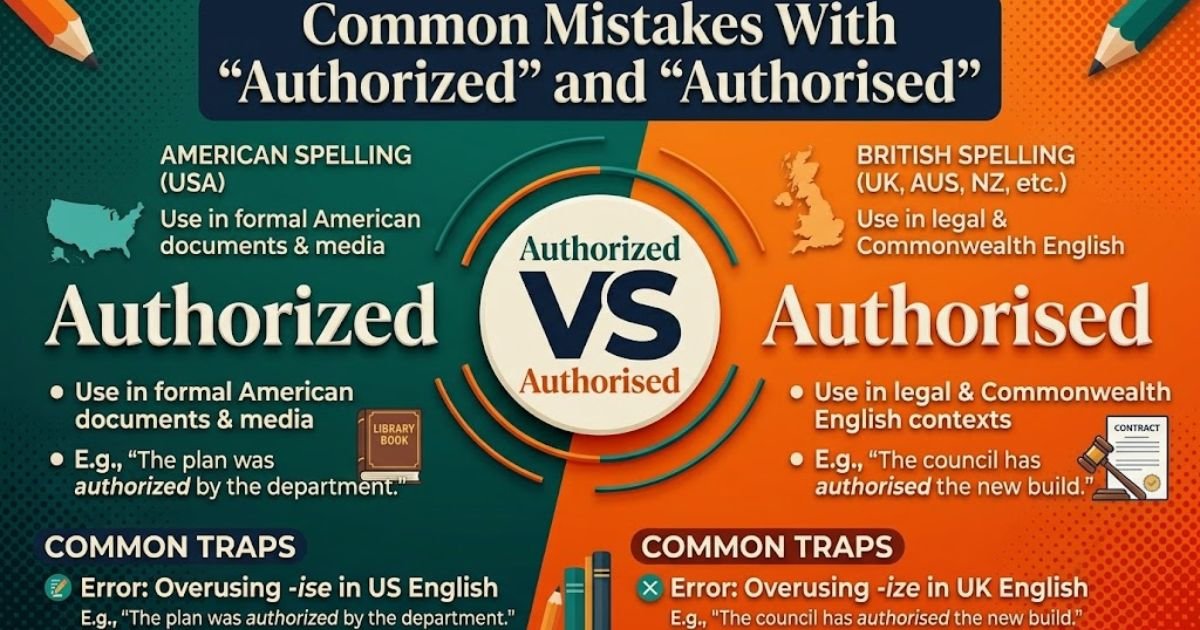
Incorrect: “The manager authorised the request, and the new hire was fully authorized by Friday.” Correct: “The manager authorized the request, and the new hire was fully authorized by Friday.” This sentence mixes British and American spelling in the same paragraph, which reads as inconsistent to any editor.
Incorrect: “She recieved authorized access to the account.” Correct: “She received authorized access to the account.” This mistake is unrelated to the US/UK spelling issue. It is a common misspelling of “received,” which follows the “i before e except after c” pattern.
Incorrect: “The document was unauthorised copied without permission.” Correct: “The document was copied without authorization” or “The document was copied without authorisation.” “Unauthorised” or “unauthorized” should describe the action or access, not stand in awkwardly for a missing noun phrase.
Related Words That Follow the Same Pattern
Several other common English words follow the same American “z” versus British “s” pattern:
- Organize / Organise
- Realize / Realise
- Recognize / Recognise
- Apologize / Apologise
- Specialize / Specialise
If you already know which regional spelling convention applies to your writing, you can apply that same rule to all of these words, including “authorized” or “authorised.”
Practical Guidance for Choosing the Right Spelling
If you are unsure which spelling to use, ask these three questions:
- Who is my audience? Match their regional English variety.
- What style guide am I following? AP and Chicago favor American spelling. Oxford and most UK publishers favor British spelling, though Oxford style technically permits “z” spellings in formal writing.
- Am I being consistent? Once you choose a spelling, use it for every related word in the same document.
For international or global business writing where the audience is mixed, American spelling (“authorized”) is the more common default simply because it dominates global software, tech, and business documentation.
FAQ’s
Is “authorized” or “authorised” correct?
Both are correct. “Authorized” is standard American English, and “authorised” is standard British English.
Which spelling should I use in a resume or CV?
Use “authorized” if applying to US companies and “authorised” if applying to UK, Australian, or other Commonwealth employers.
Does Microsoft Word mark one spelling as wrong?
Word will flag whichever spelling does not match your selected language setting. If your document is set to English (United States), it will flag “authorised,” and vice versa for English (United Kingdom).
Is “authorized” used in Canada and Australia too?
Canadian English commonly uses “authorized” in business and tech contexts, though usage varies. Australian English generally follows British convention and uses “authorised.”
What is the noun form of authorized or authorised?
The noun form is “authorization” in American English and “authorisation” in British English.
Conclusion
Both “authorized” and “authorised” are correct English spellings, and the right choice depends on whether you are writing in American or British English. Pick the spelling that matches your audience or style guide, then stay consistent with it throughout your writing, including related words like “authorization” or “authorisation.”

Smith Jason is an SEO expert with 2–3 years of experience, sharing grammar tips, confusing words, vocabulary and writing advice.










1 thought on “Authorized or Authorised: Which Spelling Is Correct?”