If you have ever paused mid sentence wondering whether it is “realy” or “really,” you are not alone. The confusion usually comes from how the word sounds when spoken quickly, which makes the double “l” easy to miss. The correct spelling is always “really.” “Realy” is not a word in standard English and is considered a spelling error in every context.
What Does “Really” Mean?
“Really” is an adverb that means “in reality,” “truly,” or “actually.” It is also used informally to add emphasis to a statement.
For example:
- “I really appreciate your help.” (meaning: truly, sincerely)
- “Is that really what happened?” (meaning: in fact, actually)
- “This cake is really good.” (meaning: very, extremely)
The word comes from the adjective “real” plus the adverb forming suffix “-ly.” This is the same pattern used in words like “final” becoming “finally” or “usual” becoming “usually.” Because “real” already ends in “l,” adding “-ly” naturally creates a double “l”: r-e-a-l-l-y.
Why Do People Write “Realy” by Mistake?
The mistake almost always comes down to pronunciation. When people say “really” out loud, especially in casual speech, the double “l” sound blends together and can sound like a single “l.” Writers who type based on how a word sounds, rather than how it is spelled, often drop the second “l” without realizing it.
Another factor is that many other “-ly” adverbs do not double a letter, such as “quickly” or “slowly.” This makes “really” feel like an exception, even though it is simply following the normal spelling rule for adjectives that already end in “l.”
Is “Realy” Ever Correct?
No. “Realy” has no legitimate use in standard American or British English. It does not appear in dictionaries, it is not an alternate spelling, and it is not used in any formal or informal register. If you see “realy” in writing, it is a typo or spelling mistake, not a stylistic choice.
Some people confuse “realy” with the name “Riley” or the word “realty” (referring to real estate), but these are entirely different words with different meanings and spellings.
Realy vs Really: Quick Comparison
| Term | Correct? | Meaning | Common Use |
| Really | Yes | Truly, actually, in reality | Adverb used in speech and writing to add emphasis or confirm truth |
| Realy | No | No meaning; misspelling | Not used anywhere in standard English |
| Realty | Yes (different word) | Real estate; property | Used in business and legal contexts |
Read Related Post: Commit vs Comit: Correct Spelling and Usage Guide
How to Pronounce “Really”
“Really” is pronounced REE-uh-lee or REE-lee, depending on the speaker’s accent and speaking speed. In fast, casual American speech, it often sounds closer to “REE-lee,” which is likely why the second “l” gets dropped in writing.
There is no version of the pronunciation that supports spelling it “realy.” The double “l” is part of the word’s structure even when it is not clearly heard.
Grammar Breakdown: Part of Speech and Usage
Understanding how “really” functions in a sentence makes it easier to remember the correct spelling.
Part of speech: Adverb
Function: “Really” typically modifies verbs, adjectives, or entire sentences.
- Modifying a verb: “I really enjoyed the movie.”
- Modifying an adjective: “She is really talented.”
- Modifying a full sentence: “Really, I had no idea.”
“Really” does not change form based on tense, number, or subject. It stays the same whether the subject is singular or plural, and regardless of whether the sentence is past, present, or future tense.
Formal vs Informal Usage
“Really” is acceptable in both formal and informal writing, but its tone shifts depending on context.
In formal writing, it usually means “in actuality” or “genuinely”:
- “The results were not really consistent with the hypothesis.”
In informal speech and writing, it often functions as an intensifier, similar to “very”:
- “That test was really hard.”
Some style guides suggest limiting “really” as an intensifier in academic or professional writing, since words like “significantly,” “genuinely,” or “notably” can sound more precise. This is a style preference, not a grammar rule, so “really” is never technically incorrect in formal contexts.
Real Life Examples of “Really” in Context
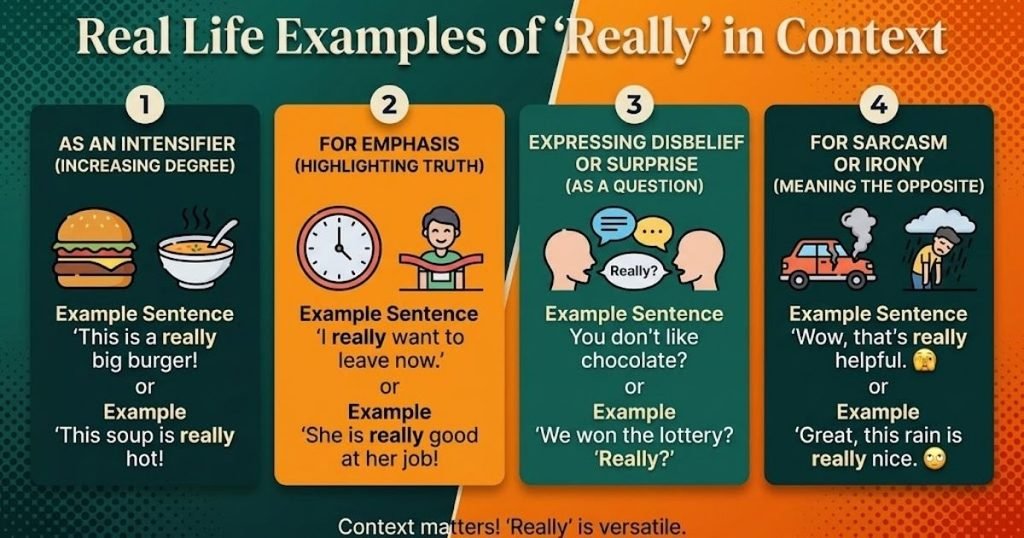
Everyday conversation: “I really need coffee this morning.”
Workplace communication: “We really need to finalize this report before the deadline.”
Academic writing: “The data does not really support the original theory, which suggests further research is needed.”
Email: “I really appreciate you taking the time to review my proposal.”
Casual texting: “lol that’s really funny”
Each example uses “really” correctly as an adverb, either to add emphasis or to indicate genuine truth.
Common Mistakes With “Really”
Incorrect: I realy think we should leave now. Correct: I really think we should leave now. The double “l” was dropped, likely due to how the word sounds when spoken quickly.
Incorrect: Are you realy going to the party? Correct: Are you really going to the party? This is one of the most common typing errors, often made when writing fast without proofreading.
Incorrect: That was a realy good idea. Correct: That was a really good idea. Autocorrect usually catches this one, but it still appears often in handwritten notes or quick messages.
These are simple typing slips, not signs of poor grammar skills. Almost everyone drops a letter occasionally when writing quickly.
Related Words and Terms
A few words are often confused with or related to “really”:
- Real (adjective): genuine or actual, as in “a real problem”
- Realize (verb): to become aware of something
- Realistic (adjective): reasonable or true to life
- Realty (noun): property or real estate, unrelated in meaning despite the similar spelling
- Truly (adverb): a close synonym for emphasis or sincerity
Keeping these words separate in your mind can help you avoid mixing up spellings, especially “really” and “realty,” which look similar but serve completely different purposes.
Tips to Remember the Correct Spelling
If you tend to mistype “really” as “realy,” try one of these memory tricks:
- Remember that “really” is built from “real” plus “ly,” so the double “l” is expected.
- Say the word slowly in your head while spelling it: r-e-a-l-l-y.
- Compare it to “real,” a word most people already spell correctly, and simply add “ly.”
Spell checkers and autocorrect tools will usually flag “realy” automatically, but understanding the reasoning behind the correct spelling helps the habit stick.
FAQ’s
Is “realy” a real word?
No. “Realy” is not a recognized word in English. The correct spelling is always “really.”
What does “really” mean?
“Really” means “truly,” “actually,” or “in reality.” It can also be used informally to mean “very,” as in “really tired.”
How do I use “really” in a sentence?
Use “really” to emphasize truth or intensity, such as “I really want to go” or “That is really impressive.”
Is “really” formal or informal?
“Really” works in both formal and informal writing, though some style guides prefer more precise alternatives in academic work.
Why do people misspell “really” as “realy”?
The mistake usually happens because the double “l” is hard to hear in fast speech, so writers accidentally drop one letter.
Conclusion
“Really” is the only correct spelling. “Realy” is a common typo caused by how the word sounds in casual speech, not an accepted variation. Whenever you are unsure, remember that “really” is simply “real” with “ly” added, keeping both L’s intact.

Smith Jason is an SEO expert with 2–3 years of experience, sharing grammar tips, confusing words, vocabulary and writing advice.










1 thought on “Realy or Really: Which Spelling Is Correct?”